Author: Casino Connection Staff

Virginia Skill Game Company Sues Convenience Stores

The skill game company Queen of Virginia has filed nearly 150 breach-of-contract lawsuits against convenience store owners who have installed the company’s video games, according to a Virginia Mercury review of state court records. Small business owners get a share of the profits from the games.

The Mercury reviewed dozens of nearly identical lawsuits filed by Queen of Virginia claiming a store owes tens of thousands in damages for removing Queen machines and/or replacing them with similar games from a competitor. According to court records, Queen of Virginia contracts include a broad non-competition clause that grants it exclusive rights to have its games at a particular store.

Michael Barley, a spokesman for Georgia-based Pace-O-Matic, Queen of Virginia’s parent company, said, “Like most companies, we vigorously defend our contractual terms. Our contracts have been ruled time and time again to be valid.”

Attorney Steve Heretick, representing several convenience store owners, said Queen of Virginia is acting like a “bully” by trying to “corner the marketplace.” He said, “It’s an extremely aggressive tactic. Most of the smaller owners, especially convenience stores that have been working with us, they really don’t understand the legal nuances of the situation. All they know is they’re being threatened.”

Part of the problem is Virginia has not established nor enforced a clear policy on skill games. Queen of Virginia claims the machines are games of skill, not chance. The Virginia Alcoholic Beverage Control Authority seemed to agree in an unofficial determination in 2017. But at least one Virginia prosecutor disagreed and stated the machines violated the state’s laws on illegal gambling; he subsequently was sued by Queen of Virginia. The Virginia Lottery also has said the machines’ proliferation was taking away revenue from education.

In 2020, lawmakers considered banning the machines but instead gave them a 1-year reprieve to raise money for Covid-19 relief. The ban took effect in July 2021 but a truck-stop owner challenged the ban, resulting in a judge temporarily suspending its enforcement. Attorneys for the plaintiff said the ban is unlawful discrimination against a type of arcade-style game people play to win something of value. The case will be heard November 2 in Greensville Circuit Court.

The Virginia General Assembly attempted to strengthen the ban this year but the pending lawsuit has created uncertainty. As a result, skill machines are in legal limbo, with no regulation from lawmakers and the continued spread of illegal machines due to the lack of oversight. Covering all its bases, Pace-O-Matic has donated more than $820,000 to both the Republican and Democratic parties, including six-figure donations to Governor Glenn Youngkin and former Governor Terry McAuliffe.

In court filings, Heretick and other attorneys representing store owners have argued the deals businesses signed with Queen of Virginia were voided when the state banned the machines. Therefore, the contracts can’t be enforced now because they require store owners to break the law. Heretick said a Richmond judge recently ruled the contracts were unenforceable.

Business owners point to a letter sent by Queen of Virginia General Manager Jeanna Bouzek in June 2021, instructing them to unplug all Queen machines in accordance with the approaching ban. Attorneys for the store owners have argued the letter was a “farewell,” that reasonably could be interpreted as the end of its dealings with Virginia businesses. The letter stated, “We appreciate the business we have enjoyed with you and take pride in knowing we assisted small businesses to survive during the pandemic.” The letter also warned store owners they could be fined if they don’t follow the ban.

An attorney for some convenience store owners said, “My defense is that once that letter went out the contract was over. And Queen of Virginia is now trying to revive it.”

Heretick, who said he supports some form of state-sanctioned skill gaming in Virginia, said Queen of Virginia is the party that’s “behaving badly” by pressuring store owners to keep running machines the legislature has determined are illegal gambling devices. “It’s my standard advice to my clients that this is illegal, Queen’s threats notwithstanding, it is illegal.”

Commercial Casinos Set Revenue Record

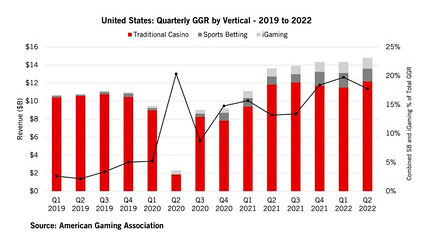
Nationwide commercial gaming revenue totaled $14.81 billion in the second quarter of 2022, according to the American Gaming Association’s Commercial Gaming Revenue Tracker. The total sets a new quarterly record for the industry, beating Q4 2021 by 3.3 percent.  

With $29.16 billion generated through the first half of the year—a nearly 18 percent year-over-year increase—2022 is on pace to set a new annual record for commercial gaming revenue for the second consecutive year. 

“Q2’s results mark a 16-month period of gains for commercial gaming,” said AGA President and CEO Bill Miller. “With increasingly difficult year-over-year comparisons, our strength through the first half of 2022 reflects sustained consumer demand for legal options as well as gaming’s record popularity.”

The industry’s growth rate softened throughout the second quarter, with the pace of monthly year-over-year gains slowing from 13.1 percent in April to 10.7 percent in May, and 2.5 percent in June—demonstrating stabilizing consumer demand and the return to normal gaming operations one year ago.

Twenty-two of the 31 commercial gaming jurisdictions operating during the same period last year experienced revenue increases in Q2 2022. Nine states reported all-time quarterly highs: Arkansas, Iowa, Maryland, Massachusetts, Nevada, New York, Oklahoma, Oregon and Pennsylvania.

Traditional casino gaming continued to drive the industry’s success, with both brick-and-mortar slots and table games seeing quarterly revenue records.

While slot machine revenue was up 0.2 percent year-over-year, revenue from table games jumped 18.2 percent, indicating the lingering impact that Covid-19 restrictions had on table games in the first half of 2021.

In the first six months of the year, traditional casino gaming generated $23.67 billion in revenue, 11.7 percent ahead of the first half of 2021.

The sports betting sector also continues to grow. Consumer demand coupled with six new state market launches over the last year put the vertical up 58.7 percent from Q2 2021. The $3.04 billion in sports betting revenue thus far in 2022 is a 63.9 percent year-over-year increase.

Meanwhile, the six operational U.S. iGaming markets generated $1.21 billion in Q2 2022, narrowly beating the vertical’s previous record set in Q1 2022. With the addition of one market, the $2.42 billion in commercial iGaming revenue generated through June is a 43.5 percent jump over the same period in 2021—the vertical’s highest-grossing year.

“While on pace to set an annual revenue record, we are cognizant of the continued impacts of inflation and labor challenges as well as marketplace concerns of potential recession,” said Miller. “Our members have proven their agility and resilience over the last two years and are well-positioned to face these potential headwinds heading into the second half.”

AGA’s Q2 2022 commercial gaming revenue report comes on heels of the National Indian Gaming Commission’s announcement that tribal operators generated an all-time high of $39 billion in gaming revenue in 2021. Combined with commercial gaming’s $53 billion in revenue, 2021 beat the previous record held in 2019 by 13 percent.

“Tribal gaming demonstrated its responsible leadership throughout the pandemic and these record results reflect that commitment,” Miller said. “The full recovery and ongoing success of tribal casinos goes well beyond the casino floor to support vibrant communities across the country.”

Opposition Strong Against a Casino in Manhattan

Many Manhattanites relish the opening of a new restaurant, piano bar, or the arrival of a new play. But according to lawmakers, Manhattan has little or no support for a casino in town, no matter how opulent.

When talking about the casinos downstate in New York, the subject of Manhattan always comes up. It’s discussed as a given. Manhattan casino? No brainer. Gaming operators, developers and hedge fund behemoths are going all in. Several sites in Queens, Brooklyn, Staten Island and Nassau County have been floated as potential locations for a new casino, but the promised land to gaming industry veterans remains Manhattan, according to the Commercial Observer.

Not so fast. Those entrusted with such decisions offer a resounding no, much to the chagrin of property owners and casino operators.

New York law allows for three casinos downstate, but two licenses will almost certainly go to existing casinos in Yonkers and Queens. The Genting Group, which owns Resorts World Casino and Aqueduct Racetrack in Ozone Park, Queens, and opened a Hyatt Regency hotel on its site last August, wants to upgrade its “racino” to include table games with live dealers. So does VICI Properties, which acquired Empire City Casino in Yonkers from MGM last year for $17.2 billion. (MGM Resorts International is still operating the casino.)

“The market is going to be huge,” said Marcus Threats, a senior associate with Marcus & Millichap’s hospitality practice. “Think about the close proximity of the number of people with an average income twice the national average. They’re going to come out of the woodwork for this license.”

In early October, the New York State Gaming Commission (NYSGC) will appoint a three-member panel called a Gaming Facility Location Board, which will have 90 days to issue a request for casino license applications.

To move forward, the proposals require four out of six votes from a Community Advisory Council (CAC) made up of appointees of the governor, the mayor, the borough president and the district’s state Assembly, state Senate, and City Council representatives.

“I am not a fan of casinos or gambling; I’ve voted against every gambling bill I’ve seen in Albany,” said state Senator Liz Krueger, whose Manhattan district will include Times Square and Penn Station by January and who will appoint a CAC member. “It’s not obvious to me there’s a path. Many elected officials from Manhattan and many constituents also see no place for a casino in Manhattan.”

Vornado Realty Trust Chairman Steven Roth thinks his properties near Herald Square work well.

“Manhattan has, by far, the largest number of hotel rooms, restaurants, museums, tourist attractions, and the region’s transportation network was designed with Manhattan as its hub,” Roth wrote in a letter to investors in 2021. “We have heard the chatter and have been approached.”

Morris Bailey, who owns Atlantic City’s first casino hotel, is looking into building a casino on the former McAlpin Hotel at Broadway and 34th Street. And L&L Holding Company sees his Times Square tower as appropriate.

SL Green Realty and Hard Rock Cafe met with elected officials to push a

plan to put a casino at 1515 Broadway. Hard Rock has other sites in its sights, according to chairman Jim Allen.

Related Companies discussed Hudson Yards with City Hall.

Meanwhile, other developers are stepping up to plug their sites in the outer boroughs.

Thor Equities’ Joseph Sitt and Red Apple Group CEO John Catsimatidis earmarked the Coney Island waterfront. Mets owner Steve Cohen is pitching the Citi Field parking lot or Willets Point.

Don’t bet your house that Manhattan gets the lucky license.

Other opponents include Borough President Mark Levine, City Councilman Erik Bottcher, state Senator Brad Hoylman, and U.S. Reps. Jerrold Nadler and Carolyn Maloney. Entertainment and civic institutions, including the Broadway League and the Times Square Alliance, and several business owners also say no dice.

“I haven’t heard from any constituents who want a casino,” Hoylman said. “We know that poor and vulnerable New Yorkers are often targeted by casinos. They add traffic, noise and congestion, and they affect the quality of life.”

Krueger said she has been turned off by the intense pressure from gaming industry lobbyists who have demanded tax breaks when their revenues fall short of their forecasts.

Cohen’s lobbyists have also met with Queens elected officials, including Borough President Donovan Richards and state Senator Jessica Ramos. Richards told the New York Post he wants to see “investment and job development” in the Willets Point area in any proposal. Both told the Post they had not seen any plans yet.

A Queens- or Brooklyn-based proposal would also likely have the tacit backing of the powerful Hotel Trades Council, which lobbied Albany for months to issue new casino licenses.

The mayor leans towards Queens, a site that would allow him to build on his legacy, with a project that includes a soccer stadium, hotel and convention center.

In other New York news, Jeff Gural owns a Tioga Downs casino, one of four in northern New York. Located in an economically depressed area makes it harder to earn a fortune, said Gural, who also owns Meadowlands Racetrack. He has two goals: opening a casino downstate that is in or near New York City. The other is opening a casino at the Meadowlands in conjunction with Hard Rock.

Hard to say which will be more difficult to bring to fruition.

In New York, the three licenses available are really one. There is “no way in the world,” Gural asserted, that New York gaming regulators will decline to approve licenses to upgrade Aqueduct Racetrack and Yonkers Raceway from their current slot machine-centric racinos to full-fledged casinos with live-dealer table games and sports betting.

As for New Jersey, Gural spearheaded the referendum in 2016 to approve a casino in the Meadowlands with Hard Rock. The measure lost by a 4 to 1 vote. Atlantic City has a powerful pull.

Faced with the realities, Gural has elected to stay on the sidelines and watch others duke it out in New York. Like so many others, he believes Manhattan will not allow a casino in its boundaries.

“Our strategy is just to wait,” he told a conference in Saratoga Springs on August 16. 

Gural said that “the Supreme Court saved us” in 2018, when the court ruled in favor of New Jersey’s suit to overturn the sports gambling ban.

“We’d be out of business, and now we’re profitable,” said Gural, who has a lucrative partnership with daily fantasy sports giant FanDuel to provide sports betting both at the East Rutherford track and online. “I’m not under any pressure anymore.”

“It’s almost impossible to find a location where people want a casino, other than [at Aqueduct and Yonkers, where gambling has been offered for generations],” Gural said.

So who will get the coveted third license?

“I make Citi Field the favorite, unless they screw it up totally,” Gural said of a reported bid by Cohen to seek a casino license next to his ballpark.

Gural was far more eager to see a Meadowlands casino get approved back in 2016, when he bankrolled a campaign for passage of a statewide referendum to allow for two new casino licenses in North Jersey.

“I learned a lot from the failure of that referendum,” said Gural, adding that in retrospect, he believes some elected officials “were just doing me a favor to shut me up, basically” by getting the concept on the ballot.

If Yonkers and Aqueduct attract North Jersey residents, it might be enough to get lawmakers to push for a casino in the Meadowlands.

“You have to limit where you could put a casino; it has to be specifically for the Meadowlands [Sports Complex],” Gural said of a future ballot question.

There will be no casino referendum this fall, and Gural said that these days, he seems to be the only advocate for it—at the moment, at least.

Asked by NJ Online Gambling after the panel discussion whether the Meadowlands Racetrack’s future was ever in severe peril, he said it didn’t quite get to that point. While the track began to become less and less profitable in 2014-16, the Supreme Court’s announcement in June 2017 that it would take up the sports betting case—in spite of a contrary recommendation from the office of the U.S. Solicitor General—left Gural convinced it was just a matter of time before sports betting would arrive at his track.

And none too soon, Gural added, given the Covid-19 pandemic that caused such an upheaval starting in March 2020.

“The pandemic really hurt [business], because it forced people to stay home and bet on their phone,” Gural said. “And they said, ‘Wow, this is a lot easier than coming to the racetrack.’”

MacDonald Back in the Game

Andrew MacDonald, a table game guru who helped lead Las Vegas Sands to the top of the revenue charts in Macau and Singapore, has been hired by Genting’s Resorts World Sentosa in Singapore to run the property’s gaming operations and casino marketing. Resorts World CEO Tan Hee Tek announced the appointment at an employee meeting last week.

The hiring comes a year after MacDonald stepped down as the chief casino officer at Las Vegas Sands, where he was based at the company’s Marina Bay Sands, the only other casino in Singapore.

MacDonald has a 40-year career in gaming, starting as a dealer in Tasmania. He later became a regulator in Queensland, followed by positions with Genting, Crown and Jupiters Gold Coast (now the Star Gold Coast). He then became managing director and co-global head at Macquarie Capital.

He joined Las Vegas Sands at Sands China in 2010, becoming CCO for the corporate office in 2012, responsible for the gaming at all LVS properties. At Sands China, MacDonald developed several iterations of baccarat that allowed the company’s Macau casinos to increase the number of seats at its capped number of table games.

MacDonald is recognized as one of the brightest minds in the business, and launched an academic website on the gaming industry, with dissertations for gaming executives and academics from around the world.

He’s also known for his motivational meetings, educating line employees and junior executives on the important things to consider at various stages of their careers.

Ironically, Genting and Las Vegas Sands now employ two of the most knowledgeable table game experts in the world. LVS recently hired Roger Snow, an expert at developing new games and focusing on the revenue production of existing games. Snow previously worked for Scientific Games and Shuffle Master for more than 20 years.

Okada Takeover Case Goes to Appeals Court

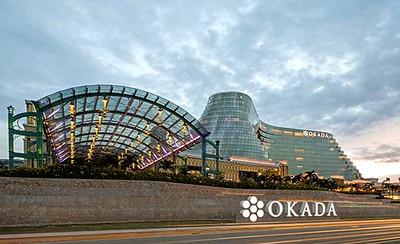
The battle between the past and current controllers of the Okada Manila integrated resort (IR) in the Philippines’ Entertainment City now rests with the country’s Court of Appeals.

In a statement filed on August 17, the Philippine Supreme Court declined to overturn the status quo ante order (SQAO) issued in April that restored control of the resort to Japanese gaming tycoon Kazuo Okada. Instead, it referred the case to appeals.

Five years ago, Okada was accused of embezzlement and was ousted from the companies he founded: parent Universal Entertainment Corp., and subsidiary Tiger Resort Asia Ltd. (TRAL), which owns IR operator Tiger Resort Leisure and Entertainment Inc. (TRLEI). Since then, he has been trying to regain control, and eventually returned to power after the SQAO.

The ousted board says Okada and his allies forcibly occupied the IR in a hostile takeover on May 31. The members claim they were “illegally and violently” ejected through “brute force and intimidation to compel key legitimate officers to vacate the premises.”

They said Okada cronies Tonyboy Cojuangco, Dindi Espeleta and lawyer Florencio Herrera III stormed a ballroom in the IR with at least 50 private guards, police officers and a sheriff and evicted TRLEI Director Hajime Tokuda and other executives.

Lawyer Estrella Elamparo, who represents the TRLEI board, said, “While we were having the stockholders’ meeting, they all of sudden turned off the electricity… and the guards swooped down on the ballroom and forcibly evicted us.” She said Tokuda was taken “physically from his chair and forced … down the lobby and into an unknown vehicle and was brought eventually to his house … This was kidnapping that happened right in front of our eyes.”

In a statement, the ousted board said, “There is nothing in the (SQAO) which remotely authorizes Mr. Kazuo Okada to take over the premises of the corporation, much less with the use of force.”

Okada’s side insists the transfer was not only legal but orderly and nonviolent, carried out “together with the sheriff and witnessed by PAGCOR,” the Philippine Amusement and Gaming Corp., which regulates gaming in the country.

They said they were within their rights due to the SQAO, which directed Okada’s “immediate reinstatement as shareholder, director, chairman and CEO” of Tiger Resort, and the reinstatement of the board as it existed before Okada got the boot, in 2017. The restored board appointed Cojuangco as president and Espeleta as vice chairman.

In an August 10 finding, the Supreme Court said the SQAO “was properly issued in accordance with law and jurisprudence,” but disputed some contentions of the ousted board, including that the takeover caused a “chilling effect on foreign investments and alleged serious damage to shareholders.”

The court conceded that any SQAO “must be implemented strictly based on the language of the order and in the context of the nature of an SQAO, i.e., to restore the parties to the last, actual, peaceable and uncontested state of things that preceded the controversy.”

The court added, “Disruption is never the intent of the SQAO.”

Meanwhile, the former board is demanding that three Okada Manila officers return PHP122 million (US$2.2 million) in casino cage money used to pay a construction company linked to Dindo Espeleta. The officers used the cage money after the IR’s bank accounts were frozen.

Kenshi Asano, TRAL representative and director of Universal Entertainment, spoke for the ousted board when he said, “We, the investors in Okada Manila, are respectfully asking the honorable Supreme Court to hasten the resolution of the intra-corporate dispute in our multibillion-dollar investment.”

TRAL has offered a reward to Okada Manila employees “who can provide information that leads to the recovery of any funds that are released from Okada Manila or improperly paid to other third parties under the management of the self-appointed board.”

Star’s Queensland Inquiry Underway, With Troubling Accusations

Star Entertainment’s licensing inquiry in Queensland has kicked off in Brisbane Magistrate Court, at the direction of former Appeal Court judge Robert Gotterson—the use of China UnionPay bank cards and the acceptance of gamblers excluded in other states are among the initial allegations.

The investigation will determine whether or not the company is suitable to hold a license for its Treasury Brisbane and Star Gold Coast casinos. Star’s Queen’s Wharf development, which is under construction, is not included in the proceedings.

The company is also currently under investigation for the same alleged practices in New South Wales (NSW), and the conclusion of that inquiry is expected to be delivered in the coming months.

Both Star and fellow operator Crown Resorts have been accused of allowing Chinese patrons to transfer funds via China UnionPay cards to hotel credit accounts, which were then exchanged for chips or gambling credit. The practice is prohibited by both countries.

Prosecutors allege that Star then further violated the law by attempting to disguise those transactions as room and entertainment charges in order to avoid suspicion from the National Australia Bank (NAB), which handles the company’s accounts. In all, Star is accused of disguising more than $50 million in such charges.

NAB officials said that they asked Star to verify the funds multiple times, and each time the company made no indication that the money was used for gambling purposes.

One of the other main points of concern for investigators has to do with Star’s acceptance of gamblers who had already been excluded from venues in other states such as Victoria and NSW. A large number of these patrons were considered to be “high-risk” due to possible connections with money laundering and organized crime.

Jonathan Horton QC, one of the prosecuting attorneys for the investigation, told the court: “There’s the issue of some persons being actively encouraged to come to Queensland and being given benefits to do so, even though—and this might be an understatement—red flags existed, which ought to have led to their exclusion, let alone not inducing the person to be here.”

Horton said that Star did implement an exclusion policy in 2019, but did not make it retrospective until May of 2022, after a lot of nagging from the Office of Liquor and Gaming Regulation, the state’s regulatory authority.

Various Star representatives, both former and current, are expected to be questioned as part of proceedings.

Panel: New York Needs Better RG Measures

Authorities in gaming, media and addiction concluded during a panel last week at the Racing and Gaming Conference in Saratoga, New York that the state of New York is lagging behind in its responsible gaming measures as the industry expands.

Bill Pascrell III, partner with the Princeton Public Affairs Group, said better efforts must be made to spot problem gamblers. “The industry used to treat the gambling-addicted customer as the VIP customer,” he said. “It can’t afford to do that anymore.”

Other panelists pointed out that spending on responsible gaming initiatives is miniscule considering the revenue being made from sports betting. “$5.7 million has been spent on problem gambling in New York,” said John Coppola, executive director of the New York Association of Alcoholism and Substance Abuse Providers. “That’s less than 1 percent of revenue from sports betting. That’s ridiculously inappropriate and unacceptable.

“We have to start with building an infrastructure and having a meaningful investment. There’s a lot of work that needs to be done to get this right. If there’s going to be a shift away from seeing a problem gambler as a good customer, if we’re going to address the needs of that person, it’s going to take a lot of work.”

“We’re balancing the public interest, the need to protect children and those with addictive proclivities,” added David Donovan, president of the New York State Broadcasters Association. “If you look at the last several months, advertising revenue went through the roof. It exploded. The traveling tent show came to New York, and frankly, a lot of my guys made a lot of money. It triggers a response, ‘What about kids?’ Since the initial surge, the demand for advertising has diminished. In particular, it shifted to more sports-formatted radio and television.”

Nevada Regulators Add Sex Trafficker to Casino “Black Book”

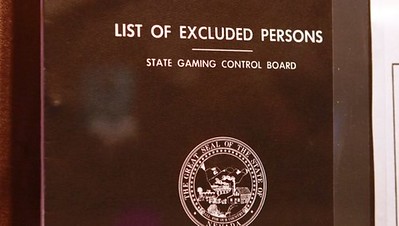
The Nevada Gaming Commission (NGC) has voted unanimously to add Kendrick Laronte Weatherspoon, a convicted felon and sex trafficker, to the state’s List of Excluded Persons, also known as the “Black Book.” Weatherspoon will now be banned from state casinos.

The decision set a new precedent for the NGC, as Weatherspoon is now the first person to be added to the list for anything other than casino cheating or having connections to organized crime. According to James Taylor, chief of enforcement for the NGC, a total of 71 individuals have been added to the list since its inception, and the recent ruling was the first addition in over three years.

When discussing whether or not to add Weatherspoon to the list, commissioners were unsure if it was a slippery slope, in the sense that there are far too many criminals, especially in Las Vegas, to consider adding them all.

However, Captain Fred Haas of the Las Vegas Metropolitan Police Department told the board that he is “not trying to go after the 300 or 400 a year that are doing this. What I’m trying to go after is those that are very sophisticated in how they do this.” He added that his department is most concerned with “the ones who are continual, year after year.”

Haas added that there are six or seven other offenders he feels should be considered for exclusion in the future.

After representatives from the Nevada District Attorney’s Office presented Weatherspoon’s laundry list of felony convictions in the state, including counts of drug possession, firearm possession, coercion and sex trafficking, Commissioner Ogonna Brown said that he was “a prime candidate for exclusion.”

Haas emphasized to the board that trafficking is a serious issue that needs to be addressed in the casino industry, and Weatherspoon’s exclusion may be a good first step in deterring such behavior.

81

Bally’s Applies For Chicago Casino License and Close to Closing Tropicana Deal in Vegas

Bally’s Corp. recently submitted its official casino license application to the Illinois Gaming Board. The company was selected to build a $1.7 billion casino complex in the River West neighborhood.

If the application is approved, Bally’s would open a temporary casino at Medinah Temple in nearby River North while constructing the permanent venue at the former Tribune Publishing plant site.

Christopher Jewett, vice president of corporate development at Bally’s Corp., said, “Bally’s submitted its casino license application to the Illinois Gaming Board. We look forward to working with the Illinois Gaming Board and the city of Chicago to bring a world-class entertainment destination resort to Chicago.”

The Chicago city council approved Bally’s as the applicant for the downtown license on May 25. Earlier, Mayor Lori Lightfoot chose Bally’s as the casino developer over Rush Street Gaming and Hard Rock International. City officials expect the $1.7 billion Bally’s casino complex to generate $800 million in annual revenue when it’s fully operational. That would generate about $200 million in tax revenue for the city to help fund fire and police pensions.

Bally’s pledged it would make the River West venue its “flagship property” and already gave the city a $40 million upfront payment. Officials said they plan to open a temporary venue at the Medinah Temple in the second quarter of 2023.

The casino complex would be developed in two phases, officials said. The $1 billion first phase would include 2,700 slot machines and 95 table games, with the possibility of expansion. In addition, this phase would include a 100-suite luxury hotel; an outdoor music venue with seating capacity for 500 to 1,000; green space; and dining options curated by One Off Hospitality, managed by James Beard award-winner and Chicago native Paul Kahan.

The $600 million second phase would kick in when Bally’s reaches a 20 percent return on investment. It would add 700 slot machines and 78 table games; six dining venues; a 400-room hotel tower with a rooftop pool and bar; and a 20,000-square-foot exhibition center featuring a Chicago-themed sports museum. An organization of River West residents has already asked Bally’s to forgo the proposed outdoor 3,000-seat entertainment venue.

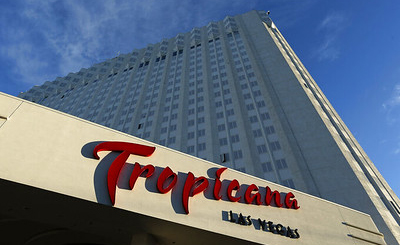
Also last week, representatives from Bally’s Corp. have announced that its $308 million deal to acquire the operations of the Tropicana Las Vegas from real estate investment trust Gaming and Leisure Properties, Inc. (GLPI) will close at the end of next month, more than a year after it was first announced.

The company also indicated, however, that redevelopment and rebranding of the property likely won’t begin until late 2023.

On a recent earnings call, Bally’s CEO Lee Fenton said even though “it’s well-advertised that we intend to develop (the site) at some point in the future,” the company plans to “run the property on an as-is basis at least for the next 12 months until we have identified the plan and the partnerships that we want going forward.”

The deal still needs to be approved by state gaming regulators, and as of now the matter has not been scheduled for review for at least the rest of this month.

Per the language of the transaction, GLPI will retain ownership of the site , with Bally’s signing a 50-year lease agreement that would start at $10.5 million per year and gradually increase. Brandon Moore, general counsel for GLPI, said recently that the company has “a strong interest” in Bally’s future plans for the property.

Perhaps the other entity with the biggest interests in the Tropicana’s plans is the Oakland A’s, as the team is exploring their options as far sites for a new stadium, both in Oakland and Las Vegas. The Tropicana is one of two locations that the team is reportedly considering, with the other being a 27-acre plot behind Planet Hollywood.

The A’s have said previously that they would like to finalize their decision by the end of this year.

Another casino mogul is also talking to the A’s. Phil Ruffin, who owns the TI and Circus Circus in Las Vegas is negotiating with the A’s about buying the 73-acre Festival Grounds at the corner of Sahara Ave. and the Strip. Ruffin’s property was considered a dark horse in the

race at one time, but this is the second time that the A’s top brass have met with him about the property.

Illinois City Changes Casino Definition

In anticipation of the Illinois legislature allowing expanded gambling in the future, the Danville city council unanimously approved an amendment to the city’s zoning ordinance, defining a casino as, “A facility with a main floor level of at least 10,000 contiguous square feet that is authorized by the Illinois Gaming Board to conduct gambling games pursuant to the Illinois Gaming Act.”

Corporate Counsel James Simon said other gambling forms might include greater or an unlimited number of video gambling terminals, expanded off-track betting parlors, expanded college and professional sports wagering or a combination of these and others. Simon noted casino developer Danville Development might want a limited satellite casino with only slots or other gaming.

In addition, he said the amendment means casino-type activity could be located in other zoning districts besides those located on the city’s southeast side. Specifically, Simon said the amendment proposes permitted uses in B-3 general business and I-2 general industrial zoning districts. The city is not eliminating or confining uses, Simon pointed out. “Illinois has a history of expanding all kinds of gaming,” he said.

Meanwhile, Simon also presented an update regarding Mervis Industries, a metal recycling business, which sued Danville over the site of the Golden Nugget Danville Casino. The lawsuit, filed in May, called for a restraining order that would have caused construction of the casino to cease. Mervis claimed it would suffer harm if casino construction were allowed to proceed. In May, Illinois 5th Circuit Court Judge Mark Bovard denied the order and ruled Mervis “has failed to show that it will suffer irreparable harm if the TRO is not entered at this time.”

Mervis attorneys had argued the development of the casino will cause injuries related to increased vehicular and pedestrian traffic, and also claimed patrons who lose money at the casino could steal valuable metals from Mervis’ property.

An earlier lawsuit against the city over the property’s zoning remains intact. Simon said Mervis heirs are trying to wear the city down. He said, “Mervis Industries is doing everything they can to shut down construction of the casino.” Simon noted the zoning amendment the city council recently approved does not aim to benefit any particular casino and it has been designed to have no negative impact on any property use to expand opportunities.

Golden Nugget Danville is expected to open in spring 2023 and create 300 new jobs.

U.S. Racetracks Should Run Fixed-Odds Betting, Experts Say

Fixed-odds betting on horse races could be a major source of revenue tracks are currently missing, according to members of a panel at last week’s Racing and Gaming Conference in Saratoga Springs, New York.

Fixed-odds betting, a form of wagering against odds offered by a bookmaker or betting exchange on racing or sports events, has been a money-maker in many racing markets worldwide, but so far New Jerseys’ Monmouth Park is the only U.S. track to offer it since the U.S. Supreme Court repealed the federal ban on sports betting in 2018.

“Racing is leaving so much on the table at the moment,” said Dallas Baker, vice president of Monmouth fixed-odds operator BetMakers U.S., at the panel. Paul Hannon, senior vice president of corporate development for PointsBet USA, added, “There is a space for it in the mainstream, especially in the summer months, where it’s really only up against baseball, golf, and tennis,” Hannon said. “We have a really strong appetite to make sure racing has that position.”

Hannon noted that because fixed odds wagering always returns overall outcomes in favor of the operator, it is a safe way to allow racing wagers. “We have a million different priorities we want to tackle, so making sure racing is investable, making sure there’s a guaranteed return on that investment, that’s very important for planning purposes, especially in the long term,” Hannon said.

David O’Rourke, the chief executive officer of the New York Racing Association (NYRA), commented on the panel that he remains optimistic about eventually offering fixed odds on NYRA’s races, but noted that the larger immediate priority I to get parimutuel account-wagering on the platforms of existing sportsbooks.

“Obviously we believe our product is going to perform well,” O’Rourke said. “We’re excited about it. It’s the biggest opportunity for racing, probably, in the last few decades.”

He added that more research on the topic is required.

“Until we introduce the product to the store, we don’t really know what the customer’s reaction is going to be,” O’Rourke said. “And these distributors are excellent at this. Once the product is there and we’re pushing it, those distributors are going to figure out exactly what the right formula is for those costumers. And us as content producers need to work with those distributors on what the right equation is.”

Clark County Still Not Ready for Marijuana Lounges—Yet

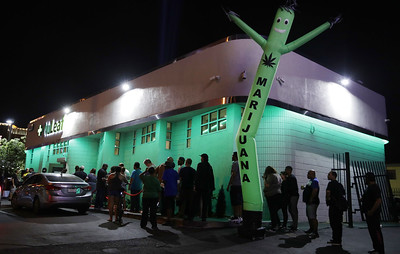
The Clark County Commission (CCC), which encompasses Las Vegas, has voted to delay further discussion regarding marijuana consumption lounges for at least another 30 days, after a meeting with the county’s business licensing department left too many questions unanswered.

The main topics that still need further discussion include the overall number of licenses to be distributed, hours of operation and whether or not outdoor consumption will be permitted.

However, officials already passed a law last year which laid much of the regulatory groundwork. For starters, licenses will only be given to marijuana dispensaries, and not gaming establishments, bars or nightclubs. The first round of licensing will include 20 vendors, with half of those being “social equity applicants” who were previously impacted by drug laws before marijuana was legalized in the state back in 2017.

Other regulations are very similar to bars and nightclubs, in the sense that patrons must be 21+ and servers must enforce “cutoff” rules for over-served individuals.

The CCC’s latest postponement means that lounges likely won’t be able to open until 2023, much to the chagrin of some officials, such as Commissioner Tick Segerblom.

Segerblom told the Las Vegas Review-Journal that he was “hoping to have everything done by the end of the year and have that first place open,” but that likely won’t be the case “based on today’s conversation.”

Local municipalities will be permitted to form their own regulations, so long as they are not weaker than anything passed by state lawmakers. Lounges must also maintain distance from casinos, schools and other establishments, but officials are still deciding whether or not they must be attached to dispensaries themselves.

Commissioner Jim Gibson told the Review-Journal that the CCC still needs to “address some of these real important issues that will continue to affect quality of life right down into neighborhoods, into the schools, into the parks.”

Lyft, Motional Roll Out Las Vegas ‘Robotaxis’

Rideshare provider Lyft has partnered with an autonomous vehicle company known as Motional to launch a new “robotaxi” service in Las Vegas. The service will allow Lyft riders to request a ride in one of Motional’s all-electric Ioniq 5 vehicles from Hyundai, and by the end of 2023, those vehicles will be fully driverless.

The two companies have been testing the autonomous service for over four years now, after originally debuting it at the 2018 Consumer Electronics Show. To date, over 10,000 trips have been successfully completed.

Motional is a joint venture between Hyundai and Aptiv, and the Ioniq 5 vehicles supplied by Hyundai have been modified for commercial, autonomous use. For now, a real driver is still present to assist in the case of an emergency, which is common practice among other robotaxi-type services, but fully autonomous vehicles will be available as early as next year.

However, Lyft and Motional are taking somewhat of a different approach by going public and not requiring riders to sign non-disclosure agreements to join testing programs or waitlists. Additionally, the companies have said that rides will be free of charge until the start of 2023.

Akshay Jaising, vice president of commercialization for Motional, told the Verge that “Any Lyft rider in Las Vegas can request a Motional AV. No NDAs. No sign-ups. That’s how Motional and Lyft have operated for the past four years. We believe the best feedback is from real riders, not employees or limited participants.”

Motional has said that it has been approved to test driverless vehicles “anywhere in Nevada,” and will secure the necessary permits to roll out driverless services on a commercial scale before the official launch.

As of now, only a small number of companies have tested and researched fully driverless services on public roads in the U.S.—Alphabet-owned Waymo has been testing vehicles in Phoenix, Arizona and General Motors-back Cruise is doing the same in San Francisco, but only during nighttime hours.

Mohegans Fund Yale Study to Create Treatment App for Problem Gaming

The Mohegan Tribe, which owns the Mohegan Sun Casino in Uncasville, in May announced its funding of an effort by the Yale University School of Medicine (YSM) to develop an app that could apply cognitive behavioral therapy to the treatment of problem gambling.

According to the YSM, the project “ will include developing digital therapeutic tools, such as a CBT-based mobile app, to ensure greater access to care for traditionally underserved populations, giving them skills and techniques to treat their problem.”

The tribe will contribute over $2 million through the completion of Yale’s research and development of the treatment and tools.

Global Gaming Business News interviewed two key researchers involved in the project, Dr. Marc Potenza, director of the Division on Addictions Research at Yale and director of the Yale Center of Excellence in Gambling Research; and Dr. Brian Kiluk, associate professor of psychiatry at the Yale School of Medicine.

“We think it will be important,” said Potenza. “Many people are now using digital technology in many ways in their lives. Telehealth delivery on mental conditions is an important and growing area. However, making sure that the interventions delivered via digital are helpful is important. Here we are taking an empirical cognitive behavioral therapy and encapsulating it into a digital platform that has the benefit of people accessing it remotely without going into an office and they can use it when they need to use it: when they are struggling with urges, to help them make better choices.”

Potenza has treated hundreds of people who have problems with casino gambling and the lottery.

“The approach we plan to take follows an approach that has been used for about 15 years by our psychotherapy developers,” he said. The app could be considered a descendent of the computer program developed in 2009 by Yale researcher Dr. Kathleen Carroll, called Computer-Based Training for Cognitive Behavioral Therapy (CBT4CBT).

Cognitive behavioral therapy (CBT) helps the patient develop increased awareness of potential triggers and incorporates better strategies for coping with them. It also helps them recognize that certain people they associate with may also have these behaviors. Once you recognize what triggers that behavior, you move closer to being able to change that behavior.

“Initially this approach focused on people with substance abuse disorders,” said Potenza. “For instance, what are factors that are linked to cocaine use? What was the situation that triggered it? An example might be, ‘I got into an argument with my wife.’ Helping the patient to think about what things he might do differently. How to resolve conflicts. How to manage emotions.”

Potenza added, “It goes back fifteen to twenty years when [professor of psychiatry] Nancy Petry modified the approach for substance use disorders and created a cognitive behavioral therapy for people with gambling disorders. In that study the CBT arm had the best treatment. That suggested that cognitive behavioral therapy was helpful for people above and beyond traditional treatment.”

The goal is “to generate a computer-based version that people can access when they need it and access it across distances. It could be used in rural areas, reaching more people.”

But first they need to develop the model and test it in a clinical trial, said Potenza. “So we are going to be testing how this would be used. Traditionally it has been computer-based on a desktop where people learn with a clinician. But now that people use smartphones more frequently it will be app-based. Our hope is we will test it and people will use it as the need arises to combat some of the factors that lead them to gamble.”

The modules for the app involve “different scenarios based on focus groups to gather information on people who have lived experience with gambling problems. That can generate scenarios that are helpful,” said Potenza. “I have been treating people for about twenty-five years in clinical settings for our state’s Better Choice Program. I’ve seen many people and heard a variety of different lived experiences that they have shared with me—but the gambling environment changes and evolves. For instance, PAPSA [Professional and Amateur Sports Protection Act of 1992] being overturned has led to more and more socially-accepted sports gambling. To understand the people who have problems with that it would be good to get the information from those people.”

Kiluk’s work is in substance use disorder treatment. One mode of treatment for that is CBT.

“It was initially developed in the ‘70s to treat depression and substance use and has been useful in treating gambling disorders,” he said. “One challenge is it requires a lot of resources to train therapists to apply CBT with a high degree of competence. To have expert supervisors is an impediment in getting it out more broadly. In the early 2000’s my mentor Kathleen Carroll had done a lot of work and wrote the manual for cognitive behavioral therapy. In 2005 she decided that one strategy to get it out there was to put it on a computer. It was put on a DVD-ROM format as a learning tool. CBT does a lot of teaching of skills to cope with thoughts, emotions and stress and what we did was put these teaching tools in a computer system. A patient could self-learn these skills.”

Now, 15 years later, computers don’t use DVDs anymore. “We created a web-based program that is adapted to mobile apps,” said Kiluk.”It teaches coping skills with patients directly. The idea is to do the same thing with a mobile app, to teach the same skills and put it on as a mobile app. They could learn and interact. They could do it when they have a few minutes alone.”

They plan to adapt CBT4CBT, which was created for substance use disorders, to problem gambling. “We designed it to mimic a therapy session of like 35 minutes, in a web-based program that makes sense,”he said. “It makes less sense in a mobile environment. We have used some later versions to make it more mobile. People would be able to do it in smaller chunks, more frequently and at their convenience, without having to make an appointment.”

The Mohegan Tribe became interested in broadening the treatments available to treat gambling addiction and thought Yale’s product could be an approach to treatment.

“It’s not just for development of the app,” said Kiluk. “We will go through evaluation to make sure the program is both safe and effective before letting it out. We aren’t just a bunch of app scientists. This is something we spent years putting together. We will want to do a clinical trial to make sure it is both safe for individuals seeking treatment and effective.”

Disney CEO Confirms Talks With Sports Betting Firms

During a second-quarter earnings call, Disney CEO Bob Chapek reiterated his prior comments that the company wants to invest in the sports betting business. On a grander scale, that is.

Disney, which owns ESPN, is already involved in a minor way through a deal with DraftKings and William Hill, now known as Caesars. The company has had ongoing discussions with a number of platforms for a while about a new wagering venture involving ESPN’s brand, which Chapek referred to as a perfect vehicle for this, according to iGaming Business.

Chapek said talks with potential partners have been ongoing and that sports betting remains a realistic option for Disney.

“We have been in conversations for quite a long time now with a number of different platforms to add some utility to sports betting and take away some friction for that for our guests,” Chapek said. “We have found that basically our sports fans that are under 30 absolutely require this type of utility in the overall portfolio of what ESPN offers, so we think it’s important.”

ESPN currently promotes DraftKings daily fantasy updates and pushes Caesars betting odds.

FanDuel Accounts for Half of U.S. Online Sports Betting Market; Enters Nevada Market

At the end of 2021, FanDuel accounted for 40 percent of the share of gross gaming revenue (GGR) in the U.S. online sports betting market. Just six months later, the gap had widened to 51 percent.

Ireland-based Flutter Entertainment PLC, FanDuel’s parent company, credited the strength of the brands, strategic partners and efficient marketing for the success, according to Covers.

“In the four years since launch, FanDuel has refined its state launch ‘play book,’ converting customers from our daily fantasy sports database at a faster rate with each new state,” the company said in a press release.

In order to close the gap, other operators might resort to introducing new products, bonuses and other advances. Mergers with other companies may also boost the operators below FanDuel.

That said, many operators have already had to pull back on promotions in order to cut costs and increase profits.

“We are particularly pleased with momentum in the U.S. where we extended our leadership in online sports betting with FanDuel claiming a 51 percent share of the market and number one position in 13 of 15 states, helping contribute to positive earnings in Q2,” Peter Jackson, Flutter’s CEO, said in a statement.

FanDuel’s position diversifies how Flutter brings in revenue. The U.S. accounted for more than a third of Flutter’s revenue in the second quarter, and the U.S. business was profitable for those three months as well.

Average monthly players in the U.S. came to just about 2.2 million the first six months, an increase of almost 50 percent from the prior year. Handle rose 115 percent year-over-year to approximately $13 billion, and revenue was up 61 percent, to about $1.4 billion.

“This was driven by efficient customer acquisition in new and existing states, our superior product driving strong customer economics and good operating efficiencies, offset by the cost of our sportsbook launch in New York where tax rates are higher,” the company said.

Flutter reported total revenue of about $4.1 billion, up 11 percent. After taxes, though, the company had a net loss of about $135 million.

“The second half of the year has started well and we look forward to the start of the football seasons in both the U.S. and Europe,” Jackson said. “Being part of the Flutter Group provides unique strategic advantages to our portfolio of brands, giving access to expertise, technology and resources to drive performance and capitalize on further growth opportunities we see ahead.”

Meanwhile, FanDuel is one step closer to entering the coveted Nevada sports betting market, now that the Nevada Gaming Control Board (NGCB) has formally recommended the company for a limited partnership with operator Boyd Gaming.

The matter will now head to the Nevada Gaming Commission (NGC) for final consideration on August 25. If approved, FanDuel would act in an advisory-type role for Boyd at its Fremont Hotel & Casino property sportsbook, which would be redesigned under the FanDuel brand. Boyd has partnered with FanDuel in other states where the company operates and FanDuel is licensed.

Despite the branding change, FanDuel representatives told the NGCB that the company will not import any technology into the state, and that Boyd will continue to operate its sportsbook and mobile app.

Erica Okerberg, an attorney for FanDuel, confirmed during the NGCB hearing that “the plans are only to provide information and guidance based on customer patterns, knowledge, and information through FanDuel and Flutter models. There will be no pooling of risk from any other FanDuel sportsbook.”

Okerberg did add, however, that there would be a “revenue share with operating that retail sportsbook.”

FanDuel was previously issued a cease and desist order back in 2015 by the NGCB for taking wagers on its daily fantasy platform without proper licensing. However, the company has since changed ownership, and is now under the umbrella of Flutter Entertainment.

According to Okerberg, “there won’t be any FanDuel employees (at Fremont),” and the sportsbook will continue to use its existing IGT-based software. NCGB Chairman J. Brin Gibson raised concerns about the details of the proposed partnership, specifically about how consumers may be misled by the sportsbook’s branding change.

Gibson asked FanDuel’s Howe: “If a patron has a dispute, are they going to presume it’s FanDuel?”

Howe reiterated the fact that the company has been “co-branding sportsbooks since we started operating,” and added that she doesn’t “have concerns around situations like this where a company is licensing a brand.”

It’s easy to see why board members would have concerns about FanDuel’s involvement in operations at the Fremont location, given the fact that the company does operate sportsbooks and provide its mobile app in 13 other Boyd properties across the U.S.

Howe said that she understood the trepidation, but reiterated that the company “has experience with this similar model with a couple of other jurisdictions, particularly in tribal markets. They’re very familiar with this and it’s not a first-case impression in understanding where the lines are. I feel confident the team understands those lines and the Boyd team understands those lines and everybody wants to work together to make sure they’re not crossed.”

Odds Look Longer For Sports Betting in California

If the sportsbook industry was setting odds for either of California’s sports betting measures—Proposition 26 or Proposition 27—to win on the November ballot, they might have to admit that they are getting longer.

That’s the assessment of Eilers & Krejcik Gaming, an independent research and consulting firm, which published a report last week for its clients.

Despite the Golden State being the golden goose of sportsbook markets, the largest in the U.S., the aggressive sniping by both sides could be alienating and dividing voters so much that they will turn their backs on both.

It has done one unifying thing, however: it has prompted both major political parties to stand together to oppose one of the measures, Prop. 27.

The Eilers report declares, “The political power and deep pockets of interests with dogs in this hunt … together with competing sports betting measures whose back-to-back presentation on the ballot is likely to confuse voters have us leaning negative on California’s sports betting legalization prospects this fall.” It concluded, “We preliminarily put the odds of one or both measures passing at less than 50%.”

The seven out-of-state operators backing Prop. 27 include BetMGM, FanDuel and DraftKings. The measure would legalize online sports betting, although it would require the operators to be connected to a gaming tribe. Called the California Solutions to Homelessness and Mental Health Act, it earmarks 85 percent of its 10 percent tax revenue to treat homelessness and mental illness. It would also give money to non-gaming tribes.

Prop.26, also known as the California Sports Wagering Regulation and Unlawful Gambling Enforcement Act, is backed by most gaming tribes. It would allow retail-only sports betting in tribal casinos and racetracks—but not card clubs. It would not authorize online sports betting.

It would also further strengthen the grip of gaming tribes by allowing them to add roulette and craps to the menu of games they can offer. Which would make them virtually indistinguishable from their Las Vegas competitors. A further sweetener, and one that is anathema to card clubs, is a provision that would make it easier for tribes to take on the role of prosecutor and sue clubs it alleges are violating the state constitution.

Kathy Fairbanks, a spokeswoman for the coalition, says Prop. 26, “was designed to continue Californians’ long-standing commitment to allow Indian tribes to offer well-regulated gaming on tribal lands.”

It’s not surprising that card clubs have contributed $42 million to defeat Prop. 26. Some organizations that oppose strengthening racetracks by giving them sports betting, such as animal rights groups, have also contributed to this war chest.

Juan Garza, who represents five cities in Southern California that host card clubs, told Bloomberg, “It would devastate us. We just want to co-exist.”

The fact that gaming tribes hate card clubs so much and therefore refused to throw them a bone and allow them to also reap some of the sports betting largesse could be the fatal flaw that brings down their measure, says Nelson Rose, an expert on gaming law. In a recent Op-Ed on his blog, he wrote: “The extremely rich and politically powerful gaming tribes in California are spending nearly half a billion dollars this year to win the right to have sports betting. Or, I should say, they are throwing away their money on a fatally flawed initiative, which the voters will reject in November. And it is the tribes’ own fault.”

The fatal flow in the initiative, says Rose, is the provision allowing the tribes to sue the card clubs. The card clubs themselves aren’t that powerful themselves comparatively, but, as Rose says, “If you use a bomb to kill a gnat; you might end up killing yourself. For the clubs have politically powerful allies. Many municipalities rely on their gaming clubs to more than balance their budgets. The club in the small city of Hawaiian Gardens in Los Angeles County supplies more than 60 percent of the city’s revenue. If the clubs close, small cities will die.”

Although the measures are competing, both could win since their provisions don’t contradict each other. All they need is to get one vote more than 50 percent. But that might also spark lawsuits.

If either or both win, California will jump to first place in the U.S. as a sports betting market, with an annual gross revenue of about $3 billion, according to Eilers. “It’s a big market, on a global scale,” adds James Kilsby, an analyst with Vixio GamblingCompliance.

The two sides have put up about $364 million, almost evenly divided, to spend on their campaigns. That makes this the most expensive election campaign in the state’s history. Ads on TV, pop-up ads, social media, billboards, streaming services and radio are almost impossible to ignore.

Although Prop. 27’s provisions are imitative of what the majority of the 30 states that have legalized sports betting have adopted, most of California’s 100-plus tribes vehemently oppose it because it challenges their exclusivity. They want to control sports betting as they control all other casino gaming in the state except card games.

But three smaller tribes have lined up with the operators because of the money the proposition promises to non-gaming tribes.

The fact that sports betting is on the ballot instead of being passed by the legislature years ago highlights the fact that gaming tribes themselves disagree on what they want. That has prevented any bill from gathering a majority, especially since the racetrack and card clubs have also clambered for a place at the table.

Enter the disrupters: the out-of-state operators who saw California’s initiative system as the only way to break the logjam, and guarantee themselves a place at the table. Prop. 27 doesn’t make it that easy for the little fries to get a place, though. It says operators must be licensed in 10 states and pony up a $100 million license fee—which would make California an outlier among sports betting states.

Nathan Click, spokesman for Yes on 27, defends that provision as being necessary so that only “responsible actors with a track record of safety” need apply.

Now different groups are picking sides. Few, it seems, support both Prop. 26 and 27.

The leadership of both the Democratic Party and Republican party in California are united against Prop. 27. That’s a rarity in the state but demonstrates the long reach of tribal lobbying—and funding.

Jessica Millan Patterson, chairwoman of the California Republican Party, declared in a press release: “Prop 27 breaks the promise made to California’s Native American tribes to grant them the sovereign right to operate gaming in California in order to improve the lives of their communities across the state.”

Another press release announced opposition to Prop. 27 from the California Teachers Association, League of California Cities, and Veterans of Foreign Wars (California Department).

Although some big Las Vegas operators back Prop. 27, a few, like Caesars Entertainment, are staying neutral to avoid alienating people they do business with. Major League Baseball has also endorsed Prop. 27

The fact that both propositions are using tribal leaders to pitch their line is confusing to a lot of voters who are used to tribes speaking with a relatively united front on gaming issues.

Regs Changed After Kansas AG Concerns and Debut of Sports Betting Due September 1

Not so fast, Kansas—Attorney General Derek Schmidt has told state lottery officials they’re not ready to go live with sports betting. Schmidt’s office approved three of the proposed regulations, but the others were sent back for adjustments, according to the Associated Press. Those changes were implemented several days later the September opening remains on track.

Kansas lawmakers eliminated oversight from all state agencies except the attorney general’s office, who would report on the regulations.

The state identified “specific shortcomings that must be remedied,” John Milburn, a spokesperson for Schmidt, said in a news release.

“Our initial review has identified significant legal issues with the agency’s proposed regulations,” Milburn said in a statement to FOX4. “Within days, we will be providing our formal feedback to the Lottery and giving them the opportunity to correct the legal deficiencies.”

Without being too specific, returned regulations could involve legal definitions, marketing agreements and advertising rules, for example.

Still, the action came after state officials gave a greenlight for the four state-owned casinos to launch sports wagering on September 1.

That date is set for a soft launch to work out any kinks, with the official debut on September 8, the same day the NFL kicks off its season.

Hollywood Casino is one of the state’s four gaming partners, but they’re not the only ones who may want to cash in.

“Whether Sporting Kansas City, which is the only professional sports team as of now in the state of Kansas, can do it, we don’t know,” Chris Boan, lead writer for Gambling.com, told FOX4. “That wasn’t mentioned in the announcement today either, but you have to imagine they’re going to be in on it as well.”

Bettors can use phone apps to place bets as well, if you are physically in the state.

“So if you’re in Kansas City Missouri, you just have to drive a couple of miles over to Kansas, and you can place a wager on mobile, or you can go to your closest casino in Kansas and bet there at a retail facility.”

Hollywood Casino is the closest casino to Kansas City, Missouri, a state that failed this year in efforts to approve sports betting.

“Missouri had its shot,” Boan said. “They had House Bill 2502. I followed that one as well this spring, which looked like it was going to pass concurrently with Senate Bill 84 in Kansas, and then for a full mess of reasons that never happened, but yeah it’s going to be a massive hit in the wallet for casinos in Missouri you’d have to think.”

Baltimore Orioles to Open Sports Betting Lounge Next Year

In Maryland, the surprising Baltimore Orioles announced a partnership with SuperBook Sports to establish a sports betting lounge in Camden Yards, set to open next year, according to WBAL NewsRadio.

“The addition of a SuperBook sportsbook only reinforces our iconic ballpark’s standing as one of the premier entertainment destinations in the region,” said T.J. Brightman, Orioles senior vice president and chief revenue officer, in a news release.

The state’s sports wagering commission also approved the license of Washington Commanders’ owner Dan Snyder to open a sports betting lounge at FedEx field. That could be operational in time for the NFL season.

Online betting will have to wait, though. The application process takes at least 45 days, and the clock won’t start until a state panel approves online regulations for operators.

Jim Nielsen, the chief operating officer of the Maryland Lottery and Gaming Control Agency, hopes the mobile component will be operational by the Super Bowl.

Industry Hopes the Return of Football in the U.S. Helps Stocks

The sports betting industry in the U.S. sees sunnier skies coming September 11 when the first Sunday of NFL games kicks off. Football is considered the top performer for wagering, by far.

The industry also hopes some of the sunshine will rub off on its stocks. So far this year, the portfolio has taken a major hit. DraftKings shares fell 35 percent; Flutter Entertainment, the parent of FanDuel, is off 20 percent; MGM and Wynn Resorts each declined some 25 percent; Penn Entertainment has plunged almost 35 percent; and Caesars Entertainment lost half its value this year, according to CNN Business.

Concerns about an economic slowdown haven’t helped. Unabated inflation and a recession on the horizon have led investors to question if gamblers will bet less.

But to some, the growing alarm of too many gambling companies chasing too few potential gamblers made the situation even worse.

“We are in a strong position from a competitive perspective as we approach the beginning of the NFL season,” DraftKings CEO Jason Robins said after the company reported earnings earlier this month. “We remain well-capitalized, ready to enter new markets as they become live, and confident in our ability to compete and win with customers.”

Some investment professionals still prefer the brick-and-mortar casinos, most of which have sportsbooks on site. U.S. tourism will continue to grow now that more people are vaccinated, and Covid-19 fears have started to wane.

“I really like Caesars. Heading into football season there should be a boost for casinos and sports betting,” said Lamar Villere, portfolio manager with Villere & Co., which owns Caesars stock. Caesars operates several casinos in Las Vegas as well as in Reno, Nevada and Atlantic City.

Villere also said that the renovation of a Caesars’ property in New Orleans could help the company. He noted that while parts of China are seeing a new surge in Covid cases, Caesars can benefit from the fact that it does not have a presence in the international gaming mecca of Macau. MGM, Wynn and Las Vegas Sands do have casinos there.

“Caesars is a pure domestic play,” Villere said. “You don’t have to worry about what’s happening with China and Macau.”