Author: Casino Connection Staff

U.S. House Approves Bill Expanding Federal Rights for Maine Tribes

On July 15, the U.S. House voted in favor of a bill that would allow Maine’s Indian tribes, who are currently bound by a 1980 state land claim settlement agreement, to benefit from all future federal Indian laws.

The measure, which was introduced by Rep. Jared Golden, was attached as an amendment to another bill known as the National Defense Authorization Act. The bill passed with a 329-101 bipartisan vote.

Per the language of the bill, tribes would still be treated the same under Maine state law, but any federal Indian laws passed in the future by Congress would have to apply to the tribes as well.

If the bill is eventually passed by the Senate, it will amend a historic 1980 land claims settlement between the state of Maine and three of its Indian tribes, those being the Maliseet, Peobscot and Passamaquoddy. At the time, tribes had claimed nearly two-thirds of the state, and as part of the negotiations, Maine stipulated that the tribes could not benefit from any past or future federal Indian laws that undermined the state’s authority, unless they were specifically included by Congress.

Since then, state tribes have been excluded from numerous federal Indian benefits, including: the ability to operate tribal casinos as granted by the Indian Gaming Act; the ability to seek federal funds for emergency relief as granted by the Stafford Act; the ability to employ out-of-state medical professionals as granted by the Indian Health Improvement Act; and the ability to prosecute non-Native perpetrators who commit acts of domestic violence on tribal lands as granted by the Violence Against Women Act.

No other federally recognized tribes in the U.S. (over 500) currently have the same limitations. This latest proposal will now head to the Senate, where passage is not a guarantee by any means.

Golden said in a statement that “what these tribes want is what all communities in my district want — economic opportunity for their families and safer, healthier communities.” He added: “”We have a long way to go until this bill reaches the president’s desk, but I have been honored to work with Wabanaki tribal leaders and my colleagues to advance this legislation.”

Kirk Francis, chief of the Penobscot Nation, also released a statement saying that he and other tribal officials are looking forward to “working with our senators on getting final passage through Congress this year.”

Perhaps the biggest opponent of the bill is state Gov. Janet Mills, who has strongly opposed amending the terms of the 1980 settlement. In fact, a similar state bill that was passed through both chambers of the Maine legislature last session was eventually withdrawn after Mills made it known she would veto it.

Macau Reopens, But for How Long?

In welcome news for Macau gaming operators, on July 20 lawmakers in the special administrative region (SAR) announced that some businesses in the city, including casinos, could reopen as of Saturday, July 23.

The measure tentatively signals the end of the city’s most recent Covid-19 lockdown, sparked by a rash of new infections that reached almost 1,800 cases from mid-June.

According to GGRAsia, Leong Iek Hou, head of Macau’s Communicable Disease Prevention and Control Division of the Health Bureau (SSM), provided “only minimal information” on what the two-week “consolidation period” would entail.

At a press conference, Leong said, “After the consolidation period starts as usual on Saturday, the initial plan is to implement the consolidation period for a two-week period, but the actual situation will be decided according to the changes of the epidemic.” In other words, the situation could swiftly change should new cases be identified.

Leong added, “It is not possible to open all residential activities during the consolidation period, but commercial and industrial businesses will be partially opened, and there will also be NAT testing.”

All Macau casinos closed after the government ordered a seven-day lockdown on July 11. It then extended the lockdown for an additional five days.

Macau Chief Executive Ho Iat Seng confirmed that essential businesses as well as commercial and industrial operations would be permitted to operate on a limited basis for the two-week term. As reported by Inside Asian Gaming, movie theaters, beauty salons, gyms, health clubs, bars, nightclubs and public swimming pools will remain closed, while restaurants will only be able to offer takeout.

Health Bureau Director Alvis Lo said, “Casinos will be reopened but no more than 50 percent of staff can be inside the casino and a single space must be arranged for staff during the meal period.” People will be required to wear N95 masks when outside and should stay home if it is not essential to leave.” Those who flaunt the health measures could face stiff punishments.

“During the consolidation period the government will open some parks for the public to relax and take a walk, but no running will be allowed,” Lo said. “People will be required to wear masks but they will not be allowed to run because of the health effects of strenuous exercise while wearing masks.”

Despite the lifting of some restrictions, the chief executive has not backtracked on his zero-Covid policy, which is also the policy of the central government. According to the Macao News, Ho reaffirmed his commitment to the strict approach during a Macau-Zhuhai pandemic prevention meeting last week. That includes mass nucleic acid testing.

For Macau, casino shutdowns challenge the entire economy, as the industry employs most of the population directly and indirectly and accounts for more than 80 percent of government revenues. Recently, J.P. Morgan analysts said the industry could “write off July and likely August” in terms of revenues. Vitaly Umansky of Sanford C. Bernstein now expects gaming revenue to fall 98 percent for this month compared to July 2019. That said, he remains confident in Macau’s long-term recovery, based on mass and premium-mass gaming.

Kenneth Fong of Credit Suisse also expected gaming revenue to be sluggish into August and September, with the recovery beginning in the first quarter of 2023.

As AC Mulls Smoking Ban, Researchers are Confident NV Won’t Budge

As New Jersey lawmakers appear to be moving towards legislation that would close a loophole excluding casinos from indoor smoking bans, researchers around the industry remain confident that Nevada will not follow suit, at least not without an epic fight.

Gaming analyst Andrew Klebanow and two colleagues from consulting firm C3 Gaming recently released a report on how smoking bans may not have as big of an impact on casinos’ revenue as previously thought. Their findings have become a huge topic of debate around the industry, especially as more of the smaller gaming markets gravitate towards non-smoking policies. So far, more than 15 states have implemented full or partial smoking bans in casinos, with many cracking down after the advent of the Covid-19 pandemic.

Atlantic City is by far the biggest gaming market in the U.S. to consider banning smoking, but that is still not set in stone—as of now, a little over half of the state’s Assembly members have endorsed legislation to close the smoking loophole, but the official vote won’t take place until September, if even then. No hearings have yet been scheduled.

Meanwhile, that debate has not yet reached the Silver State, and it doesn’t appear to be coming anytime soon. Chad Beynon, a gaming analyst for Macquarie Securities, told The Nevada Independent that gaming is simply too big of an industry in the state to consider losing any revenue, especially with the possibility of recession looming. Atlantic City’s gaming is only a part of New Jersey’s overall economy, but “given that the industry is the biggest employer of jobs in Nevada, there appears to be a strong enough fight against (banning smoking),” said Beynon.

The C3 report noted that for the most part, bettors accepted Covid-related policy changes and adapted accordingly. The authors said that “even after mask mandates were lifted and smoking prohibitions remained in place, customers collectively accepted it,” and as a result, operators “successfully pushed smoking out of their buildings at no economic cost.”

Klebanow also told the Independent that “states that are not dependent on gaming tax revenue for the lion’s share of their budgets will gradually close their smoking loopholes,” but Nevada will be “dead last” to make the change, if at all.

Cynthia Hallett, CEO of Americans for Nonsmokers Rights, has said previously that the group is “trying to build a grassroots effort” in Nevada, even though she acknowledges that “it’s a battle and we’re pushing that big stone up the hill.” However, Hallett also said that she “doesn’t believe that hill is that steep anymore.”

The Nevada Clean Indoor Air Act was enacted back in 2006, which banned indoor smoking in public places and businesses—except for casinos, of course.

Whereas most states have ramped up their smoking legislation over recent years, Nevada has done the opposite. In 2011, the act was amended to allow smoking in bars and taverns that are 21-plus only. Then in 2019, the act was expanded again to include vapes and e-cigarettes.

When the state’s casinos reopened after a historic 78-day shutdown in 2020, patrons could only remove face coverings to eat, drink, and smoke. As of now, the Park MGM on the Strip and the Fernley Nugget in northern Nevada are the only smoke-free casinos in the state.

Station Closes on 126-Acre Plot in Las Vegas

Just days after Station Casinos announced that its Texas Station, Fiesta Rancho and Fiesta Henderson properties in Las Vegas will be demolished and sold off, the operator has expanded its footprint in the area by closing on a 126-acre plot south of the Strip.

According to public records, the operator shelled out a cool $172.4 million for the land, which sits on the corner of Las Vegas Boulevard and Cactus Avenue, right next to another 57-acre plot that Station has also owned for several years.

The land was sold by well-known developer Larry Canarelli.

Station officials said in a statement that the company is “excited about the potential of this site as a local and regional destination casino resort.”

Station’s strategy is somewhat different from other operators in the area, in that the company owns large stretches of land throughout the Las Vegas area that serve as potential placeholders for future developments, some of which are pursued while some aren’t. The company has said previously that it wishes to “double” its presence in the area.

The president of Station’s parent company Red Rock Resorts, Scott Kreeger, told the Las Vegas Review-Journal that the new acquisition is the company’s “primary” focus for the area, and that it is currently fielding offers for its nearby holdings mentioned above.

And now that Station Casinos has announced plans to demolish its three Las Vegas properties that were not reopened following the pandemic—including Texas Station and Fiesta Rancho in North Las Vegas and Fiesta Henderson—local officials are giving their thoughts as to how that land should be used, including North Las Vegas Mayor John Lee and Henderson Mayor Debra March.

Lee told the Las Vegas Review-Journal that his city is “not interested” in developers putting “big-box stores” on the soon-to-be-cleared land, and that the community “needs services.” He also added that those involved will “look at what we can do to not impact that community with just a lot of traffic.”

That said, Lee noted that the city council wouldn’t be adverse to another casino project on the property—”If it’s another casino, that would be great. We’re not against that at all.”

Station has said it plans to keep the Pepsi Ice Arena, which is located near the Fiesta Rancho site, for as long as it owns the land. Lee said he’d “rather see something that the Golden Knights would put up over there,” due to the fact that North Las Vegas is “somewhat feeling that it’s being left out of sharing the success of our community.”

In Henderson, Mayor March said in a statement that she is excited to “welcome new development” that will “bring economic benefits to the community.”

March also noted that Fiesta Henderson sits on “a prime location,” and that the city will work “with the land purchaser to develop a project that will bring the greatest value and benefit to Henderson residents.”

Gaming analyst Josh Swissman from Strategy Organization told the Review-Journal that the move by Station to ultimately shutter and demolish the unopened properties is a “great defensive move” that “makes total sense,” given that the operator doesn’t “ want other casino operators to be near them or to represent that same land.”

Investors also saw the recent announcement as a positive sign—shares for Red Rock Resorts, Station’s parent company, rose 3.9 percent after the news broke, closing at $34.13 last Friday.

Steve Wynn Requests Court to Dismiss Chinese Foreign Agent Case

Casino magnate Steve Wynn and his attorneys have asked a U.S. judge to dismiss a civil lawsuit brought against him by the Department of Justice (DOJ) in May, which is seeking to compel the billionaire to register as a foreign agent for the People’s Republic of China (PRC) for previous actions he took when serving on the Republican National Committee (RNC) back in 2017.

The suit alleges that when Wynn was serving as the finance chairman of the RNC, he lobbied to former president Donald Trump to extradite Guo Wengui, a wealthy Chinese exile who was ousted for criticizing the state government. Wengui was seeking asylum in the U.S.

According to the DOJ, Wynn did so in order to appease Chinese officials and protect his business interests in Macau, and therefore should be sanctioned under the Foreign Agents Registration Act (FARA). Wynn’s attorneys vehemently denied such claims in a federal court filing.

The former Wynn Resorts CEO “believed he acted in the interests of the United States by bringing this opportunity to President Trump, not as an agent of the Chinese official or government,” according to the filing.

Wynn asserted three main reasons as to why the suit should be dismissed: that even if the DOJ’s claims are true, his obligation to register under FARA expired once the conduct stopped, which was years ago; that a forced FARA registration would infringe upon his constitutional rights; and that the conduct outlined in the DOJ’s suit does not even meet the threshold for FARA registration.

DOJ officials said that the most recent suit represents the fourth time that Wynn has been asked to register as a foreign agent since 2018—he has refused on each occasion.

Per the DOJ, Wynn reportedly spoke with Trump regarding Wengui’s deportation at the request of Sun Lijun, a former high-ranking official for the Chinese Ministry of Security. Wynn’s lawyers said in a statement back in 2018, however, that Lijun continued to pester Wynn about the expatriate, to which Wynn replied in October 2017 that there was “nothing more he could or would do.”

CA Card Club Agrees to Tax Hike Alternate

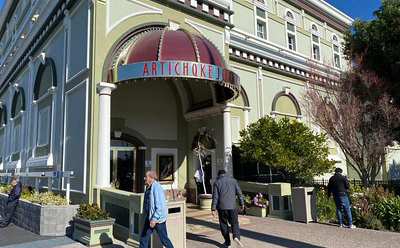
Artichoke Joe’s card club in San Bruno, California has agreed to make annual payments of $900,000 to the city in return for not having a tax hike. The agreement was signed off on by the city council two weeks ago. A tax hike would have required a vote of the people.

Last year the council contemplated raising taxes on the casino. This resulted in negotiations for the annual payment instead—which comes in addition to the $2.3 million the casino is estimated to owe this year. The casino, which has 43 card tables, has operated in San Bruno since 1916. It is one of the highest-grossing casinos in the Golden State.

Vice Mayor Linda Mason, who led the discussion of the alternative payment, commented, “I want to thank Artichoke Joe’s for coming to the table, I want to thank the council members who supported this initiative that’s now resulting in nearly a million dollars to our city every year.”

The city needs to raise funds to cover infrastructure needs and also faces a budget deficit in coming years.

Illinois Issues First-Ever Gambling Study

The Illinois Department of Human Services (IDHS) recently released a statewide assessment of problem gambling in the state. The first-ever report of its kind in Illinois, the study indicated 68 percent of Illinois residents have gambled in the past year. Nearly 3.8 percent, or about 383,000 residents, are considered to have a gambling problem and another 761,000 people are at risk.

In response, IDHS has invested in a variety of gambling services and budgeted $10 million in 2023 for treatment options. Additionally, more than 245 clinicians have been trained to provide problem gambling treatment services in Illinois.

IDHS Secretary Grace B. Hou said, “It is so important that we have data on the patterns and depth of gambling across the state. For those who do struggle with gambling disorder, they seldom seek help and often hide their behavior from family members.”

Laura Garcia, IDHS director of the Division of Substance Use Prevention and Recovery, added, “We are using these findings to develop strategies to increase awareness about problem gambling; support responsible gambling; and expand prevention, treatment and recovery services throughout the state,”

The state provides various intervention, treatment and recovery resources, including the Illinois Problem Gambling Helpline.

Chicago Virtual Meeting Addresses Casino Concerns

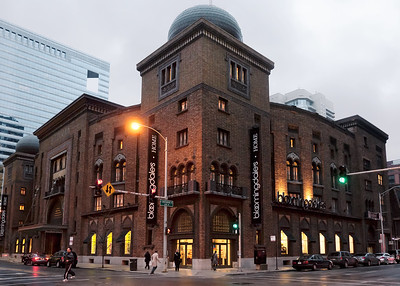
In Chicago, a recent virtual community meeting addressed citizens’ concerns over Bally’s temporary takeover of the historic Medinah Temple while its permanent casino resort is built in River West.

Mayor Lori Lightfoot’s Chief Engagement Officer Martina Hone assured participants that “the Las Vegas Strip is not going to be on your doorstep.” She said, “Today what we wanted to do was to really allow you to see the architects’ vision for the beautiful, iconic Medinah Temple in its latest incarnation as the temporary casino site.”

Built in 1912, Medinah Temple was designated a Chicago landmark in 2001. The venue previously was an amphitheater and auditorium, then Bloomingdale’s occupied the space until September 2020. Robert Jillson and Luis Collado from STL Architects, a firm working with Bally’s, said the building’s copper domes, third-floor ceiling and stained-glass windows will remain untouched. Minor adjustments will include removing some walls installed during a 2003 renovation.

Collado said most of the exterior will resemble the building’s former use as a Bloomingdale’s department store, including vertical banner signs.

Some participants also raised concerns about traffic, parking, public safety, utility use and more. Those issues were noted by city officials but Hone said another meeting will be scheduled to discuss topics outside the scope of the Medinah Temple.

Southern Illinois Casino On Track For 2023 Opening

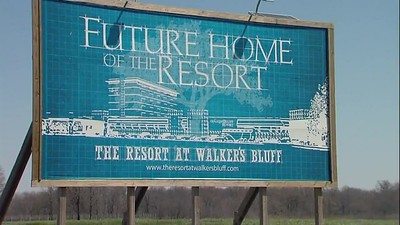
The framework for the casino and hotel at Walker’s Bluff Casino Resort in Carterville, Illinois is nearly complete and the roadways to access the property also are coming along, said Walker’s Bluff Regional Vice President Mo Hader. He said at this rate, the venue could open as soon as early next year.

Hader said, “Many exciting things are happening. The asphalt is down with the grand entrance to the facility and valet area taking shape. The hotel framing is going up and they’ve started the second level. Framing for the casino complex with spa and restaurants is in place and work has begun on the roof. Walls are starting to be enclosed and the road extension is close to completion.”

Travis Emery, Williamson County highway engineer, said that roadwork, including widening, is 65 percent finished and should be completed in late summer or early fall.

Emery said, “Currently, the south section and the north section, the earth end embankment are all completed. A lot of the curb and gutters are in place, all the drainage structures are in place. Now they’re getting ready to start the paving, that’s the largest part of the project.”

Hader concluded, “We are looking forward to bringing a beautiful facility to the Southern Illinois community.”

Virginia’s First Casino Opens In Bristol

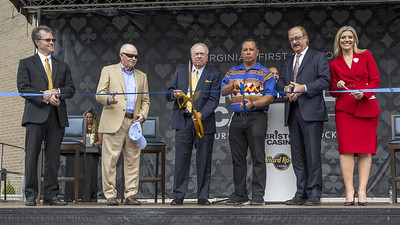
In Virginia, visitors waited in a long line for the 2 p.m. opening of Hard Rock Bristol‘s temporary casino on July 8, located in the former Belk department store at the Bristol Mall. The 30,000-square-foot venue offers 870 slot machines, 21 table games and a sportsbook, plus grab-and-go food, beverage service and a Hard Rock retail store.

Hard Rock Bristol President Allie Evangelista said, “I’ve been in a lot of casinos. This is as nice, if not nicer, than some places I’ve been and operated before. And it’s a temporary property. I’m really proud of the work. The product we have here is really nice.”

Construction on the 500,000-square-foot permanent Hard Rock Bristol is proceeding. It’s expected to open in May 2024 and offer a 100,000-square-foot gaming floor with 1,500 slots, 55 table games and a sportsbook. The facility also will have a 300-room hotel, a Hard Rock Café and 14 additional dining options, plus a 2,000-seat indoor concert venue and outdoor amphitheater.

Hard Rock Bristol has created 1,000 construction jobs and will employ 2,000 people when completed. It’s expected to attract 4 million visitors a year and generate anywhere from $16 million to $21 million in tax revenue.

Virginia legalized five casinos in 2018 and cities that conducted referendums approving the casinos have been selected as hosts. In addition to Bristol, Caesars won the bid for Danville and Rush Street won the bid for Norfolk, and the Pamunkey tribe was selected by Portsmouth. The media company Urban One was selected in Richmond, but the referendum failed. Meanwhile, Petersburg has entered the sweepstakes and will join Richmond with a vote on gaming later this year.

Players Want Massachusetts Casino to Add Poker Tables

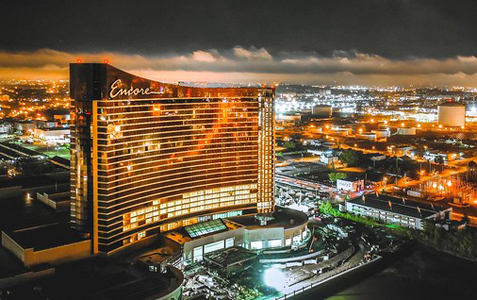
In March 2020, the two casinos in Massachusetts had a total of 95 poker tables between them. Of those, 74 resided at Encore, with the remaining 21 at MGM. The tables operated 24/7, according to Sentinel & Enterprise.

Then the pandemic closed both casino resorts.

Today, the properties possess 5,264 slot machines and 232 table games at the state’s slots parlor and casinos, but only 29 poker tables. What gives, Massachusetts?

“I’m still concerned that when we look at it statewide, how many poker tables we actually have going … for the entire state, seems very, very small to me,” Brad Hill, a member of the state’s gaming commission, said after getting an update on operations at the state’s gaming facilities. He’d like to see the numbers go up.

Pressure from the commission is what got the casinos moving on poker, even though it’s less profitable. MGM brought poker back in October 2021 and now offers 14 tables available from 10 a.m. until 3 a.m. Encore added poker back to the mix in January and has 15 poker tables that are open from 10 a.m. until 8 p.m., Monday through Thursday only.

According to Burke Cain, assistant chief of the gaming commission’s Gaming Agents Division, Encore expects to announce more hours.

“I didn’t want to steal their thunder, but I think that’s forthcoming in a very short period of time. It’s going to be expanded to some weekend hours and a little bit longer hours, as I understand,” he said.

Chair Cathy Judd-Stein has seen a deluge of commentary from poker players not too happy with the status quo. She has floated the idea to dedicate more of the time to talk poker: the number of tables, the hours, the wait time.

Encore’s application said that it plans “an exclusive poker area with 25 dedicated poker tables covering all variations of the most popular poker games.” MGM Springfield’s application said it would also feature “a 25-table poker room.”

Legal Challenge Possible if Both CA Sportsbook Measures Pass

California’s rival sports betting measures could end up in court if both are passed by the voters in November. California has the largest so-far untapped sports betting market in the U.S.

Proposition 26, a retail sports betting and casino expansion measure pushed by a coalition of some of the Golden State’s most powerful gaming tribes, is on the same ballot as Proposition 27, whose backers are seven of the top out-of-state sports betting operators, who want to be able to operate online sports.

The election campaign pitting the two propositions against each other is anticipated to be the most expensive in years in a state that is known for expensive ballot measure campaigns. Each side has promised to spend at least $100 million in promoting their measure.

California’s constitution stipulates that in the case of competing ballot measures that get more than a majority of votes, the one that gets the most votes wins. However, in the case of measures that don’t conflict with each other it is possible for both to become legal. The operators, including DraftKings, FanDuel and BetMGM, wrote their measure not to contradict Proposition 26, but to complement it. It would allow them to offer mobile sports betting, but require operators to tether with a tribal casino.

However, the gaming tribes want nothing to do with them. They want to maintain their monopoly on casino gaming and don’t want the out-of-state operators to have a piece of the action. They argue that the good work Indian gaming does for tribal members will be imperiled if the sportsbook operators siphon off some of their money. They also claim that their very sovereignty is threatened.

Proposition 27, called the California Solutions to Homelessness and Mental Health Support Act, taps into the state’s biggest political issue: homelessness. It commits to earmarking billions of dollars from a 10 percent tax on sports betting to fight that social ill, and the mental illness that often leads to it. It commits 85 percent of the tax to fund that treatment.

Besides the other arguments used against it, the tribes also claim Proposition 27 would make it too easy for minors to sign up to place bets.

Although if both measures pass they would likely both be legal, it is likely that if Proposition 26 passes tribal lawyers will challenge it, claiming that the conflict.

It is possible that the two competing measures could be consolidated before election day, but that would require both sides to agree to it.

Florida Sports Betting Years Away

The Florida tribal compact sports betting case is moving forward in the U.S. Court of Appeals, which recently issued a schedule for briefs. The state’s opening briefs are set for August 17; the response from plaintiff West Flagler will be October 6; then the state’s reply brief will occur on November 14. Dates of oral arguments from both sides following the briefs have not been scheduled, but will take place in 2023.

The saga of sports betting in Florida began in summer 2021 when the state approved a 30-year gaming compact granting the Seminole Tribe exclusive retail and online sports betting rights in the state. But in November 2021, the compact was thrown out by U.S. District Court Judge Dabney L. Friedrich, who ruled that including online sports betting in the compact violated the Indian Gaming Regulatory Act.

Florida filed several appeals of Friedrich’s decision and so did the Seminole Tribe and the U.S. Department of the Interior; all are slowly moving through the U.S. Court of Appeals.

FanDuel and DraftKings also financed an initiative to place sports betting on the November 2022 general election ballot, but petitioners did not gather the required number of verified signatures. If the issue had reached

the ballot, Florida voters could have approved or denied a motion to legalize sports and event betting at professional sports venues and parimutuel facilities. The ballot issue also would have allowed qualified sportsbooks and Native American tribes with a gaming compact to offer online sports wagering.

Under the law, sports betting tax revenue would have been directed to a state education trust fund.

The bottom line is that online sports betting in Florida is unlikely to be available for several years, unless one of the appeals succeeds. The soonest Florida online sports betting could launch is sometime in 2025 if a citizen’s petition drive is approved in 2024.

Retail sports betting could be legalized if it’s included in a new gaming compact with the Seminoles. However, it would exclude online sports wagering and limit retail sportsbooks to casinos owned by the tribe.

Vermont to Reconsider Approving Sports Betting

Vermont’s legislature is giving sports betting another chance. Upward of $10 million a year in potential tax revenues for the general fund is something sure to heighten interest.

Past proposals never got anywhere, but this time they seem serious, as lawmakers prepare to come up with fees and a tax structure, as well as develop regulations. A report from the nonpartisan Joint Fiscal Office came up with the revenue figure the state could earn, according to WCAX.

“Different models yield different favorability with the industry, with my colleagues, and with the public,” said State Senator Kesha Ram Hinsdale, D-Chittenden County.

The Vermont Department of Liquor and Lottery would regulate the industry and come up with age limits, licensing operators, and setting limits on the amounts and numbers of bets.

“Right now, we are investigating an illegal gambling operation in Vermont where the players have lost tens of thousands of dollars. That wouldn’t happen in a regulated sports betting market,” said Wendy Knight, the department’s commissioner.

Another question that lawmakers need to address is problem gambling and addiction.

“This is a social proposition that we have to take very seriously,” Representative Tom Stevens, D-Waterbury said.

Supporters hope it becomes law next year.

Just like Vermont’s cannabis industry, lawmakers have been tackling similar questions of revenue, regulation, and education, and some believe legalization will make it easier to cross over the finish line next year.

NBA’s Silver Says League May Consider Vegas Expansion Team

In a recent interview with the Las Vegas Review-Journal, NBA Commissioner Adam Silver said that while the league is not actively pursuing new markets at this time, Las Vegas is certainly near the top of the leaderboard should they wish to do so in the future.

No league officials have confirmed when exactly they might consider expanding, but the general consensus is that that won’t happen until after a new TV and media rights contract is negotiated—the current nine-year, $24 billion deal doesn’t expire until 2025.

According to Silver, the terms of the new contract will “impact the value of a franchise here (Las Vegas),” which is why the league is “just not going to engage” in speculation as of yet.

However, he did note that “Vegas has a huge footprint,” and the advent of streaming services makes it so that “the size of local markets become less relevant than they did historically.”

Silver also called the city a “very non-traditional market,” and because of the success of the Golden Knights and Raiders franchises, his “personal view is there’s room for everybody.”

Regardless of whether a team moves there, Las Vegas already has a large NBA presence, in that it hosts the annual NBA Summer League tournament every year. The 2022 tournament alone, which just wrapped up, is said to have had an economic impact of over $120 million.

Las Vegas Convention and Visitors Authority CEO Steve Hill told the Review-Journal that the agency has “talked to the NBA about a number of opportunities in Las Vegas,” and added that “their brand and the Las Vegas brand make a lot of sense together.”

Even if the league doesn’t gift Las Vegas with an actual team, it could negotiate a deal for the city to host more of its popular events, as Silver said the area boasts “incredible hotels, entertainment outside of basketball and great facilities.”

Perhaps the biggest question of whether or not a team will come to Vegas has to do with where it would play—there is a new project in the works near the south end of the Strip that would include an NBA-ready arena as well as a casino-resort and shopping centers.

That development is funded by Oak View Group and is being headed by Tim Leiweke, a well-known arena developer and former president of the NBA’s Denver Nuggets franchise. Several high-profile figures have signed on to the project, including former Raiders president Marc Baidan, who was instrumental in the building of the Raiders’ new state-of-the-art Allegiant Stadium.

When asked about how the new arena may help the city’s chances, Silver said that “it always helps to have first-class facilities in a market.”

CA Democrats Oppose Online Sports Betting Measure

The alliances for and against tribal-controlled sports betting and the rival operators’ measure that would legalize online sportsbooks and use taxes raised to fight homelessness have largely gelled. With the election about three months away, let the huge expenditures of money begin! In fact, they have already begun.

The California Democratic Party July 10 voted to oppose the online sports betting measure, Proposition 27, proposed by seven out-of-state sportsbook companies led by DraftKings, BetMGM and FanDuel. The Democratic Party’s executive committee voted to remain neutral on Proposition 26, the tribal proposition that would legalize sports betting in tribal casinos and racetracks only, while expanding the casino games they can offer.

The party largely controls the levers of power in the Golden State, having more than two-thirds of both houses of the legislature and the governor’s office.

The electoral battle over Propositions 26 and 27 is the fiercest in the two-plus decades since California voters amended the state constitution to authorize tribal gaming. In each subsequent electoral challenge to their monopoly of Las Vegas style gaming, the tribes built on past successes and expanded their reach. Proposition 26 would do that also by adding craps and roulette to the casino games they can offer.

The campaign promises to be comparable to the most expensive ballot proposition to date in California, the 2020 fight over Proposition 22. In that campaign, the state’s gig economy, led by Uber, Lyft and DoorDash, spent more than $200 million to overturn the law limiting independent contractors.

The Coalition for Safe, Responsible Gaming is leading the fight against the operators’ measure and for the Tribal Sports Wagering Act. It has corralled more than 80 civil rights organizations, religious leaders, public safety groups and tribes. It is led by the San Manuel Band of Mission Indians, the Rincon Band of Luiseño Indians and the Pala tribe. Its ranks include almost 40 tribes and tribal organizations.

Operators’ proposal, known as The California Solutions to Homelessness and Mental Health Act, has fewer supporters. But it does have supporters, including some city mayors. They like its focus on fighting the homeless problem. It is also supported by three small gaming tribes.

In fact, it is possible that both propositions could pass, although the tribes say the operators’ measure represents a dagger aimed at their sovereignty. Proposition 27 would authorize statewide digital wagering with platforms tethered to tribal casinos. Operators would pay a $100 million application fee and only those who operate in ten U.S. jurisdictions would qualify. This would lock out smaller operators, tribes argue. Individual tribes would pay $10 million if they chose to operate under their own name. The funds raised by a 10 percent tax on gross revenues would be earmarked to fight California’s homeless problem and to treat mental health issues.

The Democratic party’s stance immediately won praise by Reid Milanovich, tribal chairman of the Agua Caliente Band of Cahuilla Indians, who declared: “By opposing Prop 27, California Democrats rejected out-of-state corporations and reaffirmed their commitment to California’s Indian tribes.” Milanovich added, “Prop 27 is not a solution to anything. It would expose children to a massive expansion of gambling and turn every cellphone, gaming console, tablet, and laptop into a gambling device. Prop 27 is a direct attack on tribal gaming and Indian self-reliance.”

California Democratic Party Native American Caucus First Vice Chairwoman Dr. Joely Proudfit added, “There is no question that Proposition 27 is an assault on tribal sovereignty. Proposition 27 threatens decades of progress for California’s Indians, erodes Tribal sovereignty, and threatens the future economic sustainability of California’s indigenous people.”

Tracy Stanhoff, president of the American Indian Chamber of Commerce of California, said in a release, “The revenue generated by this measure will bring tens of millions of dollars each year to our state budget and local governments alike. It will also support tens of thousands of jobs. It’s a win for tribes and all Californians.”

Other tribes opposing Prop. 27 include the Cahuilla Band of Indians, whose Chairman Daniel Salgado described how it could hurt his 200-member rural tribe that owns the small Riverside County-based Cahuilla Casino that offers limited gaming. “From our tribe’s perspective, it hits on a couple of notes—tribal sovereignty and self-determination.” He continued, “It takes away a tribe’s sovereign right to choose. We look at how many people are actually going to participate. There are a little over 60 tribes that offer gaming facilities, so those who don’t participate can’t be a part of this. When you look at limited gaming tribes like ours, we’re forced to make a determination.”

Salgado concedes that someday online sports betting will come to California, but argues, “We want to ensure that we continue to maintain the primary responsibility for regulating the gaming environment. We want to make sure we help shape that and create an environment that is safe.”

One non-tribal supporter of Prop. 26, the Riverside Sheriffs’ Association, said in a statement: “Requiring individuals to be physically present in-person to place bets is the safest and most responsible way for California to legalize sports wagering,” adding, “It is the best way to prevent underage gambling and ensure people are not placing bets illegally, and it provides funding for enforcement against illegal gambling and problem gambling programs.”

The Urban League of San Diego County added, “California’s tribes have been strong partners to the San Diego community. The Tribal Sports Wagering Act will create new economic opportunities for tribes and all Californians – creating new jobs and revenues that will benefit our region as a whole.”

The state’s gaming tribes are mostly united in opposing Prop. 27, but not in how they would approach sports betting. A second tribal group, Stop the Corporate Online Gambling Prop, is led by the Pechanga Band of Luiseño Indians, the Agua Caliente Band of Cahuilla Indians, and the Yocha Dehe Wintun Nation. It claims 50 tribal allies. The same group last year supported a measure that would have allowed mobile sports betting, but controlled by tribes.

All of that said, homelessness is considered the Golden State’s number one issue. A measure that promises to spend 85 percent of the taxes raised on fighting that, and on the related mental health issues, makes a potent campaign pitch. The remaining 15 percent would go to tribes that don’t have casinos.

According to the operators’ website: “The California Solutions to Homelessness and Mental Health Act is the only measure on the 2022 ballot that will guarantee hundreds of millions of dollars each year to fight homelessness and fund mental health treatment in California. The initiative achieves this by licensing, tightly regulating, and taxing online sports betting.”

Finally, the state’s card clubs and several cities that get a lion’s share of their budgets from them are trying to defeat Prop. 26. Taxpayers Against Special Interest Monopolies claims the measure violates the state constitution. In a press release the group declared, “the measure puts more than 32,000 jobs, $1.6 billion in wages, and $5.5 billion in total economic impact at risk. Cities rely on this revenue for resident services such as public safety, housing and homeless programs.”

U.S. Legal Sportsbook Growth Has Not Curtailed Illegal Betting

When legal sports betting began to spread after the Supreme Court’s landmark decision in 2018, the hope was it would kill off illegal offshore sportsbooks.

Well, it didn’t. And now, it seems that chasing them down is not a very high priority.

But a group of legislators sent a letter to Attorney General Merrick Garland urging the Department of Justice (DOJ) to devote time and money to the cause. The American Gaming Association (AGA) is optimistic the DOJ will act, according to the Las Vegas Review-Journal.

“We know this is going to be a long process,” said Chris Cylke, senior vice president of government relations for the AGA. “Our view is that the squeaky wheel gets the grease, and so by continuing to beat the drum on this, we’re more likely to see some kind of action.”

The letter went out June 29, with 26 co-signers and endorsements from several sports organizations and the AGA.

“These predatory operations expose our constituents to financial and cyber vulnerabilities; do not have protocols to address money laundering, sports integrity, or age restrictions; and undermine states’ efforts to capture much needed tax revenue through legal sports betting channels,” the letter reads.

Operators wonder why they have to compete against offshore sportsbooks who didn’t have to pony up millions in licensing fees, Cylke said. “Why is it that my app or website has to compete right alongside those who aren’t doing any of these things and didn’t lift a finger in order to open up this marketplace?” he said.

Of course, even if the DOJ decided to go after offshore sportsbooks, the case wouldn’t be an easy one to make.

Anthony Cabot, a distinguished fellow in gaming law at UNLV’s William S. Boyd School of Law, told the Las Vegas Review Journal that arresting someone in some locale in Europe borders on the impossible. Arrests, if they are made at all, often happen on a flight to the U.S., Cabot said.

The DOJ can take an indirect approach, like zeroing in on intermediaries, such as payment processors. Companies that do advertising business with the offshore sportsbooks can be attacked too. Or regulators could seize the domain name, thus preventing customers from logging into accounts.

“You can try to play cat and dog by changing domain names, but that’s really disruptive to the business,” he said.

The letter to Garland cited three offshore sportsbooks: BetOnline, Bovada and MyBookie. Jack Andrews, a sports bettor and a founder of Unabated.com, a website that provides tools and resources for sports bettors, told the RJ he wasn’t surprised to see those sportsbooks listed.

“They’ve been the three that have tried the hardest to infiltrate the U.S. subversively through guerrilla advertising,” he said.

Essentially, they just pretend that they’re legal in the U.S. and still place ads to entice American customers, Andrews said. In Bovada’s case, it uses the domain name Bovada.lv, with many customers interpreting “lv” as Las Vegas instead of Latvia.

The Garland letter said, “Internet searches nationwide for offshore sportsbooks increased by almost 40 percent in 2021, outpacing searches for legal ones, with Bovada constituting half of all sportsbook brand searches.”

In an interview with GGB, American Gaming Association President and CEO Bill Miller said that the industry is open to all avenues to block illegal cites from U.S. citizens, even through pressure by the State Department.

“We’ve talked about this with folks over at the State Department, hoping to get them to prioritize this,” he explains. “We have bilateral trade agreements with many of these countries. So far has been somewhat difficult, but it is on the list. And the list is an exhaustive one. We try and do everything that we can to at every opportunity shut them down.”

Andrews said there are many reasons why bettors might stay loyal to offshore sportsbooks. Many books allow users to play on credit and settle up after a certain period of time instead of putting up the money up front.

The main reason some big bettors are forced to play offshore is that legal sportsbooks will not take the amount of money they want to wager, Andrews said. The biggest legal sportsbooks in the U.S. deploy what is known as the “soft book” model.

“And that is that sports betting should just be for recreational use, and anyone who bets seriously is not a customer that they desire,” he said.

Richard Schuetz, a gaming industry veteran, recently wrote an opinion article about the offshore sportsbook letter for GGB News called “Dancing the Silly Dance.” In short, stakeholders are just appearing to be busy for their constituents.

Actions like the letter “are oftentimes a valuable tool before elections to remind certain companies that these politicians are on the job for them and deserve a political contribution or two,” Schuetz wrote. “The lobbyist folks like to run with such campaigns, for it keeps them top of mind with the people who pay their bills and gives the impression they are doing something.”

The letter asks for a response from Garland by September 6.

U.K. Gambling Study Can Help U.S. Sports Betting Market

by the National Centre for Social Research could give the U.S. some tips, according to Legal Sports Report.

Researchers David Forrest and Ian McHale analyzed 140,000 U.K. accounts between July 1, 2018, to June 30, 2019, pre-pandemic. These are some of the findings.

  • More than 129,000 lost a minimum of $2,395 a year each.
  • A limited sample of 50,000 played what amounted to eight full days of online slots; the group was mostly female.
  • Online slots made up 60 percent of all gaming spending in the report.
  • Most gamblers participated in a single online gambling activity.
  • The study found that 94 percent of revenue came from men.
  • More than half of bettors and online gamblers ranged between 25 and 44 years old and they contributed more than half of all revenue.
  • If betting on horse racing and football (soccer) are removed from the equation, betting on virtual sports was “skewed towards the most deprived areas.”
  • The top 1 percent of customers (based on betting volume) accounted for 36.4 percent of the operators’ total win. The top 10 account for 79.1 percent.
  • Bettors with the highest losses also tended to live in less well-off neighborhoods.
  • Like sports bettors, 20 percent of customers accounted for 90 percent of online casino revenue.
  • No more than 20 percent took advantage of deposit limits to curb gambling harm.
  • Timeouts and self-exclusion were used less frequently.

Participants offered suggestions for reducing gambling harm.

  • Restricting certain types of play;
  • Limiting advertising around in-play wagers;
  • Multi-operator self-exclusion;
  • Hard stake limits, as self-imposed limits were deemed “weak.”

While sports betting (including horse racing) proved more prevalent than online casino gambling, online casino is where the money is made. Spending was higher in online casino gaming across all eight studied age groups. The rapidity of online slots was viewed as a risk factor associated with heavy losses.

Ohio Sports Betting Applications Pour in at Due Date

The window for applying for a sports betting license in Ohio closed on July 15. Entities can still submit applications, but without a guarantee they would be awarded a license by January 1, 2023, the day it all comes together.

The Ohio Casino Control Commission still must give the applications and all listed partnerships final approval before they go into effect, according to Saturday Tradition.

As expected, Type A (online sports betting) license applications were in demand; 22 came in.

Just about every pro sports franchise submitted applications to run sportsbooks from arenas and stadiums: The Cleveland Guardians, Cincinnati Bengals, Cleveland Browns, Cleveland Cavaliers, Cincinnati Reds, Columbus Blue Jackets, FC Cincinnati, and Columbus Crew.

Twenty sports betting operators submitted applications to serve as “mobile management service providers,” or online sports betting skins, in Ohio.

Here is a complete list of the operators and their listed partners:

  • BetMGM: MGM Northfield Park
  • PointsBet: Hollywood Gaming at Mahoning Valley
  • DraftKings: Hollywood Casino Toledo
  • Barstool: Hollywood Casino Columbus
  • FanDuel: No partner listed
  • Fanatics: Columbus Blue Jackets
  • William Hill: Scioto Downs
  • Hard Rock: Hard Rock Cincinnati
  • BetFred: Cincinnati Bengals
  • bet365: Cleveland Guardians
  • PlayUp: JACK Cleveland Casino
  • SuperBook: FC Cincinnati
  • Tipico: Columbus Crew
  • Fubo Gaming: Cleveland Cavaliers
  • Instabet: Hall of Fame Village
  • Parx Interactive Ohio: Murfield Village Golf Club
  • Underdog Sports Wagering: Cincinnati Reds
  • Out the Gate: SPIRE Institute
  • Gamewise: No partner listed
  • Bally Bet: Cleveland Browns

Massachusetts Lawmakers Signal Concern Over Sports Betting

We return to Massachusetts again, where lawmakers in the state Senate and House have until July 31 to come together on the differences between each chamber’s sports betting bills. If July ends without the passage, they’ll have to wait for the next legislative session. And things are not looking good.

Last week, Governor Charlie Baker entered the fray again in an interview on Boston Public Radio.

“You know, it’s hard to tell at the end of session sort of what is or what isn’t going to get through the gate at the end,” Baker said. “It is certainly on the minds of people in the legislature … People are asking questions about it — people are still discussing it.”

While Baker said other bills were sure to be passed by the deadline, he couldn’t predict if sports betting would join them.

“It’s very hard for me to draw a conclusion,” he said

For her part, Senate President Karen Spilka remains optimistic. If negotiators reach a tentative agreement, she vowed to take a roll call vote.

State Rep. Jerry Parisella also sees hope outdistancing the differences.

The Senate took a voice vote on the actual sports betting bill in April, shielding elected leaders from disclosing their preference, according to MassLive.

“I know the conference committee is working on that, too,” Spilka said in regard to the possibility of an agreement on sports betting occurring this week. “We have, what, six or eight conference committees going on? It would be wonderful to resolve all of them. I’m hopeful.”

One of the key issues revolves around wagers on college games. The House says OK; the Senate does not.

House Speaker Ron Mariano says that’s a deal-breaker.

“I think there’s an opportunity to include college sports, rather than let it be only handled by bookies,” Mariano said. “I mean, I don’t understand if you’re going to do sports betting why you would leave out Final Four bowl games and the whole college football season. It doesn’t seem to be worth doing if you’re going to leave those.”

The Senate has a tighter curb on ads, marketing and use of credit cards. The House does not. The House has a 12.5 tax rate for in-person play and 15 percent for online. Compare that to 20 percent and 35 percent in the Senate.

The Greater Boston Chamber of Commerce and the Greater Springfield Convention and Visitors Bureau have supported passage.

Let’s say all this falls into place. Regulations still need to be drafted and implemented, said MassLive.

Should the prohibition against college betting remain, it could foster a rush to black market offshore operators.

“Every year that legal betting is not available, Massachusetts is losing valuable tax revenue to our neighbors,” Parisella said.

He cited the statistic from sports betting operator DraftKings that 30 percent of all Super Bowl 2022 bets made in New Hampshire came from Massachusetts residents who drove over the state line. Lawmakers project sports wagering could generate around $35 million in annual tax revenues for the state.