Author: Casino Connection Staff

Pre-Closure, AC Set Revenue Record

February will be remembered as the last month before a viral attack swept over the U.S., and Atlantic City casinos made the best of it. Leap year and an extra Saturday helped create a favorable calendar. The extra weekend day plus Super Bowl wagering contributed to a 19 percent increase in gaming revenues compared to last February, for the city’s 21st consecutive monthly gaming revenue increase.

The New Jersey Division of Gaming Enforcement released stats on March 12 indicating the state’s nine casinos and two racetracks reported GGR of $287.3 million, including sports betting.

Bettors wagered $494.8 million, which included those in the days leading up to the Super Bowl, as well as during the game. It was the fourth-largest monthly total in New Jersey since legal sports betting began in June 2018.

“Revenue from slots, table games, internet wagering, and sports wagering all grew,” said James Plousis, chairman of the New Jersey Casino Control Commission.

Seven of AC’s nine casinos reported increases in revenue compared to 2019. Ocean Casino Resort, the former Revel, increased more than 42 percent to $21.3 million.

“February was an incredibly strong month for the property,” said Terry Glebocki, Ocean’s CEO, who also cited mild weather as a contributing factor. “We continue to see strength in our slot business, which increased 88 percent for the month.”

The Meadowlands racetrack in East Rutherford, New Jersey, continued its dominance in sports betting, taking in nearly $11 million in revenue. Monmouth Park in Oceanport brought in $1.2 million. Collectively, sports betting took in just over $17 million. Internet gambling revenue was almost $52 million, up 63.7 percent from a year ago.

Rummy Pandit, executive director of the Lloyd D. Levenson Institute of Gaming, Hospitality & Tourism at Stockton University, said last month’s results were the highest for the month of February since 2011, when 11 casinos operated.

“The especially mild weather, and efforts by city businesses to bring more shoulder season entertainment to the resort, has led to increases in visitation.”

That was then. Only weeks later, in mid-March, the Covid-19 threat forced the state’s casinos and racetracks to shut down indefinitely.

Delaware Casinos Shut Down

Delaware’s three casinos closed their doors to the public Monday, March 16, in response to a declaration by Governor John Carney that also limited all restaurants, taverns and bars to take-out and delivery service only.

According to a report in the Dover Post, Delaware Park in the Wilmington area was the first to shut down, for an indefinite period. The White Clay Creek Golf Course on the property remained open.

Dover Downs closed its casino to the public beginning 8 p.m. March 16, keeping the hotel and take-out restaurant Sweet Perks open until Thursday, March 19, when it completed the property shutdown.

“We sincerely regret any inconvenience to our customers,” said Nick Polcino Jr., vice president and general manager of Dover Downs, according to the Post. “However, the state’s efforts to slow the spread of the Covid-19 virus are of paramount importance. We believe this preventative approach is a necessary step to help ensure the health and safety of our employees, customers and all Delawareans.

“During our closure, we will work diligently to implement additional protective measures for our customers upon reopening. We will keep you apprised of any updates relative to the temporary closure of Dover Downs Casino.”

Harrington Raceway and Casino closed at 4 p.m. March 16, but officials said the property will reopen April 1.

San Manuel Leads the Way

As the coronavirus ramped up in the United States and several governors of eastern states ordered places of large gatherings, including casinos to close, the San Manuel Band of Mission Indians were already far ahead.

“We had been talking about it with our tribal leadership for more than two weeks at that point,” said Loren Gill, the CEO of the San Manuel Band of Mission Indians. “Our leadership believed that we had to be responsive to anything that could come with the virus and realized the closing the casino was one of our options.”

At a meeting of a members of state tribes in early March, Gill says tribal leaders told other tribes about their thoughts.

“Our tribal chairwoman, Lynn Valbuena, told them that we were considering this because we had to keep our employee, tribal members and customers safe.”

Of course, since the San Manuel casino is on sovereign land, no order of any state government official could be enforced. But the tribe, always known for being leaders and doing the right thing in California, made the decision to close days before Governor Gavin Newsome put out the order for non-essential businesses to shut down.

While San Manuel is known for doing the right thing, they also wanted to do it right, according to Gill.

“We agreed to pay all our employees their full wages and benefits through the end of the month,” he said. “We need to take care of our employees and our tribal members, so that was something that took very little time to decide.”

Gill says that tipped workers will also receive a payment equal to the average amount of their tips.

“We know those people depend on the tips and it’s often much larger than their hourly wages, so we wanted to make sure it wasn’t an immediate hardship for them,” says Gill.

Gill says the tribe was also cognizant of difficulties in the community that would extend from a casino closure.

“One of the reasons we wanted to make sure all our employees got paid was to make sure that our community partners wouldn’t suffer,” he says. “We know that pay they receive from San Manuel filters down to the businesses in the community, and we wanted to keep that pipeline open.”

“We’re a leader in that we were the first to take the responsible step to close down,” Gill continued. “I also believe we’re taking the best leadership position in taking care of our employees and our community.”

No affected by the casino closure is the ongoing $500 million expansion project at San Manuel that will create a 17-story hotel with approximately 450 rooms and suites, a pool complex, a 3,000-seat entertainment center, and a spa and fitness center. The first phase of the project opened in late 2019 when a 2,400-space parking garage debuted.

But work continues on the second phase of the project, even with the casino shutdown.

“The workers are continuing to work full force,” says Gill. “Penta is our general contractor, which is constantly monitoring and evaluating the virus threat, so we’re not concerned about their safety. There has been no slowdown and we’re still anticipating an opening mid-2021, just over a year from now. We hope the project continues to go forward. We’re well planned and well capitalized, so we’re not concerned about the project.”

As for re-opening, Gill says there will be a lot of factors to consider.

“There are many data points,” he says. “It seems like the country is moving toward less gathering space, less meetings and less employees in the same location. We’re talking more about quarantines. We’ll have challenges ahead of us in the short term, so I don’t then any of us is ready to predict when we’re going to reopen. We continue to monitor city, county and state events and circumstances very closely. Those will influence our position.

“If we don’t feel good as we get closer to the end of the month and don’t feel there has been a stabilization, well then we may have to remain closed. We don’t want to but we’re going to take it one day at a time.”

But Gill says all companies are handling this situation differently.

“Everybody has been using this somewhat arbitrary 14 day closure,” he says. “If it goes longer than that many companies will be forced to make difficult decisions.”

Wynn, MGM Employees Still on the Payroll

Wynn Resorts and MGM Resorts International say they’ll continue paying their workers during the casino shutdown imposed in Nevada last week to help in the battle against the coronavirus.

Both companies are extending the commitment to all employees, not only full-timers.

In Wynn’s case this includes employees of Encore Boston Harbor, which is under a similar closure order in Massachusetts, and tipped employees, who will be paid on the basis of an average calculated since the start of the year, according to a memo distributed to employees at the two Las Vegas resorts and obtained by the Las Vegas Review-Journal.

Wynn’s casino hotels on the Las Vegas Strip𑁋Wynn Las Vegas and Encore𑁋employ approximately 4,000 people.

“I need you to focus and work on a singular task: stay home and keep your family healthy and safe,” CEO Matt Maddox said in the memo.

MGM, which employs some 70,000 people at its 20 U.S. properties, all of which, including the 13 in Las Vegas, are closed, has committed to paying employees for at least two weeks and health benefits through June 30. The company also has begun laying off workers, as has Caesars Entertainment, which operates eight Strip resorts, the Sahara Las Vegas and others.

“Our policies and benefits are evolving along with the rapidly changing news and predictions of how long this could grind businesses to a halt across the country,” an MGM spokesman said.

Prior to last week’s closure order, MGM canceled a planned $1.25 billion share buyback, one of several major operators nationwide that began moving actively to marshal cash as the contagion’s impacts widened. The company has said more recently it planned to start drawing down as much as $1.5 billion of its backup loans.

Wynn, meanwhile, has begun drawing on an $850 million line of credit.

Caesars, which is reported to be fully drawn on three credit facilities totaling $1.15 billion, declined comment on its layoffs, according to a report in the Nevada Independent.

A statement from the Sahara issued prior to the statewide closure order said the virus’ impact has “forced (the company) to make drastic cuts to its operations, adding the property will “continue to evaluate the business and make operational adjustments as necessary, with the hope of returning team members to work once these challenges have passed.”

A spokeswoman told the Review-Journal that employees will retain their company-paid benefits.

R.I. Lawmakers Grill IGT, Twin River on Joint Venture

Rhode Island lawmakers last week grilled representatives of IGT and Twin River about their proposed joint venture to exclusively contract to the state for 20 years to provide lottery services. The lottery also oversees the video lottery terminals that are deployed at the state’s two casinos, Twin River Casino Hotel and Tiverton Casino Hotel.

International Game Technology and Twin River, once bitter enemies over this issue, mended fences recently and agreed to a joint proposal to the state. Then last week they found themselves undergoing new tough questioning by the House Finance Committee Wednesday.

They also faced probing questions from the state Department of Revenue, which oversees gaming. The department implied that the proposed contract does have a large enough up-front payment from the companies.

Director of Revenue Marc Furcolo wrote the committee: “The proposal in this bill includes exclusive management of 100 percent of the video slot machines by an IGT/Twin River Joint Venture. Given that this proposal is for two exclusive licenses instead of one, the committee may want to consider an increase in the upfront payment.”

The partners propose to pay Rhode Island $25 million over two years, similar to what IGT had negotiated with the state to pay last year. Twin River opposed that contract and launched a long and bitter public relations campaign, in which both companies found themselves at the receiving end of advertising.

Then both companies followed the urging of legislative leaders, began talks on a joint agreement. They reached an agreement in January to include Twin River in the lottery contract in return for the casino company agreement to invest $100 million on its casino in Lincoln. The deal gives IGT 60 percent of the lottery receipts and 40 percent to Twin River.

Furcolo also questions Twin River’s proposal to raise its debt limit as part of the contract. This would allow it to form a REIT and lease back the property where its casinos are.

Some lawmakers have said that Rhode Island will pay the partners too much for the lottery service and criticized the agreement for not requiring that slot machines be replaced fast enough. They also point out that the state’s lottery underperforms neighboring Massachusetts’s.

Another critic, Steven Frias, says the contract shouldn’t be longer than ten years. He wrote, “This no-bid contract provides a subsidy to IGT that exceeds the amount of tax revenues it directly generates to Rhode Island. It will undermine the ability of the State of Rhode Island to maximize its lottery and gam-bling revenues for the next two decades. To get the best deal for taxpayers, Rhode Island should go out to competitive bid.”

Twin River Executive Vice President Marc Crisafulli told the committee members, “We acknowledge this has to be a better deal for Rhode Island taxpayers and one that is better than anything that could be accomplished through a competitive bidding process.”

He added, “We thought it essential to create a three-way partnership between the state, Twin River and IGT to enhance our ability to compete with Massachusetts and Connecticut and maximize revenues.”

Coronavirus Case Closes WV Casinos

For a time, West Virginia held the distinction of being the last state to report a coronavirus case. But once the first resident tested positive, Governor Jim Justice closed all restaurants, bars and casinos.

“We knew it was coming,” Justice said, “but we were prepared. We should be concerned, but we should not panic and live our lives the best we can.”

Officials at the Greenbrier resort in Sulphur Springs, owned by Justice family members, suspended operations on March 19, closing its casino, hotel, 20 restaurants, six golf courses and 36 retail outlets.

Officials issued a statement saying, “The health and safety of our guests and team members is our top priority, and this move is critical to ensure the well-being of all involved. We appreciate the continued loyalty and understanding of our valued guests, and we look forward to welcoming them back when our doors reopen soon. Our thoughts and prayers are with all of those impacted by Covid-19.”

White Sulphur Springs Mayor Bruce Bowling said the closure of the Greenbrier is “worrisome, that’s the main employer in our county, but what are you going to do? It’s what everyone else is doing, and it had to be done.”

Iowa Governor Shuts Casinos, Declares Emergency

To combat community spread of the coronavirus, Iowa Governor Kim Reynolds last week activated the state’s public health disaster emergency plan, closing the state’s 19 commercial casinos, as well as bars, restaurants and other businesses until the end of the month at the earliest. The overall health emergency will remain in effect until 11:59 p.m., April 16 unless the governor ends or extends the order.

Reynolds said, “These are unprecedented times and the state of Iowa will do whatever is necessary to address this public health disaster. I have authorized all available state resources, supplies, equipment and materials to combat the spread of Covid-19. The actions taken today are necessary to protect the health and safety of all Iowans and are critical to mitigating the spread of the virus.”

Some casinos voluntarily closed prior to Reynolds’ decree, including Prairie Meadows in Altoona, three Elite Casino Resorts properties and Q Casino in Dubuque. All will pay employees at least through the end of the month.

Iowa Racing and Gaming Commission Administrator Brian Ohorilko said

casinos must continue to staff their security and surveillance forces.

Louisiana Casinos Closed

The Louisiana Gaming Control Board closed down the state’s 20 commercial casinos and nearly 200 video poker truck stops on Tuesday, March 17 for two weeks, to try to limit the spread of the coronavirus. Impacted casinos include Harrah’s New Orleans land-based casino, 15 riverboat casinos and four racinos. Soon after Governor John Bel Edwards ordered all bars and movie theaters to close, and limited restaurants to delivery and drive-thru orders only.

The casino closure will remain in effect for at least 14 days but could be extended beyond that. The governor’s proclamation currently extends through April 13.

Gaming Board Chairman Ronnie Jones said he made the decision to shutter casinos after consulting with the governor’s office throughout the prior weekend. The board gave casino managers the required eight to 10 hours needed to shut down operations. Jones said the state will lose an estimated $1.5 million a day, or $22 million over two weeks, based on the latest three-year averages. That excludes tax revenue loss to local governments

Wade Duty, the executive director of the Louisiana Casino Association, said his members had expected to be shut down. “There’s absolutely no pushback,” he said. Whether laid off employees will continue to collect their salaries is up to each property owner, he said, however he believed most would continue to pay workers.

One of those is Caesars Entertainment, which said it will pay salaried employees and give tipped employees their average wage. Caesars owns Harrah’s New Orleans, Horseshoe Bossier City and Louisiana Downs, also in Bossier Parish.” The 4,500 team members at Penn National Gaming’s L’Auberge Casino and Hotel also will receive salaries and benefits during the closure.

Las Vegas-based Eldorado Resorts closed its Isle of Capri Lake Charles, Belle of Baton Rouge and Eldorado Shreveport on Monday, March 16.

Native American tribes do not have to follow the gaming board’s order but elected to close their Louisiana casinos, including the Coushatta Tribe, the Tunica-Biloxi Tribe of Louisiana and the Chitimacha Tribe.

Coronavirus Precautions Close Arkansas’ Three Casinos

Arkansas’ three casinos–Oaklawn Racing Casino Resort in Hot Springs, Southland Racing Casino in West Memphis and Saracen Casino Annex in Pine Bluff—were ordered by Governor Asa Hutchinson to close on Tuesday, March 17 through the end of the month to limit the spread of the coronavirus.

Oaklawn had already closed its casino and sportsbook on Monday morning. It held horseraces the prior weekend without on-site spectators. Officials said the property’s 1,000 employees would continue to receive full pay and benefits during the closure.

Southland officials closed the greyhound racetrack Tuesday morning until further notice.

The Quapaw Nation of Oklahoma shuttered its Saracen Casino Annex and Q-Store in Pine Bluff on Tuesday, March 17 for two weeks. Quapaw Chairman John Berrey said the closure will affect 300 employees. “It’s fluid, but right now we’re paying people for two weeks. We want to be smart and protective,” Berrey said. He noted construction will continue on the Saracen Casino Resort for now.

Michigan Casinos Suspend Operations

To slow the spread of coronavirus, Detroit’s three casinos — MGM Grand, Greektown and MotorCity — closed for two weeks, starting Monday, March 16, following Governor Gretchen Whitmer’s call to end gatherings of 250 people or more. “It is not time to panic. This is about saving lives,” Whitmer said. She noted casinos are “where there are masses of people who congregate.” Whitmer said she discussed the situation with other governors. Following the initial 2-week closure period, casino officials said they will re-evaluate.

In a statement, MGM Grand Detroit said, “As we continue to navigate through this unprecedented health crisis, we will close for the safety of our employees and the community.” Casino officials said full-time employees would be paid two weeks’ salary.

Penn National Gaming, owners of Greektown, issued a statement noting the casino would continue to pay salaries and benefits for its 1,650 employees during the closure. Greektown’s and MGM Grand’s hotels will be closed during the 2-week period. MotorCity Casino’s hotel will remain open. Sportsbooks at the three venues closed within days of the shutdown of most sports.

Prior to the closings, the Detroit casinos closed buffets, set up temporary partitions throughout their properties, disabled some slot machines to make more space and increased chip washing.

In addition to the three commercial Detroit casino, 12 Native American tribes operate 23 casinos, regulated by the National Indian Gaming Commission. Nine of those had closed their gaming operations as of March 20.

The largest tribe east of the Mississippi River, the 44,000-member Sault Ste. Marie Tribe of Chippewa Indians shut down its five Kewadin casinos and hotels in Michigan’s Upper Peninsula between March 18 and March 22. Reopening currently is set for April 6. Tribal Chairman Aaron Payment said employees will be paid during the closure.

Bay Mills Indian Community Tribal Chairman Bryan Newland said its Bay Mills Resort and Casinos in Brimley would be closed from March 20 through April 10. Newland said the casino is reviewing options for paying its 600 workers but can’t afford to do that across the board. “A tribe like Bay Mills has very little margin on our cash flow, and very limited cash reserves. Full shutdown, while paying workers, could dry us out very quickly,” he said.

The Gun Lake Tribe announced it was closing the Gun Lake Casino temporarily through March 30. Casino officials said the entire facility will be deep-cleaned during the closure period.

FireKeepers Casino Hotel in Battle Creek, operated by the Nottawaseppi Huron Band of the Potawatomi Indians, also closed on March 16 and may reopen April 13.

The Pokagon Band of Potawatomi Indians closed all of its Four Winds Casino locations in New Buffalo, Dowagiac and Hartford as well as South Bend, Indiana on March 17 through March 30. Employees will continue to be compensated during the closure.

Other closures include the Grand Traverse Band of Ottawa and Chippewa Indians’ Turtle Creek and Leelanau Sands casinos; the Saginaw Chippewa Indian Tribe’s Soaring Eagle Casino & Resort, Saganing Eagles Landing Casino & Hotel and the Slot Palace & Bingo Hall; the Little River Band of Ottawa Indians’ Little River Casino Resort in Manistee; and the Little Traverse Bay Bands of Odawa Indians’ Odawa Casino locations.

The Keweenaw Bay Indian Community reduced the hours at its Ojibwa Casinos, closing nightly from 2:30 a.m. to 7 a.m. until further notice.

Illinois Regulators Order 2-Week Shutdown

After the Illinois Gaming Board on Sunday, March 15 ordered the state’s 13 riverboat casinos to close in an effort to limit exposure to the coronavirus, state officials shut down video gambling until the end of March. The order assures all of the 35,483 video gambling machines at 7,307 locations across the state are now temporarily inaccessible; most would have been unavailable following Governor J.B. Pritzker’s order closing down all bars and restaurants except for takeout and delivery orders.

Illinois was the first state to require casinos to close for a period of time. Earlier, Governor J.G. Pritzker called on establishments statewide to temporarily cancel gatherings of 250 people or more due to coronavirus fears. Before the shutdown mandate, casinos tried to keep the coronavirus at bay by increasing cleaning rotations.

The state’s most lucrative gambling operation, Rivers Casino in Des Plaines, announced its hiatus would start Sunday, March 15—just four days after it had opened the state’s first legal sportsbook. Rush Street Gaming operates Rivers Casino; the majority owner is Churchill Downs.

Penn National Gaming operates Argosy Casino Alton, Hollywood Casino Joliet and Hollywood Casino Aurora. Argosy Casino Alton was set to open the state’s second legal sportsbook on Monday, March 16 but the grand opening was canceled. Officials said they still would take wagers on the few remaining scheduled sports events but that ended with the temporary casino closures. Penn National will continue to pay employees’ full wages and benefits.

Other Illinois casinos included in the temporary shutdown include Caesars Entertainment’s Harrah’s Joliet and Harrah’s Metropolis; Eldorado Resorts’ Grand Victoria in Elgin; Delaware North’s Jumer’s Casino Hotel in Rock Island; Boyd Gaming’s Pair-A-Dice hotel casino in East Peoria; and the employee-owned Casino Queen in East St. Louis.

Horseracing betting still is available via mobile and online wagering. Fairmount Park in downstate Collinsville is closed to spectators, including at their off-track betting parlors, but said they’ll broadcast races to wager on. Hawthorne Race Course in Stickney announced Monday evening they’re suspending races through the end of the month.

Mississippi Gaming Commission Closes Casinos

The Mississippi Gaming Commission ordered all of the state’s casinos to close at midnight on Monday, March 16 until further notice in response to the coronavirus. The commission said only essential personnel may be on-site at the casinos.

Bill Hornbuckle, president and chief operating officer at MGM Resorts International, owners of the Beau Rivage Resort & Casino in Biloxi and Gold Strike Casino in Tunica, said, “We will continue monitoring the situation and announce plans for reopening when appropriate.”

The gaming commission has the authority to order the casinos closed, but individual operators can choose to keep the hotel and other amenities open. For example, Palace Casino’s hotel remains open, with limited food service available.

Also, the gaming commission’s order does not apply to tribal casinos. As of March 18, the Mississippi Band of Choctaw Indian’s Pearl River Resort, Bok Homa Casino and Golden Moon Hotel and Casino remained open but the buffet, spa, fitness center and pools were closed, entertainment was cancelled, and social distancing was established on the casino floors.

The shutdown will affect most of the 10,400 employees at the 12 coastal casinos and 16,000 statewide.

Kansas Lottery Shutters Casinos

After consulting with the Kansas governor’s office and the Kansas Racing and Gaming Commission, the Kansas Lottery shut down the four state-owned casinos on Tuesday, March 17. Earlier, Governor Laura Kelly had issued an executive order banning gatherings of 50 people or more to combat the coronavirus, according to CDC recommendations.

The four state-owned casinos are the Hollywood Casino in Kansas City, Kansas Crossing in Pittsburg, Boot Hill Casino in Dodge City and Kansas Star Casino in Mulvane. The hotel at the Kansas Star will remain open.

Kansas Lottery and casino managers said they will actively monitor the pandemic situation and continue to comply with government recommendations for operational procedures.

Missouri’s 13 Casinos Close

As of midnight on March 17, Missouri Governor Mike Parson ordered the state’s 13 casinos to close as part of the battle against the coronavirus. “I have consulted with the chairman of the gaming commission and Missouri casinos will be closed at midnight tonight through at least March 30 in order to help prevent the spread of Covid-19,” Parson said.

Missouri Gaming Commission Chairman Mike Leara said closing the casinos could result in lost revenue of $1 million for the state. “I don’t think we had any choice in this,” he added. :The governor’s office was concerned that gatherings of more than 50 people were not in the best interest of the state.”

Leara said based on what Missouri casino operators saw occurring in other states, they accepted the governor’s decision. “They started to see this coming,” he said.

California Casinos, Card Rooms Close

Some of California casinos and cardrooms tried to remain open, despite the impact of the Covid-19 outbreak, but their hopes were quashed on March 19, when Governor Gavin Newsom ordered all residents of the state to go home and stay home. Due to the “shelter-in-place” mandate, the following casinos are closed until further notice:

Los Angeles County. The Commerce Hotel & Casino, the Gardens Casino in Hawaiian Gardens, the Bicycle Hotel & Casino in Bell Gardens and Hollywood Park Casino, the Golden State’s largest card room casinos, all are closed.

Together they employ about 8,000 workers and usually have about 20,000 patrons per day. Over the weekend a worker at the Commerce had tested positive for the virus.

San Jose County. San Jose card rooms Casino M8trix and Bay 101 Casino have closed, at least until April 4.

San Diego County. All casinos in San Diego County are now closed. San Diego has the largest number of tribal casinos in the Golden State.

Before they closed the casinos Sycuan Casino Resort attempted to deal with coronavirus concerns by installing more hand sanitizers, increasing staff training and cleaning slot machines and “touch points.” They also installed anti-bacterial soaps in restrooms and used a company to sanitize gaming chips. Sycuan closed last week for an indefinite period.

Barona Resort & Casino had taken similar actions. But it also noted that its air filtration system includes ultraviolet light disinfecting.

Other San Diego casinos that closed are Harrah’s Resort Southern California, which first instituted a regime of reminding employees to hand wash often, posting signs reminding guests to do the same, and increasing sanitizing work areas before giving in to the increasing pressure to close. This was followed by cancelling all shows in March.

Although at first Valley View Casino in Valley Center didn’t join the rush to close, eventually it too succumbed to the pressure and said it would close on March 20. Its popular buffet, high limit lounge and spa closed days earlier. Prior to the closure the casino and hotel had increase the frequency of sanitation and disinfecting of surfaces, slots, kitchen and food areas.

Pala Casino, Spa & Resort did not cancel any shows in advance of announcing that it would close as of March 20.

San Bernardino County. On March 14, San Manuel Casino announced a temporary closure until the end of March, but that the date could be extended depending on circumstances.

Riverside County. The largest casino on the West Coast, Pechanga Resort Casino, announced it would close March 14. On March 19, Pechanga announced that it would be donating $100,000 word of food to local charities.

“We’re happy to know that people who need it most in our region will be getting the food assistance they need during this difficult time,” said Jared Munoa, president of the Pechanga Development Corporation. “It’s a lot of food. The amount of food service our team provides can be staggering and we give our guests the best quality. We are very glad it’s going to deserving folks who are undergoing unprecedented circumstances.”

Other casinos that are closed include Agua Caliente Resort Casino Spa Rancho Mirage, Fantasy Springs Resort Casino, Soboba Casino Resort,

Morongo Casino, Resort and Spa, Spotlight 29 Casino in Coachella,

Augustine Casino, Cahuilla Casino.

Santa Barbara County. The Chumash Casino, owned by Santa Ynez Band of Chumash Indians, closed on March 15.

Northern California. Cache Creek Casino Resort, operated by the Yocha Dehe Wintun tribe, was the first tribal casino in Northern California to close. Other casinos in Northern California that closed were Table Mountain Casino, owned by Table Mountain Rancheria, Jackson Rancheria, Red Hawk Casino, Thunder Valley Casino Resort in Lincoln, Sherwood Valley Casino.

Ohio’s 4 Casinos, 7 Racinos Close

Late Friday, March 13, Ohio Governor Mike DeWine issued an order banning gatherings of 100 or more people in an effort to control the spread of the coronavirus. As a result, Ohio’s four casinos and seven racinos were given a choice: either to close or limit the total number of people in the buildings, including employees, to under 100. DeWine’s spokesman Dan Tierney said, “The governor was clear that the order applies to casinos,” as well as racinos.

MGM Northfield Park, the state’s busiest racino with 2,200 video lottery terminals, was first to announce it would suspend operations Friday at midnight. JACK Cleveland Casino and JACK Thistledown Racino in North Randall later announced they also would close that evening. All venues, including the state’s four casinos–JACK Cleveland Casino, JACK Cincinnati Casino, Hollywood Casino Columbus and Hollywood Casino Toledo—also voluntarily closed on Saturday.

The state’s other racinos are Belterra Park in Cincinnati, Eldorado Gaming Scioto Downs in Columbus, Hollywood Gaming Dayton, Hollywood Mahoning Valley and Miami Valley Gaming in Lebanon near Cincinnati.

Ohio’s gambling industry was heading to a record year with revenue at the 11 facilities, after payouts, up 14.6 percent to $338.9 million through February.

Massachusetts Casino Bill Gets Mixed Reception

A bill that would slash the investment required to build a Massachusetts casino is getting a mixed reception.

The bill, H 4070, introduced by Rep. Susan Williams Gifford at the behest of the Notos Group, would lower the bar in what is officially known as Region C. It would allow a second slots parlor in the state and open the gate for Notos’ proposed $300 million Wareham Park project.

Currently, the minimum investment required for a casino is $500 million.

Notos, led by a family of developers who built the Marina Bay complex and Granite Links Golf Club in Quincy, proposes a thoroughbred racetrack, slot parlor and baseball park, plus dining and a hotel. The 2011 law that expanded Massachusetts gaming only allows for one slots parlor, which is held by Plainridge Park Casino in Plainville.

The Region C license has never been issued, mainly because it’s appeared tied to the fate of the $1 billion tribal casino that the Mashpee Wampanoag tribe has fought to build in Taunton. That project has been stymied both in the courts and because the Trump administration rolled back the land-into-trust decision that was made under the Obama administration. This has left the southeastern part of the state unable to benefit from the economic stimulus of a casino.

The South Shore Chamber of Commerce has thrown its support behind the bill, if not the actual project proposed by Notos. President Thomas O’Connell and CEO Peter Forman wrote to Gifford, signaling their support.

Forman is a former minority leader of the House. Both he and Gifford are Republicans. The letter says chamber’s leaders are troubled that the region “is almost effectively blocked under current law from even considering a gaming option.”

Forman told GGB News, “We’re backing legislation that would allow the state to consider options other than a full resort casino. We have not endorsed any specific proposal that might be made to the state.”

Forman noted that the chamber is in a unique location geographically in terms of the three gaming regions. “We’re about 25 communities, covering the shoreline between Boston and Cape Cod, including a small section of Region C,” he told GGB News. “Our northernmost community is almost a Boston suburb, and we go to the Cape Cod Canal. If you got something in Southeastern Massachusetts, it could have some impact in our economic basin.”

He continued, “When the legislature set up the three gaming zones, they did it with full casino resorts in each zone and one slots parlor. Our chamber straddles Region C and A. The other two regions have the two casinos and a slots racing casino. It is looking like there won’t be a practical market opportunity for a full resort casino in Region C anytime soon.”

Forman added, “Our board endorsed the legislation that would allow the commission to consider other options, if we think that door should at least be open, and the region should be able to consider some options. If the door is open, I think there would be lots of proposals. The chamber has not endorsed any specific proposals and we think there will be several coming forward and we haven’t spent any time analyzing any proposals.”

The idea of introducing live horseracing “seems to have a little more potential value to the region, because there are lots of farms in the region and there is an agricultural spin to horseracing,” he added. “Whether it’s possible to have a sustainable horseracing industry, I would leave those in the industry to find out.”

Forman described the region’s economy as “fairly good right now, pretty strong. Housing prices are good, unemployment is very low. We do look to some future challenges as industries change. Obviously we’d like to see future growth, so we want to diversify our economy.”

Existing law requires a minimum investment of $500 million for a destination casino, and a $125 million minimum investment for a slot parlor.

The city of Wareham supports the bill. Officials say that it could give a shot in the arm to the town’s finances.

However, the senator whose district includes both Wareham and Taunton opposes the bill as not in keeping with the original intent of the gaming expansion legislation of 2011.

Speaking to GGB News, Senator Marc Pacheco said, “I believe passage of that piece of legislation would corrupt the system and the plans that the Massachusetts Legislature and governor put in place. We took a lot of time to study this issue, to look at what the implications were and what the market would be like in Massachusetts. Even though the market might be able to bear more, we decided there would be three region-based casinos and one slots parlor, which is in Plainridge.”

It’s wrong, Pacheco said, “to allow something that’s dissimilar to the other regions, that is significantly less in terms of the investment in the commonwealth and is legislation to benefit one developer: the Notos Group. It’s essentially that group that wants to see this accomplished, and they want to see it accomplished so they would be eligible to develop in Region C.”

He added, “Anytime you are doing something only for one developer— when you’re talking about the gaming industry—that’s very dangerous territory to be heading into. The question would be, why would you do that when the existing framework allows the region to have one destination-based casino?”

Asked about the assertions of those like the Notos Group who say the area is too saturated to support a destination resort casino, Pacheco noted, “When the gaming industry announces they’re going to build a casino, very rarely do a lot of the estimates come to pass. They’re usually more lucrative in terms of their vision rather than the reality.”

Nonetheless, he said, gaming has produced “significant job growth, significant tax dollars with the casino in Springfield and the Encore in Everett and in Plainridge.” He said it’s in the interests of existing casinos in Massachusetts, the Foxwoods and Mohegan Sun casinos in Connecticut and the two Rhode Island casinos “not to have an additional destination based casino in Region C, but that’s not in the interest of the commonwealth of Massachusetts.”

The state’s interest “has always been has been using gaming as only one tool for an economic development plan, and having a destination based in Region C was part of that plan,” he said.

In a March 5 interview with the Boston Globe, Pacheco said, “The most effective way to assess market saturation is to simply use the process in place. Skepticism about the industry’s viability could be settled very quickly—when the timing is right—by putting Region C out to bid.”

The senator said he’s frankly surprised that the legislation was even introduced, given the level of support for it. “I’m surprised there were people willing to file this legislation. I would have said we were hundreds of miles away from such a bill,” he said.

Another player’s interests are also rubbed raw by this bill—Mass Gaming & Development, a subsidiary of Rush Street Gaming, owned by billionaire Neil Bluhm, whose proposal for a casino resort at the Brockton fairgrounds was turned down by the Massachusetts Gaming Commission several years ago because commissioners feared it might interfere with the development of the Wampanoag $1 billion First Light Casino, which at that time was still considered very viable.

Joe Baerlein, a spokesman for Mass Gaming Development, told GGB News that the Brockton proposal is still very much alive.

“As you may know on this project, (the Notos Group’s) total investment is $300 million; the gaming legislation has a minimum of $500 million investment for a full-scale resort and casino. Right there, they’re not in compliance with the law. Our view is that, if you want to be a bidder in Region C, you should conform to all of the requirements. And if they don’t, they don’t make the cut.”

North Jersey Still Hopes for Casinos

North Jersey continues to beat a dead horse. A referendum four years ago would have allowed casino gaming outside Atlantic City. That effort lost, with almost 80 percent of voters saying no.

Yet the idea still lives, according to the Associated Press.

In January, a handful of state legislators reintroduced bills from 2016. They have no plans to advance the proposals right now, but they want them primed and ready to go, in case Atlantic City takes a nosedive again.

“We want to see Atlantic City succeed,” said Assemblyman Ralph Caputo, a northern New Jersey Democrat and former Atlantic City casino executive. “These bills are in case Atlantic City gets into trouble. The signal it sends is that we’re watching carefully to see if we need to act on this. But not at this time—I want to make that clear.”

Four years ago, Atlantic City had witnessed several casino closures, hurt by a faltering economy and competition from nearby states. The closings cost the region some 11,000 jobs.

The referendum rationale went like this: North Jersey gamblers lost their money to casinos in Pennsylvania and Connecticut, so open casinos at the Meadowlands, and those gamblers will return.

But casino interests in Atlantic City and New York funded an effective lobbying and publicity campaign against the ballot question, in which voters were asked to support two casinos in North Jersey.

Bill Cortese Jr. was the director of that effort, called “Trenton’s Bad Bet.” He said the resurfacing of the bills comes as no surprise. But since 2016, Atlantic City’s casino market has stabilized with the opening of Hard Rock and Ocean.

“The jobs and the growth that has been added since then, probably north of 7,000 jobs and millions in revenue, is something we can be proud of,” he said. “But there are still a good number of people in Trenton that still want to push for casinos in north Jersey.”

State Senate President Steve Sweeney, from South Jersey, said none of the reintroduced bills will advance through the legislature. “Atlantic City is doing very well right now; we’re not going to reverse it,” Sweeney said.

Jeff Gural, who operates the Meadowlands and has partnered with Hard Rock International on a future casino project at the Meadowlands, did not ask lawmakers to bring back the bills this year.

And he won’t until casinos open in or near New York City.

“I am prepared to wait until the three downstate casinos open in New York and see how people living in northern New Jersey feel about paying the toll to drive over the George Washington Bridge to gamble,” he said. “My guess is they will not be happy.”

Kentucky Derby Moved to September

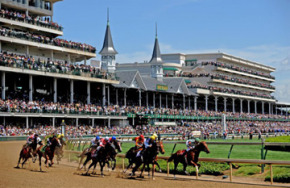
Faced with the prospect of running the Kentucky Derby without spectators, mint juleps or fancy hats, Churchill Downs has postponed the legendary race, moving it from May 2 to September 5.

It’s only the second time the Run for the Roses has been moved—the other time was at end of World War II.

“Our team is united in holding the best Kentucky Derby ever and certainly the most unique in any of our lifetimes,” said Churchill Downs Inc. CEO Bill Carstanjen. “It had to be done. We own it and will make it a really special day.”

Like the rest of the gaming sector, Churchill Downs shares have suffered record declines during the spreading COVID-19 coronavirus outbreak, according to CDC Gaming Reports.

“The postponement of the Derby should provide some relief for the shares, given concerns that the event could be canceled and its magnitude in the earnings stream,” Jefferies gaming analyst David Katz told investors. “We presume there should be some cost impact related to the change, but modest compared with other outcomes and likely contemplated in current stock price levels.”

Ryan Dickey of Horse Racing Nation says the rescheduling will not take away any of the luster.

“The Derby will still be the same premier race restricted to three-year-olds going a mile and a quarter on the dirt, as it is every year, regardless of when it’s run. The date does not diminish the accomplishment.”

Jack Knowlton, principal of Sackatoga Stable, which campaigns one of the early Kentucky Derby favorites Tiz the Law, also won the 2003 Derby with Funny Cide.

“Everybody who has ever participated in the game at any role, that’s the race they want to win,” Knowlton said. “Whether it’s the first Saturday in May or the first Saturday in September, I don’t think it matters.”

Virus Curtails NFL Draft Fest

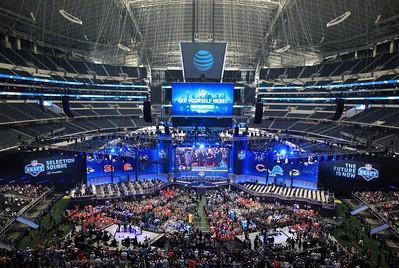
The National Football League canceled plans to hold its annual college player draft in Las Vegas in April, foiling the plans of an estimated 350,000 visitors. More than a year of planning to turn the Las Vegas Strip into the center of football will be significantly altered, as the NFL mulls a response to the Covid-19 pandemic.

“This decision reflects our foremost priority—the health and safety of all fans and citizens,” Commissioner Roger Goodell in a statement.

The clubs’ selection of players will proceed April 23-25, and the NFL hopes to come up with innovative options to present on TV.