Author: Casino Connection Staff

PA Bill Would Divert Sports Betting Funds to Tax Relief

A bill introduced in the Pennsylvania state Senate would divert sports betting revenue to a property tax relief fund designed to aid citizens suffering financially due to the shutdown of businesses during the Covid-19 pandemic.

The legislation, sponsored by Senator Doug Mastriano, would divert Pennsylvania’s sports betting taxes—at 36 percent of revenues, the highest in the nation—temporarily to the Property Tax Relief Fund. The fund is normally replenished by a portion of all casino taxes, but sports betting revenues are, by law, funneled to the state’s General Fund.

“Pennsylvania homeowners already face high property taxes, and the Covid-19 pandemic will only worsen that reality,” Mastriano said, according to Legal Sports Report. “With a mandated shutdown of businesses that are not ‘life-sustaining,’ many Pennsylvania families find themselves out of work with no income, and have voiced concern about paying their property taxes.”

“All sports wagering authorization fees, manufacturer license fees, manufacturer renewal fees and all fees for licenses issued under Chapter 16, and all money collected by the board for violations of this subchapter shall be deposited into the Property Tax Relief Fund,” according to the bill.

The diversion of sports betting funds under the measure would last through June 30.

California Sports Betting Petitioners Stop Effort

Proponents for a measure that would legalize sports betting in tribal casinos and racetracks in California have stopped collecting signatures, after nearly reaching the threshold for the November ballot.

The coalition of 18 tribal casinos and racetracks in the Golden State were forced to stop by Governor Gavin Newsom’s executive order shutting down the state on March 16.

The measure the tribal coalition came up with would have elbowed out the more than 60 commercial card clubs in the state and also expanded the types of table games that the tribes could offer. It would not authorize online sports betting. All wagers would have to be made on the premises of a brick and mortar tribal casino, or a racetrack.

Most gaming tribes fear any type of sports betting that doesn’t bring patrons to their physical operations.

Rep. Adam Gray three times introduced legislation, in 2016, 2017 and 2019.

In 2018 Californians for Sports Betting started an effort collect signatures to put a measure that include card clubs. It died in the water due to no interest by donors.

Last November the 18 tribes began their effort to get nearly one million signatures by April of 2020. They collected close to that number when the coronavirus descended on the state.

That hasn’t stopped the cardrooms from gathering money for a campaign just in case something miraculous happens that the coalition makes the deadline.

California’s sports betting market is seen as the most potentially lucrative in the United States. The American Gaming Association has estimated that residents could bet more than $18 billion annually. Depending on the tax rate, the state treasury could collect hundreds of millions of dollars each year.

The tribal initiative would ban wagers on college teams based in the state. However, the state with the largest population also has the largest number of professional sports teams.

Nevada Approves Three More Esports Events

The Nevada Gaming Control Board on April 14 approved bets on three esports events, as sportsbooks seek new ways to wager in without most traditional sports.

The events sanctioned by the board include Overwatch League, League of Legends European Championship and the North America League of Legends Championship.

These options come as betting options have been limited to obscure, live sporting events still taking place around the globe, as well as futures bets, such as next week’s NFL draft and the odds to win the Super Bowl. Sportsbook operator William Hill U.S. said it has received more than $100,000 in total bets daily on international table tennis.

“Ping-pong is the star of the show,” William Hill director of trading Nick Bogdanovich told ESPN. “The games are one on top of one another. Guys are playing three or four times a day. Everyone is probably betting the same guy or against him all day. People are betting five-, six- and seven-teamers.”

WSOP, GGPoker Create New Online Poker Series

A new partnership between the World Series of Poker (WSOP) and GGPoker will bring quality WSOP Circuit action to the online poker scene. The two poker organizations will join forces to present the WSOP Super Circuit Online Series on the GGPoker Network.

The online tournament series will include hundreds of individual poker events, including 18 WSOP Circuit gold ring tourneys. The winner of each of these events will be awarded a coveted gold piece of WSOP Circuit paraphernalia.

In addition, the first-ever WSOP Super Circuit Online Series will also extend two invitations for participation in the $1 million freeroll WSOP Global Casino Championship, which is an official WSOP gold bracelet event.

One of those invitations will be given to the WSOP Super Circuit Online Series Main Event winner and the to the player who collects the most points throughout the series.

The new online poker series is set to kick off in early May and to run for approximately three weeks.

GGPoker head Jean-Christophe Antoine said the move “brings together two like-minded global organizations. I can’t wait to see GGPoker players competing for WSOP Circuit rings online.”

WSOP Executive Director Ty Stewart said he’s excited to partner with GGPoker, “an operator on the rise who is both aggressive and passionate about growing poker engagement around the world.”

GGPoker ambassador and poker professional Daniel Negreanu said that he gives credit to the WSOP for “bringing the circuit online during these trying times” and that online poker players “will love the experience of chasing rings at GGPoker.”

Shutdown Takes Revenue Toll, Boosts iGaming in N.J.

The March 16 shutdown of New Jersey casinos and racetracks took their toll in the March sports betting revenue results. The combined retail and online sportsbooks took in a third of the expected handle. At the same time, online casinos and poker rooms blossomed.

Sportsbooks lost out on nearly $370 million in wagers, according to PlayNJ.com estimates, while online casino and poker revenue set a new record with $64.8 million in revenue.

“Shutdowns from the coronavirus pandemic are affecting New Jersey’s gaming industry in ways that are unprecedented, and that will continue until the country begins to return to some semblance of normalcy,” said Dustin Gouker, lead analyst for PlayNJ.com.

New Jersey’s online and retail sportsbooks collected just $181.9 million in bets, according to official reporting released April 15. In an industry that has seen consistent year-over-year growth of 50 percent or more, March’s handle fell 51 percent from the $372.5 million posted in March 2019 and down 63 percent from $494.8 million in February 2020. March’s handle, which pushed New Jersey sportsbooks past $7 billion in lifetime wagers, was the smallest since August 2018.

New Jersey sportsbooks produced $13.2 million in gross revenue, yielding $1.7 million in tax revenue for the state. But revenue was down 58 percent from $31.7 million in March 2019.

Most of the betting happened made before March 11, when the NBA suspended its season and triggered a spate of cancelations through the sports world. When the smoke cleared, bettors had a handful of international events and futures betting available. The most significant loss for bettors was the NCAA basketball tournament which would have generated more than $150 million in New Jersey alone, based on PlayNJ.com estimates.

“The loss of March revenue will not be something that New Jersey sportsbooks can make up,” said Eric Ramsey, an analyst for PlayNJ.com. “Until sports are able to get going again, New Jersey’s online and retail sportsbooks will continue to be uncomfortably quiet.”

Online betting generated 89.9 percent, or $163.4 million, of the state’s handle in March. FanDuel Sportsbook/PointsBet led online sportsbooks with $5.7 million in gross revenue, down from $9.6 million in February.

“Professional leagues are trying to figure out a way to get back out on the field, which is the good news,” Gouker said. “The bad news is there is no way to know when that will be, and it doesn’t appear that it will be particularly soon.”

Colombian Regulator OKs Live Dealer Games

Colombia’s licensed online gaming operators can offer live dealer casino games as a way to generate revenues during the Covid-19 shutdown.

The country’s gaming regulator, Coljuegos, OK’d the games last week, according to CDC Gaming Reports. Coljuegos launched Colombia’s regulated iGaming market in June 2017. Since then, it’s grown to account for 13 percent of gaming revenue, with almost 3 million registered player accounts across 16 licensed operators.

Looking at live casino games in markets including as New Jersey, Belgium, Spain and the UK, the regulator found that the addition of live dealer complemented rather than cannibalized online casino revenue.

The country is on lockdown until at least April 27.

BetAmerica Back Online After Cyber-Attack

BetAmerica, an online sportsbook owned by U.S. casino and racetrack operator Churchill Downs Inc., came back online on April 17, three weeks after sports betting platform provider SBTech was disabled by a cyber-attack.

The attack in late March forced the shutdown of more than 50 sports betting operations, including BetAmerica, which launched in New Jersey in early 2019 and in Pennsylvania in February. Others affected by the attack included Resorts and Golden Nugget, both based in New Jersey.

Some sportsbooks powered by SBTech, including the Oregon Lottery’s Scoreboard app, returned online April 2.

Maryland Director: Online Lotteries to Come of Age

The outbreak of COVID-19 has caused widespread disruption to the lottery industry, with retail sales hampered by lockdown restrictions and an under-developed online sector now even more eager to take off, according to Gordon Medenica, director of the Maryland Lottery and Gaming Agency.

In an interview provided exclusively to GGB News, Medenica said the pandemic, which has limited players’ ability to buy tickets in a retail environment, has started to break down the “irrational political resistance” to lotteries selling products through online channels.

“Lotteries, and their vendors have been prepared for years to offer products through the online channel,” Medenica said. “The barriers are political, not technical.”

Amid the crisis, operators have had to make drastic changes to their internal work processes, moving many employees to teleworking and using other techniques to maintain minimum operations, or even closing front-facing customer service offices.

Retailers, meanwhile, have been instructed to encourage players to limit their time in stores by filling out play slips in advance, using Quick Pick, self-service machines and advance play and subscriptions, with a natural impact on sales.

Medenica predicts that the industry will change as a result of the current health crisis, as lotteries do what they can to maintain sales while emphasizing social distancing and teleworking. “Right now, it’s all about public health and safety, as it should be,” Medenica said. “Once we get beyond this health crisis, I believe states will take a new look at online sales. It only makes sense.”

But he also acknowledged that there will be some casualties: “The lottery industry will survive this crisis and probably rebound in much the same form as existed before. However, some trends, such as the declining interest in the large national jackpot games, have been exacerbated in the crisis and may not recover fully.”

The future of lottery monopolies is another question that has been brought sharply into focus in the wake of the pandemic. Medenica says that an important element of their status lies in their ability to raise significant funds for the various good causes they support.

“Protection of that status should be a primary objective for all state sponsored lotteries,” he added. “Nevertheless, lotteries would benefit from state regulatory structures updating and allowing lotteries more flexibility in marketing, game design, distribution channels and procurement.

“The more lotteries can operate like private businesses, the more successful they will be and the more funds they can raise for good causes.”

Medenica will be a featured panelist on the iLottery session for the ICE North America Digital conference, beginning at 4:30 p.m. on Monday, May 11. To register for the free conference, visit icenorthamerica.com.

Will Philippine Online Gaming Restart This Week?

Despite concerns linking them to crimes including murder, Philippine Offshore Gaming Operations (POGOs) will be back in business by the end of April, according to Labor Undersecretary Dominique Tutay. At a recent press conference, Tutay said, “POGOs will continue as long they are allowed by law. We will just continue our initiative to regulate and ensure that these firms are compliant with labor and immigration laws as well as payment of taxes.”

The POGO industry has also been linked to sex trafficking, botched work visas, money-laundering, and kidnapping.

Tutay said the department was currently investigating up to 2,000 foreign nationals that were allegedly working in POGOs without the required foreign work visa.

Last month, the labor department also found 4,000 foreign nationals in POGO firms that were using the same Tax Identification Numbers in their work visa.

These concerns were set to be discussed and resolved in March, but the work halted due to the lockdown in Luzon.

“Abby and the Arts” Stay at Home Art Contest sponsored by Absecon Lighthouse

Absecon Lighthouse is sponsoring a Stay at Home Art Contest, “Abby and the Arts,” to inspire a lasting love of the arts in Atlantic City. Absecon Lighthouse will be awarding cash prizes for 1st , 2nd , and 3rd place to Atlantic City schoolchildren who submit original artwork using Absecon Lighthouse as inspiration in the following categories:

  • Drawing/Painting
  • Photography
  • Poetry

The contest is open to Atlantic City students, grades 1st through 12th.  One submission per student is allowed.  Submissions will be accepted through Friday, May 15, 2020, at 3pm.  Winners will be announced at the Reopening Celebration, the specific date of which is to be determined.  All submissions will be on display at the lighthouse, and the winners will be selected by a panel of local artists and arts administrators.

Information and an official application can be found at www.abseconlighthouse.org.

Funding has been provided in part by the NJ state Council on the Arts, Department of State, administered by Atlantic County Office of Cultural and Heritage Affairs.

Absecon Lighthouse is a state-owned historic property administered by the non-profit Inlet Public/Private Association.  Located at 31 So. Rhode Island Avenue in Atlantic City, it is open to visitors Thursdays through Mondays, 11 am to 4 pm.  Absecon Lighthouse received a general operating support grant from the New Jersey Historical Commission, and a stabilization grant from the New Jersey Cultural Trust, both divisions of Cultural Affairs in the Department of State.

For more information about Absecon Lighthouse and its programs call (609) 449-1360 or visit us on the web at www.abseconlighthouse.org.


South Jersey AIDS Alliance Virtual Walk

Five of New Jersey’s leading AIDS service organizations have unified their efforts to produce a single
state-wide awareness and fundraising event from May 1-3, 2020.

Due to the spread of the coronavirus, the NJ AIDS walk committee has decided that this year’s event will be virtual. NJ AIDS Walk participants will be provided with a virtual walk media kit containing tools need for their participation. Following local and federal health guidelines participants are encouraged to create and share their own NJ AIDS Walk posters, video messages, photos while taking their personal walks!

Keeping social distancing and outdoor area restrictions in mind, the walk will be extended from May 1-3, 2020. This will not only give everyone ample time to participate, it will give the organizers the opportunity to share a special 3 day photo and video documentation of the Past, Present, and Future of the fight against HIV/AIDS. They will be posting throughout that time, including all of the amazing things you’re doing as supporters!

Registration is free, so please register now!

Please visit www.njaidswalk.org and support Atlantic City!

A Message form the SJAA:

Since the inception of NJ AID Walk 10 years ago, we have raised more than $2 Million dollars to support HIV/AIDS services in New Jersey. Your continued support is the key to the success of ending the HIV epidemic. Today we need you now more than ever as we help our clients and communities, this very moment, navigate through the COVID-19 Pandemic!

If there is any community that has the strength, the will and the passion to fight the current COVID-19 pandemic IT IS US! We are doing everything we can to support our communities NOW! We have front-line staff making sure people receive life sustaining food and crucial medication. Staff are on call, operating from home by phone and online providing community wellness checks, support that ensures people are able to stay in their homes safely. SJAA staff are assisting with housing referrals, food delivery and handling case management to ensure health services continue.

Support for this free event can take many forms. Each of us has a role to play. For some it will be using social media talents and skills, for others it will be making sure we remember all the loved ones we’ve lost. And for others who have the means, please consider making a monetary donation. Every contribution, in any form counts and is appreciated.

Once again, on behalf of SJAA and the entire NJ AIDS WALK team, we thank you for your patience and understanding. Please feel free to reach out to us with any concerns or questions, and please keep yourself, your family and your community safe and healthy!

Remember, if there is any community that knows how to get through this, it is us!

WE ARE ALL IN THIS TOGETHER! STAY JERSEY STRONG!

Register today and download the Virtual NJ AIDS Walk media kit.  www.njaidswalk.org

What Atlantic City May Look Like Post-Coronavirus

Now more than ever, who wouldn’t want to get hold of a crystal ball—an accurate one? While there’s been plenty of speculation about the Covid-19 pandemic—how long it will last, how soon businesses will get up and running, how consumers will consume in the post-viral age—the lasting impacts of the contagion will be known only in hindsight.

In the meantime, we asked Bob Ambrose to share his views on the pandemic, and how it may shape the industry in Atlantic City and environs. A noted hotel and casino consultant, adjunct professor of casino management, and onetime Atlantic City casino executive, Ambrose spoke from his home in New Jersey.

At first, we were looking at a brief shutdown for Atlantic City. Now April is a loss, and May is looking questionable. How much can the industry tolerate? And is it important for AC to reopen by summer?

Ambrose: There’s no question that going past 30 days is scary for the entire industry. It’s going to depend on the properties themselves, how they’ve controlled their debt, and whether they’re individually owned. The Mt. Airy Casino in Pennsylvania, for example, is owned by a single entity. For properties that are part of a corporate structure based in another jurisdiction—like MGM or Caesars—that’s a whole different model.

If Atlantic City doesn’t see some summer revenue—worst-case scenario, it’s closed for part of the summer—it’s definitely going to impact not just the properties themselves, but all those suppliers and vendors, and the employees of those suppliers and vendors, and then the community: the local dry cleaner and grocery store.

Hopefully this can be right-sided pretty quickly, but the virus is a moving entity. We’re seeing the worst of it now in New York and North Jersey, but other states could be coming into the pipeline two to three weeks later, so casinos in those jurisdictions will be down longer and coming back online later.

The impact is horrible financially for the entire industry. The outbreak will have a negative impact on tourism for the remainder of 2020 and beyond, both in the U.S. and internationally.

When casinos reopen, could local or regional properties in Pennsylvania and New York grow their markets at the expense of AC?

At least for a time, people may choose to stay closer to their home base, for a smaller, regional casino experience, rather than travel and enter a huge casino property. The smaller properties—I’m thinking Parx, Rivers and those entities on the Pennsylvania side—will benefit, as people think, “I’ll just go out for an hour, do my thing, then go home” instead of driving to the shore.

It’s important to keep in mind that part of the disruption has been people’s income flow. The pipeline of disposable income for travel, gambling and entertainment among the masses will not be flowing as it did in pre-virus days.

Let’s look at online gaming as a potential bright spot. How much was it adding to the revenue pot in AC before the shutdown, and how much has it spiked since?

Atlantic City’s internet gaming had steady growth since legalization in New Jersey in 2013; iGaming saw a 61 percent increase year-over-year in 2019, a revenue total of $482.7 million. I think it’s too early to tell how much it’s activity contributed during the shutdown, but any gaming revenue for a casino during this time is meaningful.  

A lot of players are migrating online. Is there a chance they may not return to the casino, because online is more convenient and they’ve grown accustomed to it?

I don’t believe so for the long term. Online gaming has its purpose and some customers do prefer it, and the brick-and-mortar experience is completely different.

In the short term, online may continue to see more of a bump than normal, simply because of a reluctant customer base, people not wanting to return to a crowded environment such as a casino.

What will this crisis do to non-gaming, and will the whole resort “ship” be stabilized at once?

The integrated resort experience has grown in product and diversification in recent years, with each segment contributing its own unique experience and financial bottom-line under one property brand umbrella. Many times, these are separate companies within themselves, paying rent and employees apart from the main property host.

A positive note is that in Atlantic City, its hotel/casino properties were in a much stronger financial position headed into the shutdown. The entire model has been disrupted, but the financial way back will be a collective effort, with all parties in it together. The next quarter in gaming and hospitality will be very fluid, and the remainder of 2020 at times could resemble a patchwork quilt on the spread sheet.

The length of the shutdown is unknown, and it’s a huge factor as to what the industry looks like post-virus.

What do you foresee happening as we move into spring and summer?

Casino properties will reopen in stages. Obviously, customer demand will be slow, and we may see jurisdictions limiting the number of people and open areas within the casino environment, restaurants and other venues, mimicking what supermarkets are presently doing.

Casino floor managers have told me they’re looking for ways to redesign sections of their gaming floor, at least in the short term, to create more space between banks of games and individual units. It’s hoped that will make casino patrons feel more comfortable. Perhaps blackjack tables will be limited to three players. All of this is going to be on people minds when the government finally says, “You can go out now.”

There will be some pent-up demand, with people just wanting to be back out in the world. The variable in the equation is how long the industry is shut down, but marketing executives should be developing plans to revamp their summer campaigns, take an additional look at fall, and adjust as necessary.

Do you feel optimistic about the rebirth—again—of Atlantic City?

I’m always impressed with Atlantic City. It amazes me how it always comes back from adversity. Just when you think they’re about to close the Atlantic City Expressway, some little spark happens, and it all comes back to life.

We just saw that in the past couple of years. Properties like Hard Rock and Ocean took a chance, and investors followed, not just on the casino-hotel side, but at the street level. The city as a whole, despite its political issues, had just started to walk again from a steady crawl.

It’s down now, but yes, it’ll come back. The remainder of this year, in terms of projections for the properties, will have to be rewritten. Marketing plans have been scratched. Okay, we don’t like to lose the entire month of April, and this thing may go on even longer, but at least there’s a (tentative reopening) date out there, so marketing can begin to come up with ideas and plans and offers to infuse the flow of the customer base once things get operational.

It’s so important to stay in touch, not just with employees but with customers, letting them all know, “We’re all in the same boat. We want to get back to work and serve you and welcome you to our property.” But it’s going to be a very slow ramp-up. It’s not going to be like flipping a light switch. You’re not going to see a mad dash to the nearest casino.

Some Atlantic City Casinos May Not Survive C-19

Atlantic City is a ghost town these days due to the Covid-19 outbreak, and the state could lose $540 million per month in casino-related revenues as the lockdown continues, says the American Gaming Association.

The mandatory casino closure has left more than 26,000 casino workers jobless and will take a big bite out of the $3 billion industry.

“We haven’t seen it play out yet, but if you look at the economic numbers that are going to start coming out, this portends to be a worse economic downturn than we even saw in the Great Recession,” Clyde Barrow, a professor at University of Texas Rio Grande Valley and an expert on the casino industry, told the New York Post. “It will be the biggest blow to the casino industry that we’ve seen in a lifetime.”

Casey Clark, vice president of strategic communications for the AGA, said in a statement he remained hopeful that the casino business would rebound as it did after the recession, calling the industry “incredibly resilient.”

“Right now, we’re focused on working with the federal government so that all corners of the industry have the ability to weather this unprecedented public health crisis,” Clark said.

Still, the industry nationwide could lose more than $43 billion in revenue over the next two months if the Covid-19 crisis continues, according to a report in The Hill last month.

“Nothing is like it was before,” said Jose Torres, of Cafe di Roma in Atlantic City. “Everything has changed. Workers are only working three days as people are scared to come out. But as long as they let us keep open, we’ll stay open.”

Barrow said it’s a safe bet the pandemic will put some of the casinos out of business for good.

“Some may go into bankruptcy, as happened back in 2006 and 2010.”

In related news, at an emergency meeting April 7, the Casino Reinvestment Development Authority allocated $2 million in grants for small-business recovery in Atlantic County. The board also approved more than $60,000 for food assistance and homeless outreach in Atlantic City, according to the Press of Atlantic City.

In addition, CRDA signed a deal with the state Department of Health and Spectra Venue Management for the operation of a federally-run field hospital at the Atlantic City Convention Center for non-Covid-19 patients.

“I think the actions that this board took demonstrate our willingness and our ability to have compassion and understanding for the people in Atlantic City and Atlantic County, and our desire to be helpful in this crisis,” Board Chairman Robert Mulcahy said.

The small business grants will be administered by the New Jersey Economic Development Authority as part of its statewide recovery response. More than 1,000 small businesses in Atlantic County have applied for the $5,000 grants since the process began April 3, said CRDA Executive Director Matt Doherty.

Conversion of the Convention Center into a 250-bed field hospital has begun. The site, selected by the U.S. Army Corps of Engineers as a regional medical center, has the capacity for up to 3,000 beds.

The Heat is On at Hard Rock with Free Bets

Before the current shutdown of the industry began a few weeks ago, Atlantic City casinos were generating healthy revenues, and no small part of that was thanks to the online gaming sites linked to the Atlantic City casinos and available to anyone with a smartphone or PC in New Jersey.

Most recently, the New Jersey online sportsbooks, most linked to those same iGaming sites, were in the thick of the emerging sports betting business heading into one of the hottest times of year for any books—March Madness, Stanley Cup Playoffs, NBA Playoffs, the start of the Major League Baseball season. And then…

With major sports around the world idled by the coronavirus pandemic, New Jersey’s freshly minted sportsbooks found themselves faced with a challenge to keep the customers they had acquired by the start of March loyal to each site. New Jersey books would need to keep their players engaged.

Hard Rock Atlantic City has found a simple and clever way to do just that: a promotion offering free over/under bets daily… on the weather. Called “Hard Rock Heat Streak,” the promotion is simple. Every day, HardRockCasino.com publishes a list of selected U.S. cities, with the forecasted high temperature for the following day for each city. Players have until 11:59 p.m. to submit an over/under number for the following day’s high for each city.

On 11:59 p.m. the next day, with each city’s actual high temperature settled, payoffs are made, all linked to play on HardRockCasino.com. People nailing the exact temperature in their over/under pick will lose. Payoffs begin for those hitting the over/under three days in a row, and go up from there the longer the “Heat Streak” lasts.

The payoffs for the free play are designed to increase engagement with the HardRockCasino.com iGaming site:

  • Three correct picks in a row = 20 Free Spins on slot game Jumanji (spins worth 50 cents each)
  • Five correct picks in a row = 30 Free Spins on slot game Jumanji (spins worth $0.50 each)
  • 10 correct picks in a row = 50 Free Spins on slot game Jumanji (spins worth $0.50 each)
  • 15 correct picks in a row = $50 in Slots Free Play
  • 20 correct picks in a row = $100 in Table Games Free Play
  • 25-plus correct picks in a row = 15% cash back on net losses for all casino play for each day you maintain the streak of correct picks (max $500 in cash back daily)

Matt Para, vice president of online gaming operations for parent Hard Rock International, led the charge on the idea. “Matt Para, along with our Sports Promotions Team, came up with Heat Streak in an effort to create a fun and engaging promotion for our players and cultivate a contest around a specific streak, which ultimately awards players with casino prizes for participation,” explained Lee Terfloth, vice president of online gaming product for Hard Rock Hotel & Casino Atlantic City, in an interview with GGB News.

Para says the idea was to keep things simple for the customer: There is no odds formula or other aspects of creating lines for sports wagering. “The player simply selects the over or under of the forecasted max temperature for the calendar day,” Para told GGB News, “and builds a streak of correct picks in order to unlock different prizes depending on the length of their streak.”

Para added that the free promotion fits in with the iGaming site’s marketing activities throughout the year. “We will continue to run contests throughout the year,” he said, “with our next contest focused on the NFL Draft. We have been running sports-centric contests since we opened in 2018, especially given they are easy to understand and participate in, yet ultimately drive acquisition and adhesiveness for us by encouraging repeat visits to the website to participate.”

Online casinos, of course, have been the one sector of the industry generating revenues during the nationwide coronavirus shutdown. While unable to detail specific performance numbers at this point, Terfloth said the site is generating healthy revenues right now by emphasizing the same player engagement that has led to a lot of crossover between online and brick-and-mortar play for the past two years. “Hard Rock Online has always seen excellent traction in converting customers that play with us on the land-based side to the online product,” Terfloth said.

“Our omni-channel integration into Wild Card Rewards is something that we have been focusing on since the first day of operation. Customers can earn both Comp Dollars and Tier Points online, and most recently we have been offering 2X Comp Dollars and Tier Points, so when Hard Rock Atlantic City opens our doors, they have the ability to stop in and have an excellent time cashing in rewards for their play at home.”

Hard Rock in Atlantic City also offers online play unlike any of the other sites, with its “Live Slots” feature. Launched in February, Live Slots are a row of 12 physical slot machines set up in a room at the Hard Rock Atlantic City property with a rig of cameras and microphones in front to record every play.

Partnering with the software firm Softweave, Ltd., Hard Rock has set up those physical slots to be operated remotely on a smartphone, tablet or PC. From their couch or armchair, players can touch a spin button on their mobile device to operate the physical slot machines.

The specific games are what is unavailable online—mechanical reel-spinners from IGT and some of the most popular video slots from Aristocrat. More games and more variety will be added in the coming months.

Live Slots, a first-of-its-kind slot experience unlike anything else in the world, continues to run irrespective (of the shutdown),” Terfloth said. “Using innovative technology, players can play real physical slot machines located in a private room at Hard Rock Atlantic City from the comfort of their home. Players can pick from a selection of some of the most popular titles including Leprecoins, Buffalo, Spitfire Multipliers, Hotter than Blaze, and 3x4x4x Double Times Pay, bet, and control the machine remotely.

“Since launching Live Slots in February, we have definitely seen interest climb. It’s possible that some of the extra interest is fueled by the fact that casinos are currently closed and HardRockCasino.com is as real as it gets for slots players, but before any closures, we definitely saw interest trend upwards.”

Loss of Gaming Taxes Could Hurt Atlantic City Social Services

In February, state taxes paid by casinos and racetracks in New Jersey amounted to almost $25.7 million. The casinos alone generated more than $24 million. It’s not chump change. The figures reflect 21 months of increasing overall gaming revenue, year over year.

That winning streak is now over with the March 16 closure of casinos in the state.

Based on data from the state Division of Gaming Enforcement (DGE)—excluding online gaming, internet sports wagering and state sales taxes—an estimated $738,261 in casino-related taxes and fees has been lost for each day the casinos have been closed. That estimate includes all land-based gaming revenue taxes, luxury taxes, parking fees, hotel room fees, tourism promotion fees, the progressive slot tax and expired vouchers, according to the Press of Atlantic City.

The one area where revenues will increase is online. If online revenues for March increase 50 percent over last March, it would generate an estimated $58.7 million. “But this would only make up about 26 percent of the $223.2 million generated by brick-and-mortar casinos in March 2019,” said Rummy Pandit, executive director, Lloyd D. Levenson Institute of Gaming, Hospitality & Tourism at Stockton University.

According to DGE spokesman Lee Moore, the 15 percent internet casino gross revenue tax and the casinos’ 8.5 percent and 13 percent sports wagering taxes are deposited into the Casino Revenue Fund for programs that assist seniors and the disabled. The 8.5 percent and 13 percent sports wagering taxes for the racetracks go into the general fund.

Will the loss of revenues affect programs funded by the taxes? It’s a strong possibility, especially if the casinos remain closed into the busy summer months, said Pandit. “The longer the shutdown continues, the more difficult it will become to make up for lost tax revenues.”

And when the crisis ends, revenues will not be back to par right away.

Gaming, hospitality and tourism consumers may have less disposable income to spend in Atlantic City for some time, Pandit said, meaning the state’s revenue projections may continue to fall short. “So it’s compounded every which way,” he said.

Podcast with Foxwoods President John James

John James has a long history in the gaming industry from working in Las Vegas casinos to multiple leadership positions in Indian Country. James took over at Foxwoods Casino Resort in July 2019, and has made progress moving the property forward, which came to an abrupt halt when Foxwoods closed in March in the wake of the spread of the coronavirus. James has been one of the most proactive of gaming executives and that didn’t change in this crisis. He and his senior management team immediately worked up ideas about how to maintain contact with the many constituencies of Foxwoods. He spoke the Casino Connection Publisher Roger Gros on April 6 to talk about how Foxwoods is approaching the situation.

Tell us how you reacted when the virus hit and all casinos across the country eventually closed down.

John James: Working in partnership with the Mashantucket Pequot Tribal Council, we monitored the breaking COVID-19 developments hour-by-hour. With guidance from the tribe’s chief medical officer and state and local authorities, we made the painful decision that Foxwoods Resort Casino would shut its doors for the first time in over 28 years. The safety of our team members, and our loyal guests, was always the driving factor.

Much like the rest of the world, we are being responsive to the changing developments of the COVID-19 crisis. We are continuing to closely partner with our chief medical officer, the state of Connecticut, and the CDC to decide when it is recommended to safely reopen our doors. This is being evaluated day by day.

It’s an unprecedented situation, and as bad as the health concerns are the economic impact is even more devastating. Explain why that is so difficult for the owners of Foxwoods, the Mashantucket Pequot tribe. 

We don’t know much about what the aftermath will be, but this pandemic will surely have long lasting effects on everyone, and we are, of course, no exception. What we do know is we carry the determination and resilience to help us pave a realistic path forward.

We remain committed to our 5,500 loyal team members, who’ve shared this journey with us for over 28 years. They are the true heart of Foxwoods Resort Casino and are responsible for creating countless memories and moments of wonder for our guests throughout the years. We will continue to cover health insurance for our team members who have been furloughed.

This is the best path for us to preserve jobs at Foxwoods and the Mashantucket Pequot Tribal Nation and show compassion for our team and loved ones during these unprecedented times.

Some people seem to think that once the casinos reopen, whenever that will be, the crisis will be over. You don’t believe that. Why is that?

Lives have been dramatically altered and the recovery back to our once “norm” will be slow. With record unemployment and significant economic impacts, rebuilding our nation will take time.

You are approaching this recovery as basically a “one day at a time” challenge. What do you mean by that?

We must remain nimble and flexible to the changing environment around us. While we can plan, success includes the right reactions at the right time to substantial recovery.

You also recognize that this crisis has hit so many of your constituencies, just some of what are tribal members, employees, vendors, tenants, partners, and charities. This is obviously the human side of this crisis. How do you take care of so many people on the way back?

We recognize the significant stress this has on our team members, partners, Tribal community and beyond, and are working tirelessly to minimize the impact. We are looking to provide as many resources as we can to our teams.

Our goal is to continue to communicate new developments and to bring everyone back to Foxwoods safely and as business levels allow.

You believe that there will be a new normal once casinos reopen. Explain what you mean by that and how casinos will be able to adapt to that. 

It will be a good time to challenge the status quo and think outside of the box on how we operate. With social distancing remaining in place, we’ll have to change how we do business and look for new ways and new technology to keep our guests and team members safe. The new “normal” is to react to new developments and use critical thinking to find solutions.

Decision making is going to be most important once the properties get the OK to reopen. What will those decisions be tied to?

At this point, it is all about team member and guest safety first. We recognize guests trust us and come to the Wonder Of It All because it makes them feel and experience something special. We will continue to infuse that optimism in all our programming regardless of the changes to operations.

What will some of the realities of this “new normal” be in the short term?

The impact to the future of how we responsibly gather will be one of our biggest priorities. We remain committed to offering a safe and healthy destination for team members and guests. We will stay adaptable and resourceful in the way we offer experiences.

The long-term health of the tribal enterprises are crucial for tribal members, employees and all the other constituents. How can that be achieved? 

We must have our state and federal leaders work with tribal leadership to help rebuild the future. Native casinos should not be excluded from funding programs benefiting the gaming industry.  It’s imperative they recognize the substantive contribution these enterprise make and those who give back to team members and their local communities.

States Losing Taxes With Casino Shutdown

A new analysis by Bloomberg Tax paints a dismal picture for states that rely on leisure industries—gaming, tourism and hospitality—for a share of their tax revenues.

Some states will be especially hard-hit by the nationwide shutdown of the casino industry, which began in mid-March and soon will go into its second month. Topping the list: Nevada, whose hotel-casino industry contributed $1.4 billion in tax revenues in 2018, or about 40 percent of receipts, according to the Nevada Resorts Association.

Taken together, based on 2018 figures, the states of the union could lose collective billions from the loss of tourism, even a single quarter. According to the Bloomberg report, in 2018 U.S. states collected a total of $83 billion in taxes from tourism and $152 million from the new sports betting sector.

Factor in gaming, and the hurt gets deeper. In its 2019 “State of the States” report, the American Gaming Association was particularly upbeat, and with good reason. The report, which summed up the industry’s performance for 2018, said it was “a transformative year for the U.S. commercial gaming sector,” due in part to the landmark U.S. Supreme Court ruling that overturned the Professional and Amateur Sports Protection Act of 1992 (PASPA), opening the door to legal sports betting, as well as a robust national economy.

“Helped in part by the expansion of sports betting,” the AGA report stated, “the commercial casino gaming sector logged its fourth consecutive year of gaming revenue growth in 2018—surging nearly 3.5 percent to $41.7 billion, a new historic high.”

Now, unexpectedly, casinos across the country are dark, as are restaurants, hotels and other attractions. Hundreds of thousands of employees have been furloughed, and unemployment rates have hit record highs. Besides the financial and health implications of the Covid-19 virus, there’s the expected psychological fallout. Will Americans return to normal consumer behaviors? Or will they squirrel away their money and shy away from public places, even after the virus has been contained?

“Overall, it’s a dire picture for state and local government budgets and economies,” said Lucy Dadayan, a senior research associate at the Urban-Brookings Tax Policy Center. “State and local tax revenues from hotels, transportation, restaurants and bars will be in the red in the month of March and most likely beyond, as we are still not seeing a flattening of the Covid-19 curve.”

For 2019, Nevada had a total of 119,232 weekly initial jobless claims. Less than a month into the Covid-19 shutdown, and more than 170,500 initial claims have been filed, according to the state Department of Employment, Training & Rehabilitation.

According to an April 8 New York Times report, U.S. Labor Department figures show that more than 16 million people have been lost their jobs in just three weeks. “Two years of job losses from the last recession produced barely half that total,” the report stated.

It’s as if “the economy as a whole has fallen into some sudden black hole,” said Kathy Bostjancic, chief U.S. financial economist at Oxford Economics.

“We went from enjoying record occupancy and record average daily rates to historic lows in just a matter of a couple of weeks,” lamented John Cunningham, president and CEO of Block 22 LLC, with three hotels and a sports arena in Boise, Idaho. “The next day the conference tournaments started canceling. Almost overnight, the situation just changed.”

“Everyone’s kind of reeling from this unprecedented mass closures of our properties,” Clark of the American Gaming Association said. “But it’s not just affecting the properties—it’s the rest of the hospitality industry. This is having a remarkable impact across the board, and it’s completely unprecedented.”

“I think we’re going to see a decrease in the ability of folks to go on vacation and engage in tourism, either because they’ve had an employment disruption—which we’ve seen already happening—or they’ve already used some of their income or savings that they may have used,” Angela Fontes, director of Behavioral and Economic Analysis and Decision-Making at the University of Chicago, told Bloomberg.

AGA Objects to Gaming Carveout in CARES Act

In a harshly worded statement released late last week, the American Gaming Association was critical of an interpretation of the act by the Small Business Administration. The SBA said the Paycheck Protection Program, which will reimburse businesses with less than 500 employees for payroll, rent and some other expenses, doesn’t apply to “gambling businesses” that derive more than one-third of gross annual revenue from legal gambling.

The AGA said it was “deeply concerned with the interim regulatory guidelines issued by the Small Business Administration, which preclude small gaming entities and their employees from receiving economic support under the newly-established Paycheck Protection Program (PPP).

“In SBA’s efforts to quickly issue guidance on the PPP, they relied on antiquated, discriminatory regulations that ignore today’s economic reality and the congressional intent behind the CARES Act, which states that any business concern shall be eligible to receive an SBA loan if they meet specific qualifications regarding their number of employees.

“Unless amended, these initial guidelines will irreparably harm one-third of the U.S. casino industry and the hundreds of thousands of Americans that rely on gaming businesses for their livelihood.”

AGA President and CEO Bill Miller said the exclusion amounts to one-third of the gaming industry that will be unable to access benefits from the CARES Act.

While most American casinos have in excess of 500 employees and are not part of the SBA plan, the interpretation could hit the smaller casinos very hard, with no sophisticated finance experts to find other ways to ease their financial burdens.

The decision appears to only impact casinos, small gaming operations and route operators who are actively involved in gaming. Gaming manufacturers are not included, according to the Association of Gaming Equipment Manufacturers (AGEM), upon advisement from the AGA. Even reaching further back into history, AGEM cited a 1960 SBA decision that exempted manufacturers from the SBA ban on loans to gambling operations.

“Although SBA does not render financial assistance to small business enterprises engaged in gambling activities, the limitation on such loans is interpreted as not intended to cover manufacturers or lessors of instruments or materials which may be used in such activities.” The opinion involved a company that was producing keno tickets and requesting an SBA loan.

Casino Mogul Fertitta Seeking Lenders

Tilman Fertitta, a Texas billionaire who owns a gaming and restaurant empire, is offering 15 percent interest to lenders willing to help him stay afloat until the pandemic recedes—which he figures will be around the end of the year.

He seeks $250 million in what is being described as a “risky corporate loan.” Fertitta owns the Golden Nugget casinos, which are closed, and a restaurant line called Landry’s Inc., which are all closed to indoor dining.

The loan will mature in October 2023. Fertitta has already drawn $300 million from existing credit and loaned himself $50 million, according to sources who declined to be named. Fertitta and his companies declined to be interviewed or to comment on the story.

The loan is being offered through Jefferies, which has had a long association with Fertitta’s businesses. Last year Golden Nugget used Jefferies to complete a $300 million loan it used to Aqure Del Frisco’s Double Eagle Steakhouses and Del Frisco’s Grilles.

Moody’s Investors Service March 24 downgraded the Golden Nugget from B2 to B3 due to expectations of lower earnings due to the closures.

Mashpee Chairman Says DOI Acting Like a Bully

The Department of the Interior has disestablished the 131 acres previously put into trust for the Mashpee Wampanoag tribe of Massachusetts. This makes the first time since the 1960s during the “Termination Era” that land has been removed from trust from a federally recognized Indian tribe.

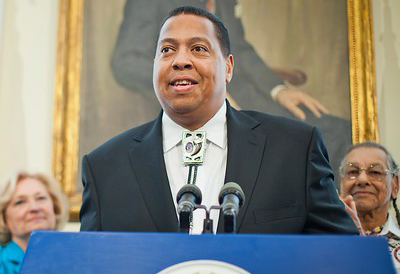
Tribal Chairman Cedric Cromwell, who has for several years led the tribe’s efforts to put land into trust for a $1 billion casino in Taunton, called the action a “hardcore blow.”

He learned of the action by the Secretary of the Interior through a phone call from the Bureau of Indian last week. He told the Taunton Daily Gazette: “It was absurd. It’s like a punch in the nose from a bully.”

This is the most recent in a series of blows the tribe has received in recent years, which included a decision by a federal judge that the previous action by the Obama administration in 2015 putting land into trust for the tribe violated federal law. That was followed by a ruling by the U.S. Circuit Court of Appeals in February that upheld the earlier ruling.

It agreed that the tribe was not under federal jurisdiction as of 1934 when the Indian Reorganization Act was passed. The tribe has a long history, and is acknowledged by most historians to have been the tribe that greeted the Pilgrims when they landed at Plymouth Rock and helped them to get through the first winter.

The tribe has a separate federal lawsuit active against the Interior Department over the issue, which is waiting for oral arguments to be filed.

The tribe has not lost its federal recognition, which was granted in 2007, according to a press spokesman for the department. “On March 19th, the court of appeals issued its mandate, which requires Interior to rescind its earlier decision,” said the department. “This decision does not affect the federal recognition status of the tribe, only Interior’s statutory authority to accept the land in trust. Rescission of the decision will return ownership of the property to the tribe.”

A bill in Congress, supported by the entire state delegation, that would help the tribe by putting the land directly into trust has been passed by the House but is hung up in the Senate. The bill’s sponsor Massachusetts Rep. Bill Keating calls the action political, blaming it on the fact that one of President Trump’s senior communications aides, Mercedes Schlapp, is the wife of Matt Schlapp, a lobbyist for Rhode Island casinos.

Taunton is about 18 miles from Rhode Island, where Twin River Worldwide Holdings operates two casinos. The president also has ties to other Twin River figures, including its president, George Papanier, who worked as a finance executive at Trump Plaza casino hotel in Atlantic City.

The Schlapp connection is also the reason for the bill’s lack of action in the Senate, he said. President Trump has called for no action on the bill, tying it to the presidential campaign of Senator Elizabeth Warren. Schlapp says his advocacy for Twin River played no factor in the president’s opposition.

“This is just a cruel act and it’s hard to understand how someone could act like that at this time,” said Keating.

The move threatens to force the tribe to shut down services, close its police force and require members to pay state taxes. The land is no longer considered sovereign Indian land. It may also spell the final doom of the First Light Casino & Resort the tribe partnered with Genting Malaysia to build, but which never got past site preparations before the federal court order shut down work in 2016. Genting wrote of its investment two years ago and is no longer funding any tribal activity.

Chairman Cromwell has called on Congress to “immediately take up the bill and pass it,” and has asked for face to face meetings with Interior Secretary David Bernhardt and President Trump. He added, “I just want to call out to all of America to rise up. We’re not giving up and this is not the end.”

Massachusetts’s two U.S. Senators, Elizabeth Warren and Ed Markey have pledged to fight the action. They issued this statement: “The Mashpee Wampanoag have a right to their ancestral homeland no matter what craven political games the Trump administration tries to play. Disestablishment of the Mashpee Wampanoag reservation would re-open a shameful and painful chapter of American history of systematically ripping apart tribal lands and breaking the federal government’s word. We will not allow the Mashpee Wampanoag to lose their homeland. We will fight this cruel injustice that promises to have ripple effects across Indian Country.”

Also supporting the tribe is Democratic presidential candidate and U.S. Senator Bernie Sanders of Vermont, who Tweeted “I stand with the Mashpee Wampanoag tribe in their fight to restore lands that belong to them, and I oppose the disgraceful decision by the Trump Administration to disestablish their lands held in trust by the Department of Interior,” adding “We must reset the partnership between the federal government and Tribal Nations by putting land—and control of that land—back in the hands of tribes.”

He also tweeted: “We need a clean Carcieri fix to reaffirm the authority of the Secretary of the Interior to take land into trust for all federally recognized Indian tribes. A Sanders administration will prioritize that.”

Carcieri v. Salazar was the 2009 ruling by the U.S. Supreme Court that tribes recognized after 1934 could not put land into trust.