Author: Casino Connection Staff

Appeals Court Rules Against Harrah’s NOLA

In a 2-1 ruling, the Louisiana First Circuit Court of Appeal recently upheld a 2019 decision by 19th Judicial District Court Judge William Morvant stating the Louisiana Revenue Department had “a clear and unambiguous” right to collect from Harrah’s New Orleans up to $50 million in back taxes dating to 2001.

Harrah’s had claimed in court since 2010 that under a 2001 law, it is exempt from paying to the state sales and occupancy taxes on hotel rooms that are comped or discount to their customers or comped at other hotels. The current room tax is 10 percent, meaning the state would collect $20 on a $200 hotel room.

Harrah’s can request that the three judges reconsider their decision, or it could appeal to the Louisiana Supreme Court. A yet-to-be-scheduled trial will determine how much money Harrah’s actually would owe.

In the appeals court decision, Judges J. Michael McDonald and Wayne Ray Chutz ruled in favor of the Revenue Department. Siding with Harrah’s, Judge Mitchell Theriot stated he did not believe the tax applied when the company comped rooms at hotels owned by others.

Most of the money would go to two state-owned facilities in New Orleans, the Ernest N. Morial Convention Center and the Louisiana Superdome Commission, and also to the state treasury. If Harrah’s had been paying the tax, the two entities and the state together would collect an additional $2 million to $3 million annually.

William Hill Opens First Arena-Based Sportsbook

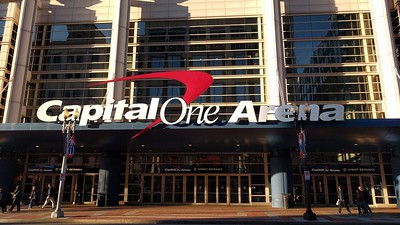
The Capital One Arena in Washington, D.C. is dark these days—no hockey, no basketball and no concerts, due to the coronavirus pandemic.

But on August 3, some light penetrated the darkness when William Hill U.S. opened a temporary sportsbook inside the arena, the first of its kind in the country. A permanent sportsbook could be in operation by late November.

“We always had a vision of a fully operational sportsbook,” said Jim Van Stone, president of business operations and chief marketing officer for Monumental Sports & Entertainment, which owns the Washington Wizards NBA team and Washington Capitals NHL team.

The temporary book will welcome bettors from 11 a.m. to 11 p.m. There won’t be any seating, just one line for the seven betting windows and one line for the nine kiosks at the box office. TVs above the betting windows will display the odds and point spreads for pro and college sports, according to the Washington Business Journal.

The permanent sportsbook will include a restaurant, bar and the obligatory walls of televisions. That two-story space expects to be open 10 a.m. to 2 a.m. every day, with access to F Street and the arena, Dave Grolman, president of retail operations for William Hill U.S., told GGB News.

“We’ll have great lounge seating up on the second floor, and we hope that the restaurant itself will serve as a first-class restaurant, not just a place where’d you go to get wings,” he said. “During game days and certain in-arena events, ticketed and non-ticketed fans will have access to the sportsbook.”

Complexes like the Capital One Arena can cost billions to develop and are dark a lot of the time. The sportsbook will take the arena from a four-hour location on game days to a 365-day destination, whether the Wizards or Springsteen are in the house or not. “It’s a destination that brings many more people to the complex,” Van Stone said.

American Wagering Inc., the Las Vegas-based William Hill subsidiary, partnered with Capital One Arena on the sportsbook.

“Our experience and brand recognition is what fans trust and seek out when placing bets on their favorite teams and players,” Grolman said. “We’re excited to bring that experience to the District. For William Hill, it’s about the relationship with Monumental Sports and being first in the marketplace.”

The arena hosts around 230 events a year. While the sportsbook will keep a presence in the building every day, arena officials expect to be more than passive landlords for the sportsbook.

“We want to really take advantage. We’ll work with William Hill to create new opportunities,” Van Stone said. Those opportunities may involve broadcasting Premier League games on Saturday and Sunday morning.

Success at Capital One should open up opportunities elsewhere, but don’t expect a similar setup in New Jersey or Pennsylvania, as neither market can legally put a sportsbook into a venue like the Capital One Arena. The Wells Fargo Center in Philadelphia has a gaming lounge, but no betting windows or kiosks are included in those spaces.

Illinois is a different story.

Under the Illinois Sports Wagering Act, master sports wagering licenses are available to as many as seven sports facilities with a seating capacity of over 17,000 persons. The decision to permit sportsbooks at sports facilities was a public policy determination made by the Illinois General Assembly, said Gene O’Shea, a spokesman for the state gaming board.

Once licensed, such venues may operate sports wagering kiosks or wagering windows inside the arena or stadium or at a location within five blocks of the facility.

Wrigley Field and United Center in Chicago have considered putting sportsbooks on site or near the venues, multiple sources told ESPN.

Sports Betting: Where Do We Go From Here?

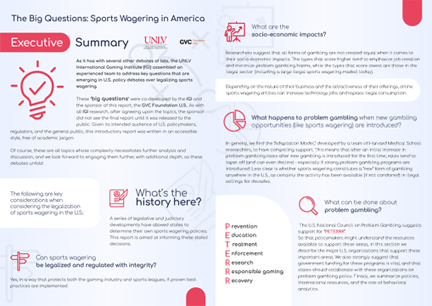
A series of judiciary and legislative developments have allowed states to determine their own sports wagering policies. The UNLV International Gaming Institute has published a report aimed at informing these states’ decisions, which can be found here (report) and here (infographic).

The 33-page assessment, “The Big Questions: Sports Wagering in America,” poses and answers a broad range of questions faced by legislators and regulators. These include:

  • Can sports wagering be legalized and regulated with integrity?
  • What are the youth gambling impacts?
  • In jurisdictions where sports wagering and/or online gambling is not legalized, what happens in the illegal marketplace?
  • Overall, what are Americans’ perceptions of gambling?

The study was sponsored by GVC Foundation U.S., a nonprofit dedicated to promoting responsible gambling and sports integrity. The major questions set down in the report were co-developed by the IGI and GVC Foundation U.S. GVC will not see the report until it is issued to the public, ensuring academic and research integrity. The research team anticipates more detailed reports as these issues evolve.

“Our goal in drafting questions for the study was to highlight all major aspects of sports betting–the good, the bad and the ugly,” said Martin Lycka, Trustee of GVC Foundation U.S. and director of regulatory affairs for GVC Holdings. “For sports betting to be the fun, safe, and well-structured enterprise that it’s meant to be, our industry needs to commit to honestly presenting its unique components to all regulators and legislators alike.”

“We expect to see a surge in the popularity of sports betting as the U.S. acclimates to this ‘new normal.’ As researchers, we want to ensure that this industry is regulated in a way that fosters the socio-economic benefits of gambling while minimizing its harms,” said Bo Jason Bernhard, executive director of UNLV IGI. “As always, the IGI seeks to shed academic light on the major debates of the day, bringing together our ‘dream team’ of experienced and multi-disciplinary thinkers to weigh in on the big questions. Today, U.S. policymakers can rely on an independent evaluation that covers a range of key issues, thanks to this first-of-its-kind report.”

Also participating in the study were Jennifer Shatley, an experienced responsible gaming executive with a 22 year career background involving extensive leadership progressing responsible gaming policy and former vice president, responsible gaming policies and compliance for Caesars Entertainment; and Alan Feldman, the chairman of both the International Center for Responsible Gaming as well as the Nevada Advisory Committee on Problem Gambling, and a former longtime executive with MGM Resorts and Mirage Resorts.

IGT, FanDuel Sign Sports Betting, iGaming Agreement

International Game Technology Plc. announced that it will boost its momentum in the growing U.S. sports betting market through a multi-year agreement with leading sports betting and iGaming provider FanDuel Group.

Under the terms of the agreement, IGT’s PlaySports platform will power all of FanDuel Group’s new and existing retail FanDuel Sportsbooks across the U.S. through September 2024. Additionally, FanDuel Group agreed to offer IGT PlayDigital’s PlayCasino games in states where FanDuel Group online casinos operate.

The multi-year agreement builds on IGT and FanDuel Group’s successful technology partnership that currently extends across nine U.S. states and includes the FanDuel Sportsbook at Meadowlands Racing and Entertainment in East Rutherford, New Jersey, the country’s highest-volume sportsbook. The agreement also expands the distribution of IGT PlayDigital’s PlayCasino games that span slots, blackjack, roulette and more.

FanDuel Group is currently leveraging top-performing IGT PlayCasino games such as Wheel of Fortune Triple Extreme Spin, Triple Red Hot 7s Free Games and Red Hot Tamales! within its mobile wagering apps and websites in New Jersey and Pennsylvania.

“IGT’s PlaySports platform has been integral to FanDuel Sportsbook’s expansion in the U.S., as we currently leverage it to power America’s #1 Sportsbook,” said Matt King, FanDuel Group CEO. “IGT is the strategic partner that we will lean on to help us expand our retail footprint across the U.S.

“IGT’s PlaySports platform enables us to create an intuitive, technologically driven customer experience at our world-class retail sportsbooks for our customers, while its PlayCasino content enables FanDuel to deliver premium mobile casino entertainment in new and existing markets.”

“IGT’s multi-faceted, multi-year PlaySports platform technology and iGaming content agreement with FanDuel Group pairs the leading content and B2B sports betting provider with one of America’s most respected sports betting operators to propel an already winning partnership to new levels and create an abundance of opportunity for both parties,” said Enrico Drago, senior vice president of IGT PlayDigital. “IGT and FanDuel Group are positioned for continued success in the U.S., and we are committed to fueling FanDuel Sportsbooks’ sustained growth through our proven, market-ready platform, player-preferred game content and self-service betting technologies.”

Since 2018, IGT and FanDuel Group have together achieved a range of significant performance milestones such as:

  • Launching FanDuel Retail Sportsbooks in eight U.S. states, including New Jersey, New York, Pennsylvania, West Virginia, Iowa, Indiana, Michigan, and Mississippi;
  • Launching online sportsbooks in five U.S. states, including New Jersey, Pennsylvania, West Virginia, Indiana and Colorado;
  • Operating the largest-volume retail sportsbook in the U.S. at Meadowlands Racing and Entertainment in East Rutherford, NJ.;
  • Deploying more than 200 IGT PlaySports self-service kiosks at FanDuel Sportsbooks across the U.S.; and,

Leveraging high-performing PlayCasino slot and table games to fuel FanDuel’s mobile casinos in New Jersey and Pennsylvania.

Pequot Chairman Calls for Connecticut to End Sports Betting Delay

Mashantucket Pequot Tribal Chairman Rodney Butler is calling on Connecticut legislators to remove obstacles to sports betting at tribal gaming halls in the state.

Butler says Governor Ned Lamont and other officials are dragging their feet because they don’t want the two tribes to have a monopoly on sports betting, which is already legal in Rhode Island and New York State.

Butler maintains that $80 million in revenue could be generated from sports betting in the state. He argues that after discussing the issue for three years, it’s now time for lawmakers to act.

Only Foxwoods and Mohegan Sun offer gaming in Connecticut. Both been given the go-ahead by the state to build a third commercial casino in East Windsor, but due to a ferocious rear-guard action by MGM Resorts, that has so far not been built.

The issue of sports betting has become entangled with efforts to build a commercial casino in Hartford, the state’s largest city.

The tribes insist that their existing state tribal gaming compacts, originally signed in 1991, guarantees their monopoly on any form of gaming, including sports betting. Butler says if the state breaches that agreement, both tribes can withhold their 25 percent payments of slot revenues to the state.

Lamont and the tribal chairmen have met a number of times to try to work out an agreement; some see the upcoming special legislative session in September as a possible opportunity to reengage.

Tensions between the tribes and Lamont rose in June when the casinos reopened despite Lamont’s misgivings. Butler wants to set all that aside and come up with a workable agreement that will put money into both state and tribal coffers.

Illinois’ Third Sportsbook Opens; Adds More Licenses

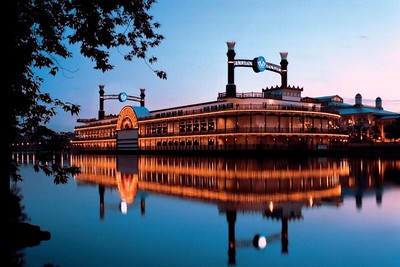
The third sportsbook in Illinois recently opened at the Grand Victoria Casino in Elgin, in partnership with William Hill U.S.

Grand Victoria Senior Vice President and General Manager Bill Gustafson said, “Partnering with the country’s leading sports betting operator allows us to offer our customers an elevated experience that features industry leading wagering and technology. The sportsbook is in a prime location that will draw sports fans in and keep them engaged as they cheer on their favorite teams.”

The William Hill Sportsbook accepts bets daily from 10 a.m. to 10 p.m. It features three full-service ticket windows, although just two currently are open to comply with social distancing guidelines, Gustafson said. The area offers several high-top tables, comfortable seating and numerous televisions.

William Hill’s application to offer mobile sports betting is pending with the Illinois Gaming Board.

William Hill’s management of the Elgin sportsbook is part of a larger partnership with Caesars Entertainment, which now operates Grand Victoria. Caesars officials said plans call for expanding sports wagering at Caesars properties nationwide.

Rivers Casino in Des Plaines was the first in Illinois to open a brick-and-mortar sportsbook, followed by Argosy Casino in Alton. Rivers launched its sports betting app in June. All 10 Illinois casinos were closed in March due to Covid-19, and allowed to reopen in July.

Other casinos awaiting regulatory approval to operate sportsbooks include the Hollywood Casinos in Aurora and Joliet, Par-A-Dice Casino in East Peoria and Casino Queen in East St. Louis.

The Elgin sportsbook is William Hill’s first Illinois operation. The company came to the U.S. in 2012 and now manages 113 sportsbooks in Nevada plus others in Indiana, Iowa, West Virginia and New Jersey.

Also last month, the Illinois Gaming Board issued its eighth master sports wagering license, this one to Hawthorne Race Course. The track, just outside of Chicago, has partnered with PointsBet as its sportsbook operator. The board issued a temporary operator permit to PointsBet at the same meeting, according to Sports Handle.

The Hawthorne license means six casinos and racetracks will seek to become the third sportsbook to accept bets in Illinois, joining Rivers Casino, which runs BetRivers Sportsbook and the Argosy.

Hawthorne will be the first racetrack to put off-track betting sportsbooks in play. Illinois law allows three OTBs designated for sports betting by each track.

“The PointsBet team is thrilled to hear the good news that our partners at Hawthorne Race Course received a 4-year master sports wagering license. “We’ll soon unveil our retail and mobile product for sports fans in the state of Illinois,” PointsBet USA CEO Johnny Aitken said.

Track President and CEO Tim Carey praised Hawthorne’s long presence in the state—next year will mark its 130th anniversary, making it the oldest sporting venue in the state—and stressed the importance of the casino to help the sagging fortunes of horse racing. “It means horsemen will be able to keep their businesses and families in Illinois.”

In related news, DraftKings has rebranded the Casino Queen in East St. Louis, changing the name to DraftKings at Casino Queen. DraftKings became the second mobile/online sports betting app to go live in the state, joining BetRivers, which launched its app on June 18. PointsBet expects to go live by month’s end.

“Illinois is home to some of the most passionate sports fans and most iconic sports teams in the entire country,” said Jason Robins, DraftKings co-founder and CEO, in a press release.

Argosy at Alton, also in suburban St. Louis, has not yet gone live with its mobile app.

William Hill U.S. added its 10th state when it opened a sportsbook August 3 on the Grand Victoria riverboat casino in Elgin, Illinois, according to Legal Sports Report. The locale also marks the first since Eldorado Resorts acquired Caesars Entertainment in July, keeping the Caesars name. Last year, Eldorado acquired a 20 percent stake in William Hill U.S. in exchange for a 25 year-deal to run sportsbooks at the company’s casinos.

The Grand Victoria sportsbook, near the main casino floor, features three full-service ticket windows, high top tables and a seating area with TVs, according to CDC Gaming Reports.

PointsBet Storms Colorado Sports Arenas

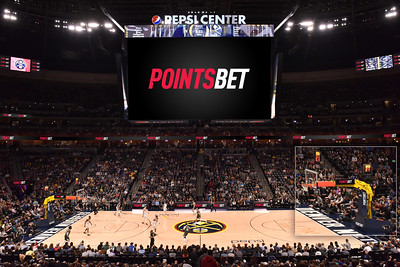
Global sportsbook operator PointsBet and Kroenke Sports & Entertainment have announced their entrance into a new, multi-year partnership making PointsBet the official and exclusive partner of the Denver Nuggets of the National Basketball Association, Colorado Avalanche of the National Hockey League, Colorado Mammoth of the National Lacrosse League, and their home arena, Pepsi Center.

The agreement includes retail and online sports betting, daily fantasy, online casino and free-to-play games. As part of the deal, PointsBet has also been named an official sports betting partner of KSE’s Altitude TV and Altitude Sports Radio, which will feature PointsBet data integration.

“PointsBet is renowned within the gaming industry for product innovation and its unique PointsBetting product, as well as for having the fastest app in the marketplace,” KSE EVP & Chief Operating Officer Matt Hutchings said. “Sports fans are hungry for the added dimension that fantasy sports and gaming add to their experience. We know that Nuggets, Avs, and Mammoth fans will be excited to have the opportunity to engage more deeply with their favorite teams via PointsBet.

“PointsBet demonstrated just how much they value Denver and the Rocky Mountain Region when they chose to locate their United States headquarters here in Colorado,” Hutchings said. “They recognize, as do we, that Denver is a fast-growing and dynamic city home to some of the most passionate sports fans in the world.”

Johnny Aitken, CEO of PointsBet USA, said, “It was instant from day one there were shared values between the Kroenke Sports & Entertainment team and PointsBet, with a clear focus for putting our fans and customers first. We’ve long stated that our goal is to become synonymous with Colorado sports betting, and this exclusive partnership with our hometown teams in the Denver Nuggets, Colorado Avalanche and Colorado Mammoth, plus premium entertainment spaces within their playing arena, is a momentous step in that process.”

As part of the multi-year deal, KSE will unveil a new in-arena destination at Pepsi Center to be live for the 2020-21 seasons, featuring three distinct areas: the PointsBet Sports Bar, an outdoor patio extension of the PointsBet Sports Bar, and the PointsBet Premium Club. Pepsi Center’s club level will also undergo a rebrand for the 2020-21 seasons, now to be called the “PointsBet Club Level” featuring signage from the sportsbook, brand ambassador placements, and more. KSE will also unveil significantly enhanced in-arena WiFi for the 2020-21 seasons, complementing PointsBet’s market-leading speed and ease of use across every customer touchpoint within the PointsBet app.

The partnership will be bolstered with the release of the KSE mobile app, designed to improve the experience of planning and attending an event at Pepsi Center. Though not yet available in the state of Colorado, PointsBet is expected to soon release its market-leading sports wagering app for sports bettors within the Centennial State.

PointsBet recently began construction on its flagship U.S. headquarters based in downtown Denver. The operator will also have a retail presence at the Double Eagle Hotel & Casino in Cripple Creek.

Four Winds Sportsbooks in Michigan Open

With major league U.S. sports back in play, it’s a good time for the Pokagon Band of Potawatomi and its Four Winds Casinos in Michigan to initiate new sportsbooks.

Four Winds partnered with Kambi Group to offer the sportsbooks at properties in New Buffalo, Hartford and Dowagiac.

“One of the reasons we partnered with Kambi is to simplify the wagering process through its ‘bring-your-own-device’ program, which will enable guests to use their smartphone to start the betting process,” said Frank Freedman, chief operating officer of Four Winds Casinos.

Guests can use a smartphone camera to scan a QR code to get to the betting website. After making their wagers, bettors receive a new QR code to bring to the sportsbook counter in New Buffalo, or to guest services in Hartford and Dowagiac. The QR code will then be scanned and the bets placed.

Visitors can also bet at one of the 18 kiosks at the New Buffalo location, or one of six kiosks at both the Hartford and Dowagiac casinos, according to Northwest Indiana Times.

Manchester Track to Close, Victim of Covid-19

Arena Racing Company (ARC) has confirmed the closure of Belle Vue Greyhound Stadium.

The closure of the Manchester track is nothing unexpected since a Manchester Planning and Highways committee approved proposals to close the stadium and use the site for housing.

“The closure of Belle Vue Greyhound Stadium has been an incredibly difficult one to make, especially given the history associated with the stadium,” Director of ARC Racing Division Mark Spincer said.

The lockdown as a result of the coronavirus pandemic, coupled with racing without fans, proved too much for the historic stadium, according to SBC News.

“We will continue to provide welfare support payments to the remaining Belle Vue trainers not currently racing at other stadia until the end of September, and assist with any homing requirements during that time,” Spincer said.

Everi, ROAR Digital Deliver Games in New Jersey

Everi Digital, the online gaming division of gaming supplier Everi Holdings Inc., announced that it has partnered with ROAR Digital LLC, a joint venture created by MGM Resorts International and GVC Holdings Plc., to launch three of its longtime player popular three-reel mechanical titles on Borgata Online Casino, BetMGM and Party Casino New Jersey.

Smokin’ 777, Meltdown and Double Ruby are available for play now in online real-money gaming in New Jersey. In addition, Everi Digital will launch Hot Spot 777, an exclusive title for GVC Holdings Plc. this month. Additional titles are expected to follow this initial launch.

“At Everi, we consider ROAR Digital to be a leading premiere operator, and this partnership is another significant milestone for our digital business,” said David Lucchese, executive vice president, sales, marketing and digital for Everi. “It enables us to introduce our world-class gaming content to more online players and expands the footprint of our proprietary, state-of-the-art remote game server (RGS).

“This move further strengthens the deep relationship with MGM Resorts International, GVC and ROAR that already exists with our games, digital and fintech businesses.”

“We are excited about the opportunity to deliver some of the industry’s best-performing land-based titles to our gaming titles for online play in New Jersey courtesy of Everi Digital,” said Matthew Sunderland, ROAR Digital’s vice president of gaming. “Our integration with Everi’s RGS will enable us to seamlessly add Everi’s compelling gaming content to our online gaming platform, which in turn helps us bring new and exciting gaming experiences to our existing and growing customer base.”

Maryland Considers iGaming Expansion to Offset Covid Losses

Maryland lawmakers heard arguments last week from the head of the state’s gaming agency last week on whether an expansion of gaming can address budget deficits growing from the effects of the Covid-19 pandemic.

Gordon Medenica, director of the Maryland Lottery and Gaming Control Agency, testified before the state House Ways and Means Committee that iLottery and online gaming could go a long way to address slumping revenue due not only to casino closures, but to the closures of the state’s bars and restaurants, which account for a significant portion of lottery ticket sales.

With casinos, bars and restaurants closed between March 16 and late June, and open since then at 50 percent capacity, gaming contributions are already down 27.3 percent compared to 2019. “I think we have to accept a long-term lowering of our expected casino contributions,” Medenica told the panel.

“There really is just no place else for people to spend some discretionary entertainment dollars,” he said. “We think that has translated into people who, locked at home, have decided—especially on instant scratch-off tickets—when they’re in the grocery store, to pick up a few.”

Medenica said other states have turned to online lottery sales and online casino games to bridge at least some of their revenue gap. “Those states (that) offer iLottery have seen their iLottery sales absolutely explode,” he said, adding that lawmakers’ concerns that online lottery sales will hurt brick-and-mortar lottery sales have proven unfounded.

“From all the experience everyone’s had with iLottery, it doesn’t hurt bricks-and-mortar sales,” Medenica said.

Gaming Innovation Group Receives NJ iGaming License

Gaming Innovation Group (GiG) announced that its subsidiary iGaming Cloud Inc. has been granted a permanent casino service industry enterprise license (CSIE) from the New Jersey Division of Gaming Enforcement.

The application was filed in June 2018, and GiG has supported Hard Rock International’s casino operations in New Jersey under a so-called transactional waiver pending the final approval.

The license is granted for five years, and gives GiG a permanent license to provide its real-money online casino platform solution to operators in New Jersey.

“We are delighted to receive the CSIE license after a long and comprehensive process,” said Richard Brown, CEO of GiG. “This is a great achievement for GiG and gives us a solid confirmation that our platform, procedures and operations are meeting the highest standards out there.”

Gaming Innovation Group is a technology company providing solutions, products and services throughout the entire value chain in the iGaming industry. Founded in 2012, the company’s vision is “to open up iGaming and make it fair and fun for all.”

Gaming Innovation Group operates out of Malta, and is dual-listed on the Oslo Stock Exchange under the ticker symbol GIG and on Nasdaq Stockholm under the ticker symbol GIGSEK.

GameCo Launches Interactive Division

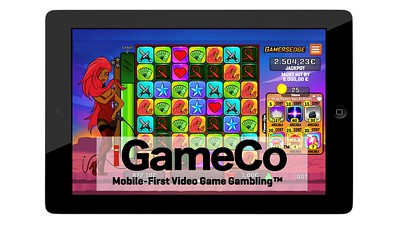
GameCo LLC, supplier of the skill-influenced Video Game Gambling Machine (VGM), announced the launch of iGameCo. The new iGameCo division and brand highlights the company’s activities across esports betting and skill-based iGaming for regulated mobile casinos and sportsbooks across the United States and abroad.

The iGameCo division launches with three synergistic offerings: skill-based iGaming, esports betting, and Freeplay Gambling. The company holds gaming licenses in almost 30 global gaming jurisdictions and with industry-leading expertise in integrating video games and esports in the land-based casino market.

iGameCo is planning to release skill-based iGaming products across many player-favorite categories, spanning Match 3, spot the difference, and sports. The company has already established distribution agreements with industry leaders such as ReelPlay and G.games, for broad release of iGameCo games. A steady slate of new games will be offered by iGameCo through the remainder of 2020 and beyond.

Through its partnership with ReelPlay, led by former senior executives from the NYX/SG Digital business, iGameCo will release games to top online casinos in Europe. iGameCo has also partnered with G.games, formed by the merger of Gluck and Gamevy, a multi-award winning games supplier focusing on highly entertaining and innovative games.

In addition to online Video Game Gambling, iGameCo offers the only full-service esports betting solution specifically built for the North American sports betting market, the company said.

“With the increased interest in esports wagering, iGameCo combines the premiere esports data platform created by Berlin-based GRID with a desktop and mobile front-end and offers odds and trading for regulated esports betting,” the company said in a press release. “GameCo provides all the necessary tools for sportsbooks and casinos to capitalize on the growth of esports wagering, which is estimated to generate $17 billion in handle in 2020.”

Wagering on professional esports is currently legal in at least seven U.S. jurisdictions and expect that number to rise as sports betting becomes legal in more jurisdictions. iGameCo has several partnerships and programs that will be announced in coming weeks.

“iGameCo is the culmination of years of research and development in combining video games and esports for regulated casinos, and we’re proud to bring our leadership in land-based Video Game Gambling to digital casinos and sportsbooks,” said Blaine Graboyes, cofounder and CEO of GameCo. “We invented the first-ever skill-based games for retail casinos, and now we’re expanding the category to bring this experience to regulated gaming markets worldwide, providing casinos with the products to attract and monetize the next generations of customers.”

GameCo recently received a Casino Service Industry Enterprise License from the New Jersey Division of Gaming Enforcement, allowing the company to bring its portfolio of esports betting, skill-based iGaming, and Video Game Gambling products to New Jersey casinos and sportsbooks. GameCo is also licensed in Nevada and other leading regulated markets in North America and Europe.

Gural Wants Facetime with Cuomo

Jeff Gural, chairman of American Racing and Entertainment, which owns two New York casinos, says he’s “healthy, but relatively miserable on every other account.”

Gural attributes his misery to the ongoing closure of Vernon Downs Casino Hotel in Vernon and Tioga Downs Casino Resort in Nichols, as well as his inability to get a sit-down meeting with New York Governor Andrew Cuomo. Gural said he needs just a few minutes with Cuomo to persuade him to reopen commercial casinos in the state (horse racing is offered at Vernon Downs twice a week, without spectators, but the casinos are closed).

It’s especially frustrating, he said, since the Oneida Indian Nation’s three casinos in Central New York have been open since June 10 and the Seneca Nation’s three Western New York casinos and other gaming halls have also opened. Lakeside Gaming in Union Springs, run by the Cayuga Nation, has been open since the middle of May.

Of his two properties, Gural said it’s more important to reopen Tioga Downs because it’s a destination. “We’ve been unable to convince the governor that it’s actually safe. We don’t disagree with the governor’s concern about not having a spike in opening things up, but as you know, we have not seen that elsewhere—including in New York City.”

In fact, Gural said, New Yorkers would be better off patronizing local casinos than traveling out of state to Mohegan Sun in Connecticut or one of the nine reopened casino properties in Atlantic City. “Those testing here are testing positive at half a percent. I’m sure it’s higher at Wilkes-Barre (home of Mohegan Sun Pocono) and Atlantic City.”

New York State “has full control over what we’re doing, and no control over the Indian casinos. I’m fully convinced we’re safer, but haven’t been able to convince the governor, who has gotten the numbers down. It’s problematical.”

He welcomed strict safety measures, and said he would abide by them to the letter. “The gaming commission (would have) people on the floor at all times. If we were to agree to masks and close every other slot, they would be monitoring that. If we had people without masks, they would go to the security people and have them escorted out.

“We would assume if we could open, it would be with maybe 50 percent capacity, higher cleaning, taking temperatures and restricting people from states that are on the governor’s list of dangerous places. And eliminate people from counties with spikes.”

Not only has he been stonewalled by the governor, Gural said he’s had no response from anyone in the Cuomo administration. “We’re flying blind. If you’re not going to let us open, that’s one thing. But at least let us know what we have to do to reopen. It seems hard to say it makes any sense when Vernon Downs is closed and Turning Stone, which is five miles away, is open.”

One of his strongest arguments in favor of reopening, he said, would be the livelihoods of the 12,000 casino and racino workers whose jobs hang in the balance. “They’re going to be in trouble, because they’re going to stop getting the $600 payments starting (this) week.”

In keeping with the federal WARN Act, Gural has sent out advance notice of layoffs that might last more than six months. He’s continued to pay his employees, and said he’s not threatening to close, though he recently told the Utica Observer, “At some point, we run out of money.”

“It would really be a last resort to close permanently,” Gural told GGB News. Ironically, he added, his “one ray of hope” is that the state is “broke. Really broke. The economic damage to New York has been catastrophic.”

Not surprisingly, he’s a proponent of mobile sports betting, which would be “a big boost” to the state’s commercial casinos, including Rivers Casino Resort in Schenectady, Resorts World Catskills in Monticello, and Del Lago Resort & Casino in Waterloo.

“It doesn’t make sense to force people living in New York State to either bet illegally or go to New Jersey,” he said. “We’re asking for a lower tax rate because we’re competing with tribal casinos. We pay a much higher tax rate on slots than tribes and they pay nothing on table games. We’re competitively disadvantaged.” Commercial casinos pay 10 percent on tables and between 37 percent and 45 percent on slots.

Gural insists that he supports the governor. “Health comes first. If we thought we couldn’t open safely, we wouldn’t open, but we see casinos open all around us and we haven’t heard of major problems. I think that people who wear masks and sit in front of a slot, the chances are pretty slim” that they will become infected.

He added, “The truth of the matter is that Turning Stone has been open for six weeks and we have not seen any spike in that area, and we know our customers are going there. I think if we could get a face-to-face with the governor we could convince him, but we haven’t been able to do that.”

Borgata Last Atlantic City Casino to Reopen

Borgata Hotel Casino & Spa has long been at the top in gaming revenue in Atlantic City, but it was last to reopen after the coronavirus shutdown. Other properties in the city came back to life in time for the July 4th weekend, but Borgata pushed its reopening to July 6 after New Jersey Governor Phil Murphy postponed resumption of indoor dining.

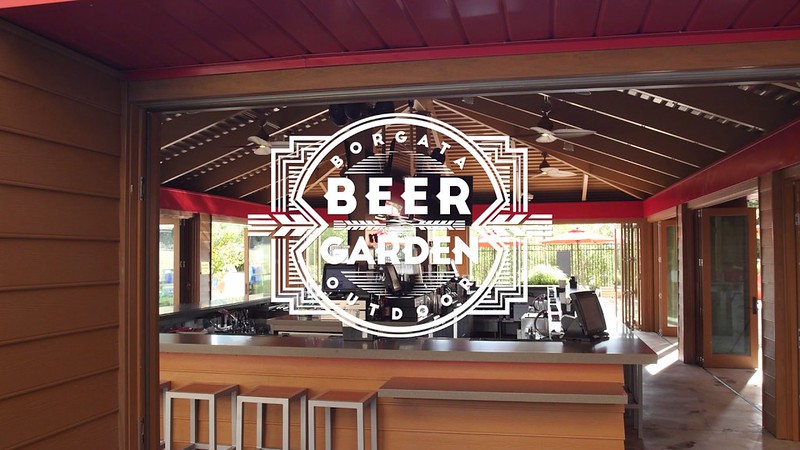
The delay gave the property a chance to add outlets such as the Borgata Beer Garden, next to an outdoor pool, Borgata Street Eats, with its taco truck and tent seating, and the SunBar at the Water Club. The property also converted its indoor pool into a player’s lounge with outdoor seating. In-room dining as well as take-out from some of the existing outlets round out the food and beverage options.

“We took the time to reassess and strategize, and what we’ve come up with—I have to give kudos to the food and beverage department—what we have right now to offer our guests is amazing,” President and Chief Operating Officer Melonie Johnson, who assumed her new role in the middle of the pandemic, told the Press of Atlantic City.

As with the other casinos in town, Borgata is operating at 25 percent capacity with strict protocols for guests and staff. The hotel has limited room availability with only an outdoor pool.

Despite the four-month closure resulting from Covid-19, Borgata will recover, said Johnson, who joined MGM in 2015 in Tunica, Mississippi before leading National Harbor in Maryland. When she arrived at Borgata, she had never met her employees in person, but Johnson knew workers were worried about their futures.

“It’s like, how are we going to open this business,” Johnson told CNBC. “We can’t just be dollar-focused … All businesses are in business to make a profit, but right now we’ve got to put humanity first.”

Free Rounds for Jersey

There are thousands of devotees to iGaming sites who also have been going to live casinos for years, and have grown to appreciate the perks and rewards they get through slot clubs. Luckily, technology has enabled many of those same features for online players.

One of the most recent is Free Rounds, a program launched early this year in New Jersey that delivers the normal “signing bonus” offered for registering on a site in a way that will be familiar to those longtime slot-club members. Free Rounds are the online equivalent of “free play,” the “free” spins that appear on a casino slot as promotional credits on the game—here used as varying numbers of free spins on a given online slot game.

It is part of the “OpenGaming” online casino suite provided by SG Digital, a division of slot-manufacturing giant Scientific Games. The OpenGaming Suite, or OGS, is a platform that feeds games not only from SG Digital (Bally, WMS, Shuffle Master) but from a lineup of “third-party” manufacturers as well. That means the Free Rounds feature is available on any of a large library of slot titles.

The OpenGaming Suite generates not only signing bonuses but instant jackpots, tournaments and other promotions that bring some features of traditional casino slot clubs to the iGaming realm. Some operators allow players to pick their favorites from the large game library, but the versatility of the technology means operators can use Free Rounds in any number of promotions, and even can tie the feature into their casino slot clubs.

“The genesis of Free Rounds is as one of many features that SG Digital’s OpenGaming product suite offers,” said Robert Hays, SG Digital’s vice president, commercial for the Americas, in an interview with iGaming Player. “Our OpenGaming system offers functionality to deliver our proprietary content directly to operators, but also as an aggregator of third-party content.

“Lastly, it’s built within a framework that provides additional features and functionality to games served through that distribution—specifically, free rounds, missions, jackpots, tournaments, and so forth. That’s really the basis for Free Rounds and free spins—a feature of our OGS OpenGaming system offering.”

Hays added that in addition to operators already using the OpenGaming system to fuel their online game offerings, others are able to tap into both the games and features such as Free Rounds through an integration with the SG Digital system. That translates into an increasing number of New Jersey sites offering Free Rounds and other OpenGaming features.

“Golden Nugget (goldennugget.com) has been very active in utilizing this tool for several weeks,” said Hays. “Resorts (mohegansuncasino.com, pokerstarscasinonj.com) is using the functionality as well, and we have numerous operators that are in some level of integration, user acceptance or actual deployment of the feature. We’ve got an anchor with some key operators in New Jersey, and we’re expanding rapidly across the network.”

One-Game Welcome

According to Hays, Golden Nugget is among several casinos using Free Rounds as a welcome bonus, at the same time promoting a specific game. “For any new player coming to their site that would like to register, the Free Rounds are awarded (to Golden Nugget players) specifically around the game 88 Fortunes, as the welcome bonus,” he said. “It’s a matter of just registering.”

Hays said the idea with Free Rounds was to provide something different than some variation of a matching amount for a certain deposit as a signing bonus. The Free Rounds feature, he notes, actually introduces the player to a site with a little fun, through actual game play that can result in winnings without having to make a wager.

“It allows the player to have a user interface/user experience with the actual site, if they’re new,” said Hays. “And it also allows them to actually experience the game. Rather than coming in with a welcome bonus and then getting into the casino lobby and hunting and pecking trying to decide which game you want to play, in this case, the operator can take what they think is compelling content, put a Free Round welcome bonus around it, and then the player can use those Free Rounds on that game, which not only highlights the actual user experience with the site, web or mobile, but also the actual game.”

Hays says most of the operators are using the Free Rounds to promote a specific game or specific set of games. “It’s up to the operator, and often it will vary by segment of player, because it’s not just a player acquisition tool; it can be a retention and reactivation tool as well. You may have segmented your player from what I call a standard player to a gold to a VIP player, and a set number of Free Rounds. The quantity of Free Rounds would vary based upon that segment, based on those player behaviors.”

He said the Free Rounds used as sign-up bonuses—ranging from five to 20 free spins, typically—can also be used to build player loyalty much in the same way as traditional slot clubs. Particularly where the OpenGaming system is tied to back-end systems such as the casino management system that fuels the slot club, Free Rounds can appear as rewards for achieving various play thresholds.

The technology is brand-new, so it’s likely to evolve. “I don’t think the current utilization is where you can accumulate Free Rounds and then use them at your leisure, which is much more akin to free play, but Free Rounds could be made available based on player behavior and activity,” Hays said. “It would be a more event-driven or independent-type offering, as opposed to accumulating and building spins akin to free play on the land-based side.”

Hays says new uses of the technology are likely to appear soon. “The level of integration that a game supplier or operator would have with our OGS environment would dictate, even right now, how robust the feature functionality would be,” he said. “Plus, as part of our core development roadmap, we’ll continue to refine the Free Rounds functionality to make it as robust as possible.”

One advantage SG Digital has in adding new features to Free Rounds and the OpenGaming Suite in general is that the company already has a longtime proving ground in the form of European and British iGaming operators. “In our case, we’re fortunate, because we’re a global operator, that we can take learnings from the European market—the U.K. and Europe—where Free Rounds are used at a very high level of frequency by almost all operators,” he said. “We get what we learn from our global engagement and bring those (features) into product development, and then they re-emerge as an enhancement, or possibly a new feature (in the OpenGaming Suite).”

Those enhancements will be even more robust when the system is linked to an operator’s established slot system, which in the future could lead to enhancements such as a player’s known favorite game popping up as the Free Rounds signing bonus. “When you’re looking to have a single view of the player across both online and brick-and-mortar channels, it comes from an integration of our platform to back-of-house,” said Hays, who says this allows operators to tailor promotions to specific players.

The OpenGaming Suite is being utilized in different ways by various operators, with many running several promotional campaigns a month on their sites, according to Hays.

“Of course, we’re constantly working with our operators to figure out the best ways to promote engagement around our content, and certainly Free Rounds is one of those tools,” Hays said.

It’s a tool that’s still in its infancy. More to come.

Global Payments Installs iGaming Solution in NJ

On July 27, Global Payments Gaming Solutions  announced that Wynn Resorts Ltd. had installed its suite of iGaming solutions for use in the New Jersey online gaming market.

The installation will allow Wynn Resorts to enable a multi-channel approach with capabilities such as online casino and sports betting.

The suite of iGaming solutions leverages Global Payment Gaming Solution’s VIP LightSpeed platform to connect the online and brick & mortar gaming experiences, making cash advance and e-check much easier; and the VIP Preferred e-check network to enable guests to quickly access funds from their checking account in a seamless, frictionless manner.

“We are seeing increased interest in iGaming both by guests looking to game from the comfort of their homes, and by governing authorities who want to ensure social distancing measures are adhered to,” said Christopher Justice, president, Global Payments Gaming Solutions. “By leveraging our technology, Wynn Resorts is creating an innovative, multi-channel gaming environment which provides guests with more choices in how they prefer to game.”

Global Payments Gaming Solutions, a division of Global Payments, enables the world’s gaming entertainment leaders to create amazing consumer experiences and maximize spend across all of their physical and digital properties. Its complete suite of payment solutions enables safe, secure and trusted cash access at the cage, on the casino floor, or online.

Learn more at www.globalpaymentsgaming.com.

Las Vegas Faces Uphill Battle to Recovery

Covid-19 is taking a brutal toll on gaming nationwide, but it’s dealing out a special kind of pain on the tourism- and convention-dependent Las Vegas Strip.

This was clear from last week’s release of the first official tally of gaming revenues since Nevada’s casinos began reopening on June 4. For those 27 days, North Las Vegas and the Boulder Strip, suburban markets patronized mainly by residents, were down 23.2 percent and 32.4 percent, respectively, compared to June 2019. Downtown was off by 55.5 percent, the Strip by 61.3 percent.

Of course, this is a vast improvement across the board over April and May, when there was barely any business at all. But gaming revenues tell only part of the story, and on the Strip, where hotel rooms, food and beverage and entertainment have been the big money drivers for years, gaming is not even the largest part.

Macquarie Securities gaming analyst Chad Beynon noted this in a new research report. Strip gaming win in 2019 was less than 1 percent below the record high of $6.5 billion in 2007. But over the same period, revenues from hotel rooms, shows, dining and retail were 30 percent higher: $12.07 billion versus $9.3 billion.

This is a problem, because entertainment venues are closed, the celebrity performers are gone, many restaurants are still shuttered due to slack demand, and major trade shows and conferences have been canceling since March.

“Midweek business (in Las Vegas) is soft due to the lack of business travel, which plays a significant role in generating profitability,” said Michael Lawson, senior research analyst for the state Gaming Control Board.

“Without large events that drive visitation and demand like concerts, shows and athletic events, the ability to fill rooms and increase gaming revenue will be difficult.”

High hopes for the National Football League Draft, which was supposed to come to the Strip in April, are history. The four-day Global Gaming Expo won’t be held this fall. CES, the tech industry extravaganza that kicks off Las Vegas’ annual convention calendar, won’t return in 2021, spelling the loss of 175,000-plus attendees and more than $280 million in economic impacts. Scheduled to begin January 6, CES was expected to include the debut of the Las Vegas Convention Center’s new $980 million West Hall expansion and the Boring Company’s $52.5 million underground transit system, developed by Elon Musk.

“Undoubtedly a setback,” said Jeremy Aguero of Las Vegas-based economic research firm Applied Analysis.

At least 18 conventions with at least 10,000 visitors each were scheduled to take place in Las Vegas between August and the end of the year, according to data from the Las Vegas Convention and Visitors Authority. Of those, nine are still planning to hold events in 2020, and nine have been postponed to 2021 or canceled.

“I suspect that we will see other conventions scheduled during the same timeframe taking pause to re-evaluate their 2020/2021 programming,” said Josh Swissman, founding partner of the Strategy Organization in Las Vegas.

There’s speculation that this year’s National Finals Rodeo, the city’s premier December event, could be next to drop off the calendar. Also, it’s unclear if the NFL’s Las Vegas Raiders will be welcoming fans in September to its maiden season at the $2 billion Allegiant Stadium.

“Following five years of 42 million visitors, 2020 was expected to break that mark, given major demand drivers,” Beynon said. “However, Covid-19 disrupted these plans, setting up 2020 for some of the worst visitation trends in decades.”

People still want to come to the Strip, Beynon said, but a lack of flights and the weak convention and meetings trade are holding them back.

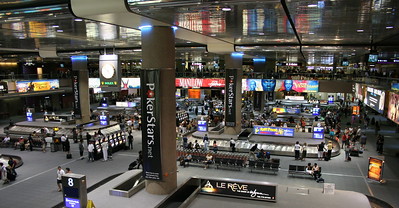
McCarran International Airport reported the return of more than 1 million travelers in June, up significantly from May’s 392,712 and April’s dismal 150,000 or so. Overall, nearly 11.7 million passengers passed through the airport during the first half, less than half of 2019’s 25.2 million over the same period.

June’s volume was down more than 76 percent from last year. Domestic arrivals and departures were off 74.7 percent. Internationally they were down 99.98 percent from 327,127 in June 2019 to just 70. And the sharp rise in new coronavirus cases in Las Vegas since the reopening could take a bite out of the demand that was expected in July and August.

“We’ve seen a dramatic impact to our trends, as far as traffic, revenue and bookings,” said Gary Kelly, CEO of Southwest Airlines, the city’s largest carrier.

“We expect the rest of the summer to remain challenging for us and the industry,” said Spirit Airlines CEO Ted Christie.

As Brendan Bussmann, director of government affairs for industry consultants Global Market Advisors, summed it up: “Until (convention) business can come back, Vegas is going to continue to suffer.”

Aguero, for one, doesn’t see that happening for another 18 to 36 months, and believes the timing will depend heavily on development of a vaccine. “That will be a key turning point for our economy and that of the nation,” he said.

But even that is being re-examined in light of the vast cultural shifts the pandemic is likely to leave behind.

“As the technology improves and convention and trade show attendants get younger, meaning they’re very comfortable doing business remotely, we expect the industry to fundamentally change,” said John Restrepo, principal of RCG Economics, a consulting firm based in the city. “Anyone who thinks Las Vegas will return to a pre-Covid convention and trade industry is not being realistic.”

Meanwhile, Nevada’s June gaming revenues are in, and as expected, the year-on-year decline was steep—45.5 percent versus June 2019—but considering the state’s win had fallen 99.6 percent in April and 99.4 percent in May, it’s not too bad.

Results released by the state Gaming Control Board show the industry collected $566.8 million from gamblers during the 27 days casinos were open in June, compared to $1.04 billion a year ago.

The Las Vegas Strip recorded the biggest decline in relative terms, down 61.3 percent at $238.2 million, compared to $616.6 million in June 2019.

Downtown Las Vegas was down 55.6 percent at $23.1 million. The Boulder Strip won $45 million, down 32.4 percent. North Las Vegas was down 23.2 percent at $17.4 million.

In the north of the state, Reno fared not too badly, recording $46.4 million, down 8.5 percent. South Lake Tahoe at $5.7 million improved on last June’s results by 6 percent.

The state’s sportsbooks suffered their first monthly loss since July 2013, taking in only $483,000, a decline of 102.9 percent on a massive $75.8 percent drop-off in volume to $78.2 million. The loss was due to the payout of over-the-count football betting tickets on previous games that were cashed in during June.

And in related news, Nevada’s recent surge in new Covid-19 infections has prompted Governor Steve Sisolak to announce an overhaul of the phased reopening of the state’s economy that was developed back in March.

The governor and his advisors have come up with a “long-term mitigation strategy” that will rely on more local indicators of the spread of the virus and hopefully provide more accurate indicators of what’s safe for businesses, residents and local officials.

The new plan will replace industry and statewide guidelines and evaluate data in a more narrow fashion, using contact tracing data to identify and place limitations on high-risk businesses. The state will also narrow county-by-county guidelines and evaluate data by municipalities and zip codes.

Sisolak said also that any gaming property not complying with the state’s Covid-19 guidelines could have part or all of their property closed by regulators. This includes a mandate imposed at the end of June, three weeks after the state’s casinos reopened and new infections began to spike, that masks be worn in all public places.

“We’re close to five months in, no more excuses. If people aren’t following the rules to keep us safe, there needs to be consequences,” he said.

Judge Sides With Tribes In Oklahoma Dispute

U.S. District Court Judge Timothy DeGiusti recently rejected Oklahoma Governor Kevin Stitt’s argument that tribal gaming compacts in the state expired on January 1, and would have to be renegotiated. DeGiusti ruled in favor of the tribes who claimed the 15-year compacts automatically renewed on that date.

The Cherokee, Choctaw and Chickasaw nations sued Stitt on December 31, and were later joined by six other tribes.

In a statement, Stitt said, “It confirms my fears, and the fears of many fellow Oklahomans, that the state entered into a poorly negotiated deal and now we must bear the cost of this mistake. The federal court determined that the 2004 gaming compact auto-renewed for 15 years because of an action taken by an agency’s unelected board to reissue licenses for gaming at horseracing tracks.”

He referred to a provision in the compacts, approved by Oklahoma voters in 2004, that allowed the compacts to renew if anyone other than the tribes was “authorized to conduct electronic gaming in any form other than parimutuel wagering on live horseracing pursuant to any governmental action of the state.”

Oklahoma Indian Gaming Association Chairman Matthew Morgan stated, “We appreciated that the court moved quickly to confirm the plain language of our intergovernmental agreements mean what they mean, and here, those words mean our gaming compacts automatically renewed January 1, 2020.”

Stitt’s attorneys had argued that “governmental action” meant legislative action, and that licenses granted by the Oklahoma Horse Racing Commission didn’t qualify as governmental action. But DeGiusti wrote that “the state strains in its arguments” and that he was “not persuaded.”

He said he agreed with the tribes’ position that compact renewal was automatic because the state authorized organizational licensees to conduct electronic gaming and live horseracing at Oklahoma tracks.

“The court rejects the state’s narrow view of ‘governmental action,’ which is inconsistent with a common understanding of that term,” DeGiusti wrote. “The court finds that these technical definitions are not required by the compacts and their use would be inconsistent with federal contract principles.”

Tribal officials rejoiced at the judge’s ruling. Cherokee Nation Principal Chief Chuck Hoskin Jr. said, “Everything in our compact now remains the same, and we hope we can move forward and build a relationship built on respect with Governor Stitt in the future.”

Choctaw Nation Chief Gary Batton said, “This is a great day. This is a strong affirmation of what we have known all along. The plain language of the compact stated that it renewed on January 1, 2020. We are grateful this issue has been resolved and are ready to put it behind us. We look forward to continuing to serve our tribal members by providing health care, education and jobs in the communities where we live and work.”

Chickasaw Nation Senior Counsel Stephen Greetham stated, “This is a good day. It’s a good day for the tribes. It’s a good day for Oklahoma. For our economy, for stability, for jobs, this is something everybody needs to be celebrating. It brings certainty and stability back into an important pillar of Oklahoma’s economy.”

Greetham added, “We’ve been saying from the get-go that this is not a complicated issue. The words say what the words say. Gov. Stitt has attempted to inject a level of uncertainty and confusion into our compacts, but it’s just not supported by the plain text of the agreement.”

Now we just kind of need to take a deep breath. We need to kind of let the waters settle and get the relationship with the governor back on track.”

Under the current compacts, tribes pay the state exclusivity fees between 4 percent and 10 percent on gaming revenue. Last year the tribes paid the state about $150 million in exclusivity fees, which mostly go toward public education. All of the current compacts have the same conditions, but Stitt said he wants the agreements to be individualized for each tribe.

DeGiusti gave the two sides until August 7 to express any further concerns. A spokesman for Stitt said he didn’t know whether the governor will appeal the ruling. House Minority Leader Emily Virgin asked him to end his legal actions. “The governor’s compact negotiations are starting to look like a stimulus package for trial lawyers. Having already spent $1.5 million, the governor is wasting money that could be spent on resources that help our citizens. If the governor continues to pursue this through the appeals process, more money will be spent on lawsuits that could have instead helped schools, our state’s IT infrastructure or our health care community. I encourage the governor to reflect on his position and ask if continuing a pursuit with an uncertain outcome is worth the risk of not protecting Oklahomans.”

The state Office of Management and Enterprise Services said the lawsuit against Stitt so far has cost $746,345.92 to Ryan Whaley for litigation preparation, management of multi-party litigation, mediation and compact negotiations; $275,548.30 to Lytle Soule & Felty for litigation preparation, mediation and compact negotiations; $252,614.37 to Revelation Consulting for mediation and compact negotiations; and $9,975 to Perkins Coie for compact negotiations.

The state also paid Dykema Gossett of Lansing, Michigan, $216,816.12 to represent Oklahoma in negotiating compacts and related agreements with the tribes, drafting related legislation and regulations and for the prosecution or defense of a related proceeding or matter. These funds came from the office of Attorney General Mike Hunter, who served as lead compact negotiator on behalf of Stitt until the governor removed him from that role on December 16.

DeGiusti’s ruling is the second recent legal loss for Stitt. On July 21, the Oklahoma Supreme Court ruled that Stitt overstepped his legal authority when he signed new gaming compacts with the Comanche Nation and Otoe-Missouria Tribe which included provisions for sports betting and house-banked card games—which currently are not legal in the state. The justices said the governor doesn’t have the authority to permit an activity prohibited by state law.

Those two tribes had model gaming compacts like the other tribes but signed new gaming compacts with Stitt, which were approved by the U.S. Department of the Interior and published in the federal register.

The United Keetoowah Band of Cherokee Indians and Kialegee Tribal Town also entered into new compact agreements with Stitt. The Oklahoma Supreme Court has been asked to rule on the legality of those agreements.

“In my first six months (in office), I traveled across the state listening to tribal leaders and to leaders from many sectors of Oklahoma’s economy about these compacts,” Stitt said. “What I heard and what I learned is that only a few tribes were receiving most of the benefit from gaming; the one-size-fits-all approach to the Model Gaming Compact was clearly broken.”

MGM: Hornbuckle No Longer ‘Acting’

The board of directors of MGM Resorts International announced July 29 that William J. (Bill) Hornbuckle has been elected as president and CEO, effective immediately. Hornbuckle had served as acting CEO and president since March 2020, when former Chairman and CEO Jim Murren stepped down.

Hornbuckle was also appointed to serve on the company’s board.

“After a thorough national search, the board unanimously concluded that Bill is the best candidate to lead MGM Resorts through these immensely challenging times and into a more promising future,” said Paul Salem, chairman of the board of directors. “There are few tests of leadership greater than what Bill has faced. His seasoned global experience, depth of knowledge and steady hand have provided reassurance and confidence to our employees, partners, guests and shareholders during one of the most difficult periods in the history of our company. He has fully earned the opportunity before him.”

Hornbuckle issued a statement saying, “I am honored to lead this company as we look toward long-term recovery, future growth and opportunity. In doing so, I am especially mindful of the thousands of MGM Resorts employees who have been profoundly impacted by the current circumstances. Their dedication to the company’s mission and safety allows guests from around the world to experience moments of happiness and hospitality amid uncertain times. I am here today presented with this leadership role due to the tremendous accomplishments, passion and courage of our people.

“While we will continue to operate in this new normal for the near term, fundamentally I am incredibly optimistic about the future of our company and our industry. We will remain focused on taking care of our guests and each other as we look toward our best days ahead.”

A gaming industry veteran, Hornbuckle was most recently executive director and board chairman of MGM China Holdings with operations and resorts in Macau. In addition, he is the chairman of the board of directors of the CityCenter JV Board of Directors (a joint venture with Dubai World) and a member of the Las Vegas Stadium Authority Board of Directors.

He was previously chief marketing officer of MGM Resorts, serving from 2009 until 2012. Before that, he spent four years as president and chief operating officer of Mandalay Bay Resort & Casino. He previously had served as president and COO of MGM Resorts International-Europe, where he worked on the development of the company’s gaming operations in the U.K. He also served as president and COO of MGM Grand Las Vegas from 1998 to 2001.

Hornbuckle’s early experience includes a term as president and COO of Caesars Palace in Las Vegas. He spent the majority of his career with Mirage Resorts in various senior management positions, including president and COO of the Golden Nugget Laughlin, executive vice President and COO of Treasure Island, and vice president of hotel operations for the Mirage, opening the hotel in 1989.

Hornbuckle is a graduate of the University of Nevada, Las Vegas with a BS in hotel administration.

Due to the impact of Covid-19, MGM recently informed a large majority of its entertainment and sports division employees Monday that they will be laid off effective August 31, with their benefits suspended as of September 1.

In a July 27 email, MGM President of Entertainment and Sports George Kliavkoff wrote that, when the company’s hotel-casinos first shut down in March, company executives “were hopeful our closure would be brief.” But conditions have forced the company to cut costs, and the resumption of entertainment may be especially challenging, given state laws that limit gatherings to 50 people, along with social-distancing policies.

Kliavkoff added that, “We remain committed to reopening all of our entertainment venues when it’s safe to do so and our plan is to call back as many of our division’s employees as possible, as quickly as we can. The decision about when to reinstate entertainment at our properties will continue to be drive by health and safety mandates and guidelines established by government agencies and by business demand.”

The announcement also says employees can seek support for everyday expenses, such as rent, mortgage, groceries and utilities, through the $14 million employee Emergency Grant Fund. Those laid off are eligible to request grants through Nov. 29. MGM Resorts has distributed more than $11 million in grant payments since the COVID shutdown.