Author: Casino Connection Staff

Pro-Am Beach Soccer

Join us May 5–6 2018 for the Biggest Beach Soccer Tournament to hit New Jersey Shores in years. Beach soccer fun is coming to Atlantic City in a Qualifier for the Pro-Am Beach Soccer National Championship! 

With an average of over 170 Teams who participated in the last five years in Santa Cruz at the west coast event, you don’t want to miss out on the ”Best Beach Soccer Tournament” of the season and your chance to qualify to play the best in the nation. 

This is the first of 8 qualifiers for the US Beach Soccer National Championship to take place on August 18th & 19th, 2018.  Be one of the first 8 spots! Nationals will host 17 Divisions; girls, boys, women, men, & Coed looking to win!

Entry fees vary, for additional information call 415-308-0603 or visit, http://proambeachsoccer.net

Motor Social at the Showboat Hotel

Save the date for the upcoming Motor Social at the Showboat in Atlantic City, Friday May 4 thru Sunday May 6, 2018.

The Motor Social presented by Classic Metal Productions and Dead Rodz Revival, is a three day indoor and outdoor event featuring cars, music, some top shelf Burlesque, and much more in a Mardi-Gras style atmosphere. Free for spectators, entry fee for cars and vendors.

When:  May 4 – May 6, 2018
Times:  Friday 5:00pm – 9:00pm
             Saturday 8:00am – 8:00pm
             Sunday 8:00am – 5:00pm
Visit: http://www.deadrodz.com/motor-social-showboat-atlantic-city/

UFC Fight Night

The UFC will bring the best mixed martial artists in the world to Boardwalk Hall in Atlantic City, on April 21, 2018

Don’t miss a chance to see two of the top lightweights in the world square off, as Muay Thai wrecking machine Edson Barboza attempts to add another clip to his highlight reel when he meets “The Motown Phenom,” Kevin Lee. This is a fight you won’t want to miss!

Tickets on sale now $60 – $150. For more information visit, http://www.ufc.com/

Chef’s Supper Club

You won’t want to miss the largest Chef’s Supper Club Yet!

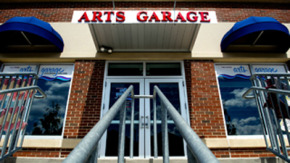
For Atlantic City by Atlantic City (4ACxAC), will host a seven-course dinner at the AC Arts Garage in Atlantic City, Tuesday, April 24, from 6pm – 9:00pm

Join them for the largest Chef’s Supper Club yet! Top Chefs of Atlantic City pair together and collaborate on dishes for a spectacular 7 course dinner to benefit the South Jersey Community Foodbank.

For 4ACxAC is a non-profit organization created by local hospitality professionals to give back to the community. 4ACxAC picks a local organization to fundraise for each year. 

4ACxAC hosts events ranging from themed parties to pop-up dinners in local venues, promoting local businesses and organizations.

When: Tuesday, April 24, 6 – 9 pm
Where:  Noyes Garage, Atlantic City
Tickets:  $75, limited available
Visit:  https://www.4acxac.com/

NBA Changes Tune for ‘Integrity Fee’

West Virginia governor suggests “partnering” with leagues

Last week, the NBA came up with yet another supposed justification for the fee, when a vice president for the league told a West Virginia radio news program that the reason for the fee is once again integrity, based on the assumption that more people would wager on sports if the wagering were legal.

“The league is going to incur significant additional expenditures to best protect the integrity of our game as sports betting becomes more widespread, so the fee would go in part to pay those fees,” said Scott Kaufman-Ross, vice president of fantasy and gaming for the NBA, in an appearance on the MetroNews network’s Talkline program.

“Secondly, the league is going to be taking on additional risk as sports betting becomes more widespread in the United States and there’s additional risk to our brand. If anything happens, it’s going to be our brand that bears the brunt of it.”

The AGA and other legal sports betting proponents have noted that legalizing sports betting will shift billions being bet illegally to legal, regulated sites, rather than resulting in sports betting becoming “more widespread.” And legal, regulated sites will require less monitoring because of their transparent nature.

In West Virginia, lawmakers of both parties said no changes are needed for SB451, which Governor Jim Justice recently signed into law. The measure would allow sports betting at the state’s four racetracks and the casino at the Greenbrier Resort (owned by Justice) if the U.S. Supreme Court lifts the federal ban. However, the legislation did not include the 1 percent integrity tax promoted by the National Basketball Association and Major League Baseball. Justice said wants to pursue an integrity tax for a lesser amount and “absolutely” will call a special session to address the issue.

Justice said, “After the U.S. Supreme Court issues its decision on sports wagering, to address any provisions of the legislation that might be in conflict, I will ask the legislature to look at the advantages of partnering with the major sports leagues. I believe there could be real value to this partnership. This approach will allow us to develop a relationship with all the major sports leagues so that it is beneficial to everyone.” Justice added West Virginia’s sports betting law could become “model legislation that the entire country can use and duplicate.”

No other state has included the integrity tax in sports betting legislation. The leagues claim the tax revenue would help them to monitor their games for corruption and to maintain the integrity of their sports.

State Delegate Shawn Fluharty, the bill’s sponsor, said, “It was two years in the making to see it come full circle. By building the interest since I first introduced it, we were able to get everyone on board and gather bi-partisan support. It passed the House with 77 votes. We do not need a special session, nor do we need changes. The governor is being pressured by the leagues to include an integrity fee. It is absurd to think we will send money out of West Virginia and to billionaire leagues. There’s no support in the legislature for it. If anything, an integrity fee should go directly to our universities, and not out of state leagues.”

State Senate Majority Leader Ryan Ferns added, “There is zero interest in integrity fees or anything else associated with professional sports in the legislature. I think major league sports were late to the game. The sports organizations recognize and admit that there is hundreds of millions of dollars in illegal betting taking place right now. Whether that betting is legal or illegal, major league sports should already be protecting the integrity of the game regardless of how the bets are being placed.”

Under the legislation, casinos would direct 10 percent of net profits from sports betting to the state. Nevada currently collects 16 percent.

In leaving the door open to future discussion of a fee, many West Virginia lawmakers mentioned a much smaller potential fee—possible as low as 0.25 percent, instead of 1 percent.

It’s something that West Virginia Governor Jim Justice may consider, after he issued a press release saying he would sign the sports betting bill in which he promoted “partnering” with the leagues on sports wagering. In the end, Justice did not sign the bill, but it became law nonetheless.

“After the U.S. Supreme Court issues its decision on sports wagering, to address any provisions of the legislation that might be in conflict, I will ask the legislature to look at the advantages of partnering with the major sports leagues,” Justice said in the press statement. “I believe there could be real value to this partnership. I expect the Supreme Court to rule on this issue in the next few months.

“This approach will allow us to develop a relationship with all the major sports leagues so that it is beneficial to everyone.”

Meanwhile, Maryland has become the latest state to consider legislation to regulate sports betting should the federal ban be lifted. The Maryland House of Delegates overwhelmingly passed a bill that would put the sports betting issue in the hands of voters. HB 1014 would create a referendum for November’s statewide ballot to create a constitutional amendment “to provide for the operation, regulation, and disposition of proceeds of sports wagering in the state.”

The bill would allow for sports books at existing Maryland casinos and racetracks. A parallel bill in the state Senate would limit sports betting at racetracks.

Rep. Frank Turner, a Democratic sponsor of the bill, told the Baltimore Sun that the amendment would target sports betting revenues for education. “We specifically want any money from sports betting to go to the Education Trust Fund,” he said.

The bill does not address whether or not online wagering on sports would be permitted.

The U.S. Supreme Court is expected to rule as early as next month on Murphy (formerly Christie) v. NCAA, the lawsuit brought by all the major sports leagues to block New Jersey’s sports betting law. New Jersey’s lawyers have argued that PASPA, on which the lower-court rulings held for the leagues, is unconstitutional. The court could partially or totally repeal PASPA. There also are bills in the U.S. Congress to repeal the federal ban, implemented in 1992.

In Illinois, five sports betting bills are in committee. State Senator and chairman of the Senate Gaming Committee Steve Stadelman said, “Some of the bigger issues and questions that we’ll have to discuss is, obviously, the tax rate. What venues would be allowed to have sports betting? For example, casinos, racetracks? Would it be offered online? Would it be offered in a retail environment?”

One of the bills in the Senate Gaming Committee, SB 3432, was introduced by state Senator Napoleon Harris III, a former NFL linebacker. The legislation includes the integrity fee. Although lawmakers are divided on the issue, Stadelman noted, “I don’t want to be debating a year or two down the road while something’s being allowed in other states. I don’t think that’s to our advantage in Illinois.” He said although a tax rate hasn’t been determined, his legislation estimates sports betting would generate $7 billion a year, with $23.8 million going to the state.

Caesars Entertainment Waitresses in Atlantic City Protest Automated Replacements

Cocktail waitresses at Caesars Entertainment’s Atlantic City casinos are protesting the introduction of a new automated drink ordering system.

The system allows patrons on the casino floor to order drinks, which are then served by the waitresses. The system reduces contact between the customers and waitresses.

According to a report at Casino.org news, casino officials say the system is more efficient and allows gamblers to play rather than wait for drinks.

The waitresses, however, say that with less contact with customers, it becomes harder to determine if patrons are drunk and should be cut off.

The waitresses have delivered a petition to the New Jersey Division of Gaming Enforcement. The petition requests that the department examine potential problems with the system. The waitresses are all employed by Caesars Entertainment-owned properties, including Bally’s Atlantic City, Caesars Atlantic City, and Harrah’s Atlantic City, the report said.

Officials for Local 54 of the Unite Here Union—the city’s largest casino workers union—said they support the petition

“All of these cocktail waitresses have extensive training in identifying when people are inebriated so they can cut them off,” Ben Begleiter, research analysts for the union told Casino.org. “They have extensive training in slowing down how often they bring drinks so that people don’t become overly intoxicated. Now they don’t have the ability to do any of that.”

Caesars Entertainment officials did not comment for the report.

New Jersey CRDA Names New Director

Casino Reinvestment Development Authority Executive Director Christopher Howard announced he will be leaving the post at a public meeting, setting stage for newly appointed Deputy Director Matt Doherty to get a quick promotion.

Howard was appointed by former Governor Chris Christie in 2016. Doherty was appointed earlier this month by current Governor Phil Murphy.

Doherty, 44, a Democrat, is mayor of Belmar New Jersey, another shore tourist town. His annual salary will increase from $150,000 to $175,000 once he assumes the new position no later than July 1, according to the local Press of Atlantic City.

“It’s been incredible,” Howard, 33, said of his time in the post. “It certainly opened some new doors for me, and I’m extremely grateful for the opportunity you all have given me.”

During Howard’s tenure, the authority downsized 15 percent of its full-time positions after casino tax revenue was diverted from the authority. The authority also established an entertainment-retail district for the Hard Rock Casino and Hotel.

“Chris Howard certainly left his mark on Atlantic City, and his leadership and management will be sorely missed,” CRDA Board Chairman Robert Mulcahy said. “We wish him the best in his future endeavors. At the same time, the board welcomes Matt Doherty to the CRDA with open arms. We are excited to continue bringing a new vision to the city together.”

In some other Atlantic City stories, GVC has launched a second online gambling site in New Jersey with PartyCasino NJ. The site features about 250 slots and table games.

GVC already offers casino games and slots through its PartyPoker site in the state. Officials said those games will remain available to PartyPoker subscribers, but the company will market the new site to online casino players.

Also, Atlantic City’s Democratic Committee has filed a criminal complaint in municipal court against Mayor Frank Gilliam and his former campaign manager, Richard Winstead, according to the Press.

The committee alleges Gilliam, a Democrat, and Winstead committed theft by unlawful taking when Gilliam deposited a $10,000 check meant for the committee into Gilliam’s campaign account.

Gilliam has consistently said the check was deposited into his account by mistake and that he returned the money after it was discovered, the Press reported.

Maryland’s Poker Market Could Pass New Jersey

Maryland and New Jersey’s combined brick and mortar and internet poker markets are running nearly neck and neck.

Data released two weeks ago by New Jersey’s Casino Control Commission showed that the combined poker rooms and sites generated $3.68 million in February, with live poker accounting for $1.91 million.

Internet poker decreased $400,000 compared to the previous year and live poker was down about $200,000 over 2017.

In Maryland the four casino card rooms brought in $3.6 million in February, which was very close to the year before. Internet poker has not yet been legalized in the state. The market enjoyed a 25 percent increase last year when the MGM National Harbor opened a 39-table poker room.

Last year, as a result New Jersey’s poker market was about $4.5 million each month, compared to $3.7 million in Maryland.

Because New Jersey’s intrastate poker market is small it’s hard to get accurate comparisons between it and states such as Delaware and Nevada.

According to the Nevada Gaming Control Board, “The consensus is that traditional poker will not experience any significant growth without a national interactive component to support growth in traditional poker by introducing new players to the game.”

Atlantic City Has Cold February

It’s been a tough winter for Atlantic City’s seven casinos as revenue declined for a second consecutive month falling 6.5 percent in February.

Online gaming, however, was still strong taking in $21 million. All told, the city’s seven casinos took in $192 million for the month according to figures released by the New Jersey Division of Gaming Enforcement.

“Let’s face it, February was a weak month,” said Jim Plousis, chairman of the New Jersey Casino Control Commission in a press release. “Business was off at virtually every casino. I am hopeful that casinos can turn this around and start expanding the market as we move into the busier spring and summer seasons.”

Only the Golden Nugget Atlantic City had a good month with a revenue increase of 16 percent over February 2017 to $25 million. That was also helped by the casino’s strong online presence in the state, bringing in $7.9 million. According to an analysis by the Associated Press, that’s almost twice the amount brought in by the casino’s nearest competitors.

Borgata and Resorts Digital each won about $3.8 million online, while Tropicana came in at $3.3 million and Caesars Interactive NJ won $3.2 million.

Caesars Atlantic City saw the biggest overall decline, down 23 percent to $17.5 million. Resorts was down about 21 percent to $11.9 million, though its online revenue was up 24 percent.

Bally’s was down 12.8 percent to $14.2 million; Tropicana, which recently took over the No. 2 spot in the Atlantic City market behind the Borgata, was down 7.2 percent to $29.2 million; Borgata was down 5.1 percent to $58.7 million; and Harrah’s was down 4.3 percent to $28.2 million, according to the AP.

Mohegan Executive to be Witness in Cosby Trial

Thomas Cantone, a senior vice president for Mohegan Gaming & Entertainment may be called to testify in the sexual assault trial of comedian Bill Cosby.

This is a big surprise to Cantone, who didn’t know that he could be called to as a witness. Last week he told the New London Day: “I have no understanding of that. I have not heard anything,” after that paper learned from the New York Post of the executive’s possible deposing.

Cantone previously was employed at Foxwoods Resort Casino, where Cosby appeared in 2003, and where Andrea Constand alleges she met the venerable comic in his hotel room. She alleges that on a different date two months later he sexually assaulted her at his home in Pennsylvania.

The judge declared a mistrial in this case last summer. Cosby’s attorneys say they plan to call Cantone to testify about when Cosby met Cantone at Foxwoods.

Hard Rock Atlantic City Launches Social Casino Site

Hard Rock Atlantic City is offering up a preview of its expected online presence in New Jersey with the launch of a social casino site.

The free-to-play site will feature Hard Rock branded casino games, according to a press release. The site is being launched through a deal agreed in February between the Seminole Tribe of Florida and BlueBat Games, a subsidiary of Novomatic’s interactive arm Greentube.

This deal covers all 11 Hard Rock properties owned by the tribe, as well as its six Florida-based casinos operated by Seminole Gaming.

“We are excited to announce the arrival of our online social gaming site that is easy to navigate and offers free play,” said Hard Rock Hotel & Casino Atlantic City President Matt Harkness in the release. “Launching this social-games website will bring excitement to those who enjoy playing the most innovated games for slots and tables online and it will be a great opportunity for many to experience and connect to the Hard Rock brand for the first time.”

The site will offer popular slots, video poker and table games for home or mobile devices, including games such as High Voltage Blackout, Rawhide, blackjack and roulette. The site will also regularly run online slot tournaments, where players can play and interact with anyone on the site at that time. Players can also play against themselves by competing in quests, the release said.

Hardrocksocialcasino.com players also have the option of linking their social games play to their Hard Rock Hotel & Casino Atlantic City Wild Card rewards account or linking to other Hard Rock properties’ rewards programs to earn more points for merchandise or casino dining rewards and other prizes and gifts, the release said.

Hard Rock will follow its social launch with the roll-out of a real-money iGaming offering powered by Gaming Innovation Group, marking its entry into the regulated New Jersey online market, the release said.

PA Online Gaming Process to Start

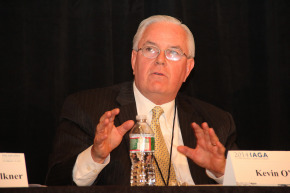
Pennsylvania’s new online gaming business is set to begin its application period next month, according to a top regulator. Kevin O’Toole, executive director of the Pennsylvania Gaming Control Board, told a state House budget panel last week that the board is prepared to begin accepting applications for iGaming licenses in mid-April.

That will kick off a 90-day period in which applications for different online gaming licenses will be accepted by the board. Only current land-based licensees will be permitted to apply for iGaming Licenses during this initial period, and according to the rules, the only licensing available during the initial period will be a package deal—online slot, table-game a peer-to-peer poker licenses for a fee of $10 million.

In August, any remaining licenses will be available individually to current licensees, at a cost of $4 million each. Thirty days after that, the board will accept licenses from outside the Pennsylvania’s current casino industry.

What remains to be seen is who applies for which license, and it is feasible that no current casino will opt for an all-in-one license because of the tax structure set up by Pennsylvania’s gaming expansion law—particularly the 54 percent tax for online slot games, which mirrors the land-based slot tax. Many operators have said they will not seek licenses for online slots at that tax rate, which they say is unworkable, particularly when online gaming in neighboring New Jersey is taxed at around 9 percent, regardless of the game.

It is conceivable that casinos could wait until after the initial 90-day period and purchase licenses for online poker or table games only.

The other important thing to keep in mind with this timeline is when non-Pennsylvania entities can start applying. After 120 days, approved outside entities can apply for the individual $4 million licenses.

Online casinos are not the only new element for Pennsylvania gambling. Applications and launch dates are in motion on several different fronts. O’Toole said licenses for video gambling terminals (VGTs) at truck stops should be available around the same time as online casinos, and online lottery sales will begin in May.

Last week, the board also released details on applying for a fantasy sports license.

The board has yet to decide on some online gaming regulations, most prominently whether or not licensees will be permitted more than one “skin,” or iGaming site, as in New Jersey. Some operators are pushing for multiple domains while others are seeking to limit casinos to one skin.

LVS to Sell Sands Bethlehem to Poarch Band

Name will be changed to Wind Creek Bethlehem

Las Vegas Sands Corporation announced that the company has entered into a definitive agreement under which Wind Creek Hospitality, an affiliate of the Poarch Band of Creek Indians of Alabama, will acquire the Sands Bethlehem property in Pennsylvania for a total enterprise value of $1.30 billion.

The tribe plans to change the name of the Sands to Wind Creek Bethlehem.

Las Vegas Sands Chairman and CEO Sheldon Adelson has been looking to unload the Bethlehem property since it became the first casino in the 29 years of the LVS empire to sign a union contract. Sands security guards ratified a three-year contract in February 2017, and the 146 guards remain alone among some 50,000 LVS employees in union representation. Adelson’s discomfort with the recently passed online gaming bill in Pennsylvania was also undoubtedly a factor.

Shortly after the union contract was signed, Sands Bethlehem halted its $90 million expansion and entered talks with MGM Resorts International to sell the facility, for the same $1.3 billion price tag. Those talks ultimately broke down—in fact, neither company even admitted they took place. LVS never completed its master plan for the property, built on the bones of the former Bethlehem Steel plant. The operator added a hotel and retail facility, but plans for an industrial museum and other uses of the former steel plant buildings ultimately were scrapped.

The Poarch Band, under Poarch Creek Indian Gaming, manages three Class II gaming facilities in Alabama, including Wind Creek Casino & Hotel, Atmore; Wind Creek Casino & Hotel, Wetumpka; and, Wind Creek Casino & Hotel, Montgomery. The company also operates two casinos in Aruba and Curacao, the Aruba Renaissance Resort & Casino and the Curacao Renaissance Resort & Casino.

The Pennsylvania property will be the tribe’s first Class III operation in the U.S., and its first experience with operating table games, which have kept Sands Bethlehem near the top of Pennsylvania’s market in terms of revenue. Wind Creek Bethlehem will be the second commercial casino owned by a tribe. The Mohegan Sun Pocono is owned by the business arm of the Connecticut-based tribe, Mohegan Tribal Gaming Authority.

But like first proposed sale of Sands Bethlehem, this buy is the second attempt by Wind Creek to enter the commercial gaming industry in the U.S. The tribe had reached an agreement to buy the Margaritaville Casino Resort in Bossier City, Louisiana last year. But when the owners of Margaritaville weren’t able to discharge a licensing agreement with the Jimmy Buffett-led company, the deal collapsed.

Even though Sands Bethlehem wasn’t a core asset for Las Vegas Sands, Adelson says he’s proud about what his company accomplished there.

“Sands Bethlehem has become one of the leading regional entertainment and gaming destinations in the United States, and we are extremely proud of the positive contributions the property has made for Bethlehem, the Lehigh Valley and eastern Pennsylvania,” Adelson said in a statement. “We are pleased to have built a strong foundation that can be the basis for the property’s future success, and more importantly, we are proud to have delivered on our promise of bringing thousands of good-paying jobs, generating significant economic impact and revitalizing a site of sentimental and historical importance.

“I’m grateful to each and every team member who has represented us so well, and I know the hard work and dedication they showed us will continue in the years to come.”

“The quality of the property and dedication of the team members to genuinely engage with customers was evident from the first time we visited the property,” said Stephanie Bryan, tribal chair and CEO of the Poarch Band of Creek Indians. “The addition of this fantastic team and property to our portfolio furthers our desire to secure a long and prosperous future for our tribe.

“We look forward to working with our new team members and the community to cement Wind Creek Bethlehem’s position as the premier entertainment destination in the northeast. We are proud of our ability to become valued partners with communities surrounding our Wind Creek Hospitality properties.”

Sands Bethlehem President Brian Carr said the pending sale will not impact the work of Sands employees.

“We’ve become an important regional entertainment destination because of our commitment to our customers,” Carr said. “That’s not going to change regardless of what the sign on the top of the building might read. I’m confident our entire team will provide a smooth and seamless transition for new ownership while at the same time maintaining the strong level of guest service for which we have become known.”

Las Vegas Sands Executive Vice President and Chief Financial Officer Patrick Dumont said that while many options exist for the use of the sale proceeds, the most likely use would be consistent with the company’s long-held strategic direction when it comes to deploying capital.

The purchase gives Wind River an entrée into the iGaming business as well since Pennsylvania recently approved a law allowing online wagering. This might also have been a catalyst for the sale since Adelson has long been known as an opponent to online gaming in the U.S. and there were doubts whether Sands Bethlehem would participate.

Another factor are the 10 “mini-casino” licenses currently being auctioned off one at a time. Sands Bethlehem had reportedly won the third auction two weeks ago, but the proximity of the site to territory claimed by another casino invalidated the win. It’s unclear if the company has eyed other sites in the state still yet to be auctioned.

Wind Creek was advised by Innovation Capital, who called the purchase the largest acquisition of a single casino property outside of Las Vegas or Atlantic City.

Wind Creek Hospitality said it expects to fund the acquisition with a combination of existing cash on its balance sheet and new debt financing. Credit Suisse has provided committed financing for the proposed transaction. Wind Creek Hospitality anticipates that the additional cash flow resulting from the acquisition will allow it to pay down debt on an accelerated basis after closing.

Atlantic City-based law firm Cooper Levenson provided legal counsel for the transaction.

Jefferies analyst David Katz was lukewarm on the transaction, calling it a positive for LVS but maintaining a “Hold” rating on the stock with a price target of $79. “Given the company’s prior efforts to sell the property, increasing competition in the Northeast, and Pennsylvania’s recent legislative rulings, we believe the announcement is modestly positive for the shares but does not alter our neutral stance on the shares,” Katz wrote.

John Cunnane, a Wall Street gaming and leisure analyst for Stifel, has concerns that Wind Creek can succeed in Pennsylvania, given their limited experience outside of Class II gaming in Louisiana.

“This is jumping into the pool at the deepest end,” he wrote. “This is a big acceleration. They didn’t buy Mount Airy. They bought Sands Bethlehem.”

The closing of the transaction is subject to regulatory review and other customary closing conditions, and will most likely take at least one year to complete.

Atlantic City Mayor Advocates Pot Friendly Zones in the Resort

Atlantic City Mayor Frank Gilliam is readying for a possible legalization of private marijuana use in the state by proposing “adult entertainment districts” within the resort.

The New Jersey state Assembly has started hearings on legalizing marijuana and allowing its sale in retail shops. That has led to several state municipalities debating whether to ban cannabis shops in their towns, according to a report from public radio WHYY in Philadelphia.

However, Gilliam sees the potential legalization as an opportunity.

“I don’t have the appetite to just be a pusher of the product. I don’t want people to think that they should just come here, buy it and leave,” Gilliam told the station. “I want it to be … a destination, where folks can come here and enjoy it in a controlled area.”

Gilliam recently travelled to Las Vegas to see how the casino city is mixing legal marijuana use within its own casino and nightlife attractions. He is now proposing “adult entertainment districts” in Atlantic City with areas designated for marijuana use.

However, Gilliam said it is unlikely that casinos would be involved in the plan. He told the radio station that Las Vegas casinos are not part of the cannabis business there and cited tight federal regulations on gaming operations that would likely discourage Atlantic City’s casinos as well.

However, Gilliam said such zones could expand the city’s tourist areas away from casinos. He did note that Nevada’s laws only allow use in private residences, which would not help attract tourists.

“That could be good for Atlantic City. If we can roll it out correctly and create a destination facility or area, that would be ideal,” he said.

The bill before the state Assembly does not allow its use in public places, but the bill’s main sponsor, state Senator Nicholas Scutari has said he could be open to allowing its use at clubs or in restricted areas, WHYY reported.

In another Atlantic City development, Hard Rock Atlantic City—which is scheduled to open this summer on the resort’s Boardwalk—will seek variances from the city for signs at the property. The signs include one that would be 63 feet high on the hotel tower and 53-foot-high guitars on the property, according to the local Press of Atlantic City.

“The variances are justified as the proposed signage is common and necessary in size and number for a casino and hotel the size of the one on the property,” Hard Rock’s application states. “The square footage of all of the wall signage is substantially less than 25 percent of the total wall surface area which is the maximum permitted under regulations.”

Integrity Fee Challenged as States Advance Sports Betting Bills

Prognosticators who were predicting a decision on March 5 in NCAA v. Chris Christie, the U.S. Supreme Court appeal of lower-court rulings blocking New Jersey’s sports-betting law which also challenges the constitutionality of the federal ban on sports betting, were disappointed last week.

However, the best odds for a decision that could overturn the 1992 Professional and Amateur Sports Protection Act (PASPA) are on the next regular date the high court announces decisions, which is April 2. Experts at the IMGL/ABA Gaming Law Minefield conference in Las Vegas last week, however, don’t expect to hear from the Supreme Court until late spring.

The case began in 2014, when New Jersey Governor Chris Christie signed a bill to create a self-regulated sports betting program centered in Atlantic City casinos. All of the major sports leagues—the NCAA, NFL, NBA and Major League Baseball—sued to block the legislation as a violation of PASPA. Last summer, SCOTUS made a surprise announcement that it would hear New Jersey’s appeal of lower-court rulings that held for the leagues.

The smart money, by the way, has moved from a long shot on New Jersey winning— from -1,000 after a lower-court ruling for the sports leagues to -250 last week, as bills have been introduced in 18 states to regulate sports wagering presuming PASPA is repealed.

Those views are held by a number of potential sports-betting stakeholders, including some of the sports leagues themselves, with the NBA and MLB both lobbying states to include a 1 percent “integrity fee” on all wagers for their leagues’ games, a prospect that many proponents of legal sports wagering consider unworkable, as it would squeeze operators to cut into already thin profit margins, rendering them unable to compete with the odds set by illegal bookmakers.

Gambling experts agree. Last week, famed gambler Jeff Ma—one of the leaders of the MIT blackjack team that inspire the book Bringing Down the House and the film 21—told CNBC that the push for a league cut of thin profits is “short-sighted.”

“Traditionally, a lot of the leagues are run by lawyers, so they think about how do we protect our assets; they don’t think about how do we monetize our assets,” Ma told CNBC at the recent MIT Sloan Sports Analytics Conference. “In this case, they are thinking protect and charge people money instead of focusing on the bigger opportunity down the road.”

Dr. Laila Mintas of Sportradar, a company that provides data to the NFL, NBA, NHL and several foreign betting operators, told CNBC that an integrity fee would not only keep bettors with the illegal bookmakers in the U.S., but would drive them offshore. “If you put too much burden on the (legal bookmakers), they will not be able to compete with the offshore markets,” Mintas said at the MIT Sloan conference.

The U.S. Supreme Court has yet to rule on New Jersey’s attempt to allow sports betting at city casinos and the state’s racetracks. The ruling—which could lead to sports betting in as many as 15 states should the court strike down a federal ban—could have been released March 5, when the court released two other decisions.

Though the court releases its decisions at its own pace, the March 5 release potential did spark a lot of media coverage which ultimately was disappointed. The court’s next scheduled release date is March 19, but again, there are no assurances that the sports betting case will be included.


WEST VIRGINIA

The West Virginia Lottery Sports Wagering Act, which would legalize sports betting, passed both the House and Senate and awaits Governor Jim Justice’s signature. If he signs it, West Virginia would become the first state to enact a sports betting law, and be ready to implement it if and when the U.S. Supreme Court removes the 1992 federal ban.

The bill authorizes the West Virginia lottery to regulate and license sports betting at the state’s five licensed casinos and racetracks; it also would allow mobile sports wagering via approved online platforms or apps. Licensees would have to pay a $100,000 application fee, to be renewed every five years at the same rate. Gross sports wagering revenue would be taxed at 10 percent.

The state commissioned a study by gaming research firm Eilers and Krejcik that showed the West Virginia sports betting market would generate $13.4 million in revenue the first year, $21.7 million the second, $29.7 million in year three, $29 million the fourth year and $28.7 million in five years. The first $15 million in net profit will go to the State Lottery Fund, then to the Public Employees Insurance Agency Financial Stability Fund.

The legislation does not include the controversial 1 percent integrity fee promoted by Major League Baseball, the NBA and other sports leagues. The fee actually is a 20 percent cut of all sports book revenue. Connecticut’s sports betting legislation does not include the fee, however, bills in Missouri, Indiana and Illinois include it. The leagues claim the fees are needed for their protection. However, observers noted the leagues have rules in place forbidding players and officials to gamble as well as internal security to handle such matters. In addition, observers said the estimated amount of money these fees would bring in—at least $200 billion in annual illegal sports watering alone—far surpasses what integrity fee measures would cost.

MLB Commissioner Rob Manfred held a conference call with West Virginia media to explain the league’s position. Manfred said, “Unfortunately in West Virginia, there’s only one interested group that has dominated the substance of this bill, and that’s the gaming industry – the people seeking to make money from sports betting. It contains literally no protections toward the integrity of the sport. There’s no recognition of that risk. It does not protect young people in West Virginia, by limiting their access to sports betting. It does not protect people with gambling problems. All it does is maximize the opportunity for the gaming industry to make money. The structure of the bill is so fundamentally flawed, bettors will seek other states with better regulatory frameworks. As a result, the expected financial windfall for West Virginia will be much lower. We will continue to urge the Governor to veto the bill.” Even if Justice does veto the legislation, the votes exist for an override.

West Virginia bar owners also weighed in on the sports betting bill. West Virginia Restaurant and Bar Association Vice President and bar owner Jake Padlow said, “We are a group of restaurant and bar owners who are tired of getting slaughtered by out-of-state corporations that own racetracks in the state. Why should racetracks get to monopolize it? If our legislators can’t trust local businesses, but they can trust these out-of-state corporations, that says a lot.” The association’s President Mike Duplaga, also a bar owner, said the legislation will hurt his business. “We are busy on Sunday afternoons during football season. Why should I stand by and watch Wheeling Island take my customers over there where they can bet?” Duplaga said. “The tracks certainly have their lobbyists on the job in Charleston. The local folks feel like they are getting left out,” said the group’s attorney and former state Senate President Jeff Kessler.


OKLAHOMA

In Oklahoma, HB 3375, passed the House Appropriations Budget Committee in an 18-8 vote and now moves to the full House. The bill—which does not include the leagues’ desired integrity fee–would amend the state constitution to legalize sports betting, but not horse or dog betting, at the state’s 70-plus tribal casinos. It also would expand tribal gaming to include non-house-banked table games. Tribes would pay the state 10 percent of the monthly net wins from sports books and non-house banked table games revenue.

The American Gaming Association estimated a regulated sports betting market annually could contribute $600 million to Oklahoma’s economy and generate up to $124 million in tax revenues for the state.


IOWA

And in Iowa, state Senator Jake Highfill has proposed legislation that would place sports betting under the direction of the state’s casinos, regulated by the Iowa Racing and Gaming Commission. Properties would be pay a $25,000 license fee and a tax of 8 percent on sports betting revenue, which would be allowed on professional and college athletics. Bettors could wager in person at the casinos or via mobile phones—a move to attract younger participants. The Innovation Group said legal sports betting could generate $80-$90 million in new annual tax revenue for the state.

The Iowa legislation does not include the major leagues’ integrity fee. NBA Executive President of Communications Mike Bass said, “We agree that time has come to give fans a safe and legal way to bet on sports. But any law authorizing betting must include rigorous protections to safeguard the integrity of our games. The bill rapidly advancing through the Iowa legislature is deeply flawed and will not achieve that critical goal. It lacks the most basic requirements for strict regulation of sports betting. We hope the legislature rejects this severely flawed bill and restarts the process to draft a bill with thoughtful, stringent protections.”

MLB issued a statement noting, “The legislation quickly advancing in Iowa would create incredibly weak and insufficient oversight of sports betting, and would not sufficiently mitigate the potential risks to our game that will emerge from legalized sports betting. The steps for strong regulation have been studied and proven to be effective for years in betting markets overseas, but this bill does not even come close to mandating the necessary precautions.”

Highfill called the integrity fee a “non-starter” in the Iowa legislation and criticized the leagues for pushing their agenda. Highfill said the Iowa proposal has more bipartisan support among state lawmakers than any gambling bill he has worked on during his six years in the state legislature.


MASSACHUSETTS

The stakes are high if sports betting is legalized in Massachusetts. According to estimates the state’s gamblers pay as much as $61 million in taxes if, first, the U.S. Supreme Court lifts the current ban and Bay State legislators adopted a regulatory framework.

The figures come from a white paper that was commissioned by the Massachusetts Gaming Commission and which recommended a path for adding another layer to the Bay State’s gaming landscape should the Professional and Amateur Sports Protection Act of 1992 be abrogated.

The White Paper posits that it is possible that other federal laws, such as the 1961 federal Wire Act, might still prevent sports betting from being conducted online because it prohibits the “interstate transmission of bets.”

In the White Paper the MGC writes “The introduction of a new aspect of the emerging gaming industry in Massachusetts presents an opportunity to bring a significant amount of gaming activity and revenues out of the shadows and into the legal market,” adding “With that transition would come the opportunity to cultivate the associated economic benefits—including tax revenues—while providing consumers of sports betting with protections not afforded them by illegal bookmakers.”

One of the references the 187-page paper cited was a study Oxford Economics did for the American Gaming Association that said if only brick and mortar casinos in the state were allowed to conduct sports betting that the annual taxes would be about $8.6 million at 6.75 percent. If the venues were expanded to retail and online, and the tax rate was 15 percent that amount would rocket to $61.3 million.

The state should also consider whether others besides casinos should be allowed to offer the service, such as racetracks and off-track better parlors, says the White Paper, and the possibility that all online gaming should be placed under an online gaming authority.

The MGC writes, “Under that approach a regulatory body would be provided the authority to address the broad subject of online gaming (including sports betting) and thus could quickly react to an industry where change is constant.”

The intent of the paper was to give the legislature “a menu of the variety of approaches,” according to MGC associate counsel Justin Stempeck.

The high court is unlikely to do nothing, concludes the paper: “Although it is possible that the Supreme Court would uphold PASPA in its entirety, it seems unlikely given that the Court chose to hear the case and extensively questioned counsel during legal argument with respect to the commandeering issue at the heart of the case. The Supreme Court could have simply denied the writ of certiorari if it was going to leave PASPA unchanged.”

Currently there is no bill in circulation on sports betting, although a bill Senator Eileen Donoghue authored on daily fantasy sports that calls for a commission to be established to conduct a comprehensive study if the Supreme Court rules that any part of PASPA is unconstitutional.

Donoghue has speculated that if that happens, “things could happen very rapidly.”

House Chairman of the Committee on Economic Development and Emerging Technologies Joseph Wagner agrees that sports betting should be “expedited” in that case.

Although at first blush there wouldn’t seem to be a connection between daily fantasy sports and sports betting, DraftKings appears to think such a connection exists. It recently hired a sportsbook director to have on staff just in case it needs to move quickly.


CONNECTICUT

Connecticut lawmakers figuratively showed the door last week to representatives of the NBA and Major League Baseball who wanted to help themselves to a share of the money that the state government might collect in the event that sports betting becomes legal—and the state chooses to regulate it.

As they have in all the states that are considering sports betting, the NBA and Major League Baseball representatives argued that they should be paid a 1 percent “integrity fee.” But while the other state lawmakers have included the fee in legislation being considered, Connecticut legislators wondered out loud what they would be getting in return.

The committee considering the legislation called the proposal something other than an “integrity fee,” they preferred “royalty” or “processing fee.”

NBA Vice President Dan Spillane, who was grilled by committee members, had to admit that the fee’s sole purpose was not to guarantee the integrity of the game. He also had to admit that the NBA commissioner Adam Silver has called such a fee a “royalty” as well.

He told the panel, “It’s the value of our product, the royalty aspect. And then the risk that comes along with it. It’s a form of insurance. I guess we could have broken the fee down into buckets. It’s akin to a royalty of the value of product we deliver.”

Some of the committee member said they believe that sports betting provides a benefit to professional sports by generating interest in the games and through the potential use of marketing and sponsorships.

Rep. Michael Dimassa declared, “I want my people to get the most bang for their buck. So if there’s a 1 percent fee I want some accountability.”

Other lawmakers said they thought the leagues want too much money, and besides, they pointed out, the money wouldn’t stay in the state.

A report by the American Gaming Association shows that more than 750,000 Connecticut residents bet more than $1.5 billion each year, mostly online.


LOUISIANA

In Louisiana, lawmakers presented bills to authorize sports betting at the state’s four live horseracing facilities and to allow online gambling. If approved, both actions would require voter referendums.

State Rep. Major Thibaut recently introduced HB 245, which would authorize “additional games and sports betting at eligible live horseracing facilities.” Currently the state has four such facilities, including the Fairgrounds Race Course and Slots in New Orleans. The measure would limit sports betting to one location in each of the four parishes that already allow live horseracing.

The proposal also would require voters in each parish to approve sports betting. It reads, “No gaming activities shall be allowed in an eligible facility in any parish unless the operation and conducting of gaming activities pursuant to this Chapter has first been approved at an election held for such purpose.”

In addition, Thibaut’s bill calls for “limitations on an eligible facility in Orleans Parish,” referring to Fairgrounds, but the legislation does not spell out those limitations.

The state already has a tax structure in place for casinos and racetracks, but the measure not address taxes or fees specific to Louisiana sports betting nor the controversial integrity fee promoted by the NBA and Major League Baseball.

In addition, state Senator Daniel Martiny recently introduced S 322, which would authorize parish-by-parish voter referendums to legalize online gaming. Every parish could determine if the proposal would be placed on the November ballot and a majority vote would be required. The ballot question would ask, “Shall internet gaming be allowed to be conducted within the parish of ______?” Online gambling would not begin before January 1, 2020, according to the measure.

The legislation also would require online gambling players to be at least 21 years old and living within the state of Louisiana. The Louisiana Gaming Control Board and gaming division of the office of state police would enforce all rules required to implement, administer and regulate internet gaming. Also, online gambling licenses would be restricted to riverboat and land-based casinos licensed by the LGCB.

S 322 does not mention taxation rates or licensing fees and does not authorizing specific forms of online gambling. However, it does include “gaming tournaments,” in which “players compete against one another in one or more games authorized by the board or in approved variations or composites thereof if the tournament is authorized by the board.”

The Louisiana legislature regular session will run March 12 through June 4. It met in “Extraordinary Session” since from February 19 through March 7.

Wynn Resorts, Okada Bury the Hatchet

Wynn Resorts and Universal Entertainment have agreed to end a long, bitter court fight over Wynn’s seizure six years ago of former Universal Chairman Kazuo Okada’s sizable shareholding in the company.

In an agreement that appears to remove a major obstacle to the company’s efforts to restore investor confidence and extricate itself from the turmoil surrounding allegations of sexual assault and harassment against former Chairman and CEO Steve Wynn, the two sides have resolved their differences with a settlement worth approximately $2.4 billion. Okada is no longer the chairman of Universal, having been purged after financial irregularities were found in connection with the company’s Manila resort.

The terms call for Wynn Resorts to pay off a 10-year promissory note valued at $1.93 billion it issued in 2012 when it canceled some 24 million Wynn shares Okada owned through machine gaming manufacturer Aruze USA, a subsidiary of Japan-based Universal, the company Okada founded and the principal source of his fortune. The move had wiped out 30 percent of the value of Okada’s holding at the time.

Wynn also has agreed to pay Aruze $463.6 million in interest on the note.

In effect, Aruze is getting $78 per share at 6 percent interest calculated over the six years of the disputed redemption.

Universal-Aruze has agreed in turn to drop all litigation against Wynn, its Hong Kong-listed Wynn Macau subsidiary and their current and former officers and directors, including of course Okada’s longtime foe Steve Wynn.

“Today’s outcome is tremendous for our client,” said David S. Krakoff, a partner in the law firm of Buckley Sandler, which represented Universal. “It resolves long-running litigation on very favorable terms and provides substantial resources for Universal to continue its international growth.”

Significantly, the settlement entails Aruze’s agreement to withdraw from a tangled court fight that as of this writing still involves a counter-claim in the Okada-Aruze case filed against Wynn by his ex-wife Elaine Wynn for the right to dispose of her 9 percent equity stake in Wynn Resorts.

Her claim stems from the terms of a 2010 divorce settlement that effectively combined her shares with her ex-husband under his control, an agreement crafted in no small part to offset Okada’s influence and ensure Wynn’s dominance of the company’s affairs.

Subsequent to his resignation on February 6, Wynn filed a motion in Nevada state court to drop his opposition to Elaine’s claim—a move that conceivably frees them both to sell their stock, mostly likely in a buy-back by Wynn Resorts—but a judge dismissed it, citing the Okada litigation, which had been scheduled to go to trial in April.

It was not known at press time how the settlement may affect the outcome of the Wynns’ dispute.

Jefferies analyst David Katz said it “clears the way for Steve and Elaine Wynn to settle their suits, which would remove obstacles to the company capturing its highest value in the public markets. Our impression is that both would be positioned to divest their shares in an efficient manner, with the larger question being how to go about it.”

Fitch Ratings analyst Alex Bumazhny said, “It removes an overhang for the company although a question remains how Wynn Resorts will fund it.”

Okada was a co-founder of Wynn Resorts and bankrolled its 2002 IPO. But as the company’s largest individual shareholder he and Steve Wynn ultimately clashed over corporate strategy. Wynn opposed Okada’s desire to develop a casino in Manila, and problems arose when Okada pursued the project himself. His Philippine affiliate along with members of Universal management were implicated in a bribery scandal in that country, and Wynn’s board launched an investigation that concluded Okada himself was guilty. On the grounds that he had breached his trust and endangered the company’s licenses he was ousted from the boards of Wynn Resorts and Wynn Macau and his shares canceled. Okada denied any misconduct and sued Wynn to undo the seizure of his stock.

What remains for Wynn Resorts now is to distance itself as much as possible from Steve Wynn and the burden represented by his 12 percent equity stake. In that regard, burying the hatchet with Okada can only help.

Wynn’s standing as a major shareholder will be a key focus of regulatory investigations into the sexual misconduct allegations now under way in the company’s home market of Nevada, where it operates two luxury Las Vegas Strip resorts, and in Massachusetts, where it is developing a $2 billion-plus resort outside Boston. Macau regulators also are looking into the allegations. Wynn Macau operates three resorts there, and the market generates the lion’s share of the parent company’s revenues.

Those investigations will have to confront the issue of what the board of directors and upper management may have known about a slew of complaints from female employees regarding Wynn’s conduct. In some instances these date back years and included a slush fund Wynn’s lawyers created to pay one of his purported victims, a former Wynn Las Vegas manicurist, $7.5 million to silence her.

Lawyers for Elaine Wynn claim members of upper management knew of the payment and have cited it as evidence that Wynn ran the company as a dictator with the compliance of a board that functioned for all intents and purposes as an adjunct of his will.

It’s an accusation also raised in shareholder suits by public employee pension funds in six states accusing the board of violating its fiduciary duties by what at best could be described as tacit complicity in Wynn’s alleged predations.

Though the $7.5 million payment was a matter of court record, it was the publication of a Wall Street Journal story on January 26 that finally brought Wynn and the company under fire. It contained testimony from a host of current and former female employees who claimed the 76-year-old tycoon routinely pressured them into performing sexual favors and which taken together amount to a decades-long pattern of serious misconduct and harassment.

The report cites testimony from salon workers who entered fake appointments in the books to help other women workers get around a request for services in Wynn’s office or arranged for others to pose as assistants so they would not be alone with him. Former employees told of female workers hiding in the bathroom or back rooms when they heard he was on the way to the salon.

“Everybody was petrified,” said Jorgen Nielsen, a former artistic director at the salon. Nielsen said he and others repeatedly told company executives Wynn’s sexual advances were causing a problem, but “nobody was there to help us”.

Alleged victims reached as high as a former personal assistant to Elaine Wynn, whose bid to regain control of her stock resulted in 2015 in her own ouster from the board.

Wynn’s first response was to vehemently deny the allegations. But then he sought to negate the story’s impact by intimidating workers at his salons, according to new accusations leveled against the billionaire.

A manicurist suing Wynn for sexual assault, battery and infliction of emotional distress, claims that a week or so after the story appeared, Wynn brought salon employees before his executives and demanded that anyone who had ever felt assaulted or abused to raise their hands. No one did, “out of fear of retaliation,” the lawsuit says.

The next day, according to the suit, Wynn showed up with audio-visual personnel during a birthday celebration for a salon staffer and demanded that all employees record a video stating he had never assaulted them.

The suit, one of three recently filed in District Court in Las Vegas, claims moreover that Wynn continues to receive manicures, pedicures and other salon services either at the hotels or at a villa he maintains on company property and does so with “full knowledge and permission” of Wynn Resorts, the Wynn board and Claude Baruk Salons, which manages the facilities.

A company spokesman told the Associated Press that Wynn no longer uses spa or salon services at the hotels.

The state Gaming Control Board, which is conducting Nevada’s investigation, has set up a link on its website to receive complaints from alleged victims, several of which have been recounted in other news reports, in past court actions and in police reports.

Meanwhile, the board of directors, which initially hired an outside law firm to investigate the allegations, switched gears last month and dropped the firm, deciding instead to review the charges in-house. Since then, one director, Ray Irani, a former chairman and CEO of Occidental Petroleum, has resigned, and a second, Alvin Shoemaker, a director of Huntsman Corp., said he is leaving when his term expires in 2019.

The board’s current probe is being led by its remaining female director, Pat Mulroy, a politically connected former member of the Nevada Gaming Commission.

But it’s unclear if all the activity at the corporate level will have any impact on the company’s license in Massachusetts.

Members of the Massachusetts Gaming Commission, which is conducting an inquiry into the continued suitability of Wynn Resorts to complete and operate the $2.4 billion Wynn Boston Harbor in Everett, are focusing on whether Steve Wynn’s continued ownership of part of the company he founded is an issue—even though he has stepped down from running it.

Now the commission is deciding whether his company is fit to operate a casino in the state—while many officials are calling for his name to be removed from the casino even if the company is allowed to operate it. Wynn currently owns 12 percent of the company.

Commission Chairman Stephen Crosby pointed out last week, “He, as a major stockholder, he would be a qualifier, even though he’s out as CEO. In due time that will be one of the issues that we will consider along with all these others.”

State gaming law requires that key employees and stakeholders of more than 5 percent must pass a suitability investigation. Wynn passed those originally, but that was before the allegations of sexual misconduct surfaced, and before it was disclosed that he had paid $7.5 million in a settlement, something that came out during the high-profile divorce case between Wynn and his former wife.

The commission’s investigation is focused on whether the company itself, as opposed to just Wynn, knew about the settlement when it was applying for the license.

Crosby said the commission has “virtual absolute authority” to make decisions in such cases. “All of those issues are on the table, including the ones the governor and the attorney general raised.”

He referred to demands by Attorney General Maura Healey and Governor Charlie Baker that the Wynn name, at the very least, be removed from the casino.

Healey last week also questioned whether Wynn Resorts should be allowed to keep the license for the Wynn Boston Harbor, which is scheduled to open in June 2019.

In a statement the AG said, “It’s clear to me, if what’s being alleged is true, that the casino cannot bear Wynn’s name. I’m not convinced the company should have a license at all.”

The governor said, “I certainly think that’s one of the things that should be on the table. Obviously, the allegations from the beginning, all of them, have been horrifying and incredibly disturbing.”

However, Crosby refused to speculate on what might be done until the investigation is complete.

Wynn continues to deny all allegations. He issued a statement: It’s revolting that the media repeated such inflammatory claims from events that supposedly occurred four decades ago without the slightest bit of fact-checking or skepticism.”

He added, “This is not journalism, it is the peddling of smut and it is atrociously unfair to Mr. Wynn, his family and friends. Mr. Wynn is left to ask this simple question: when did we abandon such fundamental fairness, due process and decency?”

Florida Gambling Bills Fail Again

Florida legislative leaders failed to act on any gambling measure by Sunday, March 11, the deadline to finalize gambling legislation. Under deadline pressure, members of the House conference committee on gaming had agreed to renew the multibillion-dollar compact with the Seminole Tribe of Florida. They also voted to allow three yet-to-be-determined counties that had voted to allow slots to add them their dog racetracks.

The three counties were required to meet certain conditions designed to minimize competition with the Seminole Tribe’s Hard Rock and other casinos. For example, no facility may be located within 100 miles of the Seminole Tribe’s Tampa Hard Rock. Any facility within 25 miles of the tribe’s remaining casinos also would not be eligible, including Naples/Fort Myers Greyhound Racing track, run by the Havenick family. But parimutuels in St. Lucie County, where Senate President Joe Negron said he wants to honor the voters’ decision, would be eligible.

The House proposal would also have required the selected counties to conduct a second referendum to confirm the first, to be held after July 1. And owners would have had to surrender a gambling permit at one of their locations and agree to “permanent termination of all gaming activities at that permitted location.” For example, the Alabama-based Poarch Band of Creek Indians operates tracks in Gretna and a greyhound venue in Pensacola; it would have to shut down greyhound operations to get slots in Greta. In addition, the new casinos would have to generate at least $40 million in annual slot machine taxes and fees.

The conference committee bill also would have required the eight casinos in Miami-Dade and Broward to reduce the maximum number of authorized machines from 2,000 to 1,500.

Until agreeing to the compromise, the House had spent the entire session resisting expanded gambling. HB 223 authorizes the 20-year agreement the tribe negotiated with Governor Rick Scott in 2016, allowing the tribe to add craps and roulette at seven casinos in exchange for $3 billion over seven years. The bill also exempts fantasy sports games from state gambling regulations.

The Senate bill had proposed expanding slot machines in eight counties that voted for them, but the Seminoles opposed that provision. It also would have allowed dog and horse racetracks to decouple racing from lucrative card games; the House bill did not allow decoupling. Both the House and Senate earlier rejected amendments that would have legalized pre-reveal games. A lawsuit about the legality of the machines is pending in the 1st District Court of Appeal.

The roadblock was the Senate, where negotiators weren’t anxious to upset the status quo.

This could be the last time gambling measures are considered in the Florida legislature, as a constitutional amendment on the November ballot would allow voters—not lawmakers–to control future gambling. The Seminoles and the Disney Company have been the main backers of the Voter Control of Gambling Amendment. It requires 60 percent approval to become effective, and would require a statewide referendum for any expansion of gaming.

State Rep. Mike LaRosa said the failure to reach an agreement stemmed from a dispute over expanding slots, which was “the big elephant in the room.”

To Fee Or Not To Fee

Sports betting legislation is moving forward in several states, including Kansas, Missouri, Oklahoma and West Virginia. Lawmakers there want to be ready to legalize and regulate sports betting if and when the U.S. Supreme Court lifts the federal ban, which could happen this spring.

Like sports betting legislation proposed in Indiana and Illinois, the controversial 1 percent integrity fee is included in sports betting legislation in Kansas and Missouri. In Kansas, the House Committee on Federal and State Affairs is considering HB 2752, sponsored by state Rep. Jan Kessinger. It would permit legal sports betting at casinos and online, on college and professional sports, regulated by the state lottery.

Kessinger said legalizing sports gambling would allow the state to regulate it, which would protect consumers and bring $100 million in additional revenue to the state.

“If, as the American Gaming Association said, $1.3 billion is already being bet in Kansas, why would we not want to regulate it? Currently, you’ve got illegal betting going on. Let’s regulate it. Let’s control it, and let’s from that generate $100 million in revenue,” Kessinger said.

The integrity fee would be paid to any sports governing body overseeing an event on which bets are placed. Major League Baseball and the National Basketball Association are behind the fee; their lobbyists have been circulating “model legislation” which the Kansas bill includes nearly word-for-word. Analysts have stated the fee essentially is a 20 percent tax on typical sportsbook revenue and could destroy any viable business model.

In addition to the integrity fee, the leagues also want right to “restrict or limit wagering on a sporting event” after providing notice; the right to impose “restrictions on the sources of data and associated video upon which an operator may rely in paying wagers;” the right to restrict the types of bets that may be offered; and the right to collect real-time information on operators’ wagers.

Sports wagering revenue would be taxed at not less than 6.75 percent, the same rate as in Nevada. Licenses may be negotiated on a case-by-case basis so that rate could be higher in some instances.

Kessinger said, “The biggest obstacle sports betting would face in Kansas is from those who construe it as an expansion of gaming.” He said his measure is not expanded gambling; it offers another game at casinos already operating in the state under the authority of the lottery.

In a statement, the Kansas City Royals said, “The legislation contains some of the strongest possible protections and requirements for the lottery to work hand-in-hand with Major League Baseball to monitor betting. Our relationship with our fans requires nothing less, and if the legislature is going to pass a sports betting law, it must contain the protections included in this bill.”

Sports betting legislation in Missouri also includes the 1 percent integrity fee. The Comprehensive Missouri Sports Betting and Sports Protection Act includes bills sponsored by state Senator Denny Hoskins and state Rep. Dean Plocher. The bills would allow sports betting on riverboats and online through those riverboats’ platforms. Hoskins estimated legalized sports betting could bring in $18 million – $40 million in new revenue for the state.

Plocher said, “If federal law changes to allow states to authorize sports betting, Missouri should be leading the nation in implementing an intelligent and controlled/monitored sports betting market. We are one of the biggest sports states in the country and have a robust and effective gaming network at our casinos, so we are as well positioned as any state to implement sports betting.”


Missouri

Like the Kansas bill, the Missouri legislation also permits the sports leagues to control the data used in Missouri sports wagering and grants the leagues a right to restrict which wagers a sportsbook can offer.

Hoskins considers the integrity fee as a “partnership.”

“Missouri should be lead the way in partnering with the sports leagues to implement a strictly monitored sports betting market that protects consumers and preserves the integrity of the sports we love,” he said.

MLB attorney Bryan Seeley stated the integrity money would help the league ensure the “integrity” of the game by making sure players don’t bet on games, for example. He added the teams should receive a portion of the profits since they provide entertainment. “We believe compensation is appropriate,” Seeley told lawmakers. St. Louis Cardinals lobbyist Chris Roepe added, “This is the path that we think protects the integrity of the game.”

The bills would tax adjusted gross receipts at 12 percent, and add on a 2 percent administrative fee for the Gaming Commission Fund.

A survey by the American Gaming Association found more than 1.3 million Missourians spend about $2.8 billion on illegal sports betting every year, Hoskins said. “This has a major impact for our state, our citizens and our business community. For every dollar placed on an illegal sports bet, that’s one less dollar in tax revenue that could be invested in improving the lives of individuals and families across Missouri.”

The casino industry opposes the integrity fee and is supporting state Senator Caleb Rowden’s bill that has a lower overall tax rate and gives the Missouri Gaming Commission greater regulatory power.

“I believe my bill provides a better path forward,” Rowden said.

But Kansas City Royals Senior Vice President Kevin Uhlich said found fault with Rowden’s bill. “As noted, the right for a casino to profit on sports betting must come with serious responsibility and robust, air-tight requirements, as the stakes are simply too high,” Uhlich said.

Missouri Gaming Association Executive Director Mike Winter commented that sports betting has a low profit margin. Casinos are more interested in legalizing it in order to bring more people to the on-site sports book. “We don’t see this as a huge panacea for us,” Winter said.

The Missouri legislative session will end May 30.


Oklahoma

In Oklahoma, the House Appropriations and Budget Committee recently voted 17-8 in favor of a bill that would bring legal sports betting to Oklahoma casinos operating under the State Tribal Gaming Act. Sponsored by state Rep. Kevin Wallace, the measure would allow the approximately 70 tribal casinos operating across the state to offer sports pool wagering “on the outcome of sporting events or other events, other than horse or other animal races.”

Sports book revenue would be taxed at 10 percent, as proposed in West Virginia’s sports book legislation. Based on that rate, exclusivity fee revenue would be an estimated $9.8 million per year, with $8.6 million directed to the Education Reform Revolving Fund and $1.2 million to the General Revenue Fund.

The bill does not include an integrity fee and does not spell out procedures or regulations regarding how sports wagering would be conducted.


West Virginia

In West Virginia, the House Finance Committee approved Senate Bill 415 which would legalize sports betting at the state’s five casinos and on smartphones.

Lottery Commission Chief Accountant Paul Barrett said sports betting would attract players from the 10 million out-of-state population that lives within 90 miles of a West Virginia casino. “We believe 70 percent of our traffic will come from out-of-state,” he said.

John Cavacini, West Virginia Racing Association president, said the casinos hope to replicate the success they had when West Virginia was the first state in the region to legalize casino table games.

The Lottery Commission estimated sports betting could raise about $5 million in first-year revenue, but a Lottery-commissioned study indicated sports betting eventually could generate $182-$315 million or more annually. Taxed at 10 percent, the state could receive $18-$30 million a year.

The bill now will go to the full House.


New York

Twin measures to revive the prospects for legal sports betting in New York have been routed to the Judiciary committees of the state Assembly and Senate.

The bills, S1282 and A5438, both dating back to February 2017, were reintroduced by Tony Avella and David Weprin, respectively, both Democrats representing sections of the New York City borough of Queens.

Both propose to amend the state constitution to authorize gambling on professional and collegiate sporting events at racetracks, OTBs and casinos, depending on regulations to be drawn up and passed by the legislature.

To get to that point, though, a unified measure would have to be approved in successive legislative sessions and then go before the state’s voters in a referendum, which means legalization couldn’t occur before the fall of 2019

PA iGaming Rule Based on Myth

An online poker site published a searing criticism of a little-noticed regulation included in Pennsylvania’s new online gaming law. The law includes a provision banning online gaming at casino sites. The article claims that this regulation was created based on a “false narrative” created when casino owners testified before legislative committees while the law was being debated.

“A false narrative was pushed during the gaming debate in the state that led to not only this strange prohibition, but also the exorbitant tax rate on online slots,” wrote Steve Ruddock in Online Poker Report. “The fear was that if online gambling has any advantage over land-based gaming, casinos would try to push all of their customers to online games.

Ruddock cited Parx Casino CEO Anthony Ricci as one of the people making this claim, quoting Ricci from an early 2017 hearing, “I find it impossible to assume that a brick-and-mortar casino paying 59 percent in taxes will not lose significant business to an online operator paying 15 percent in an open, unprotected market.”

Senators Robert Tomlinson and Lisa Boscola made the same argument, the report said, before citing real-life examples that disprove the myth.

“During the World Series of Poker in Nevada, Caesars encourages players to play both live (at WSOP Nevada) and online simultaneously,” Ruddock wrote. “In the same vein, poker players waiting for a seat in a Borgata poker game on Friday night might log on to its online poker room and play some hands online while they wait. A guest might log on and play online slots while they wait for their significant other to finish getting ready for dinner, or during the 20-minute wait for a table at a restaurant. The beauty of online gambling is it people can play in short bursts.”

Ruddock also cited Resorts Casino’s iGaming Lounge in Atlantic City, which the casino has effectively boosted the company’s profits and has provided nearly 25,000 registrations for the online service.

Atlantic City to See Live Music, Sports Competitions Increase

Atlantic City’s live entertainment scene is about to get a shot in the arm with more than 200 live music events a year planned for the soon-to-open Hard Rock Atlantic City and a return of live sports to the city’s Boardwalk Hall.

Hard Rock International announced an ambitious live concert strategy of 200 or more events a year at its new casino scheduled to open this summer on the resort’s Boardwalk.

Hard Rock CEO Jim Allen told a local community audience that the casino is planning an entertainment schedule never before seen in the city.

“When’s the first time someone has done 200 shows in Atlantic City?” He asked. “When’s the last time you saw entertainment on a night other than Saturday in Atlantic City? We’re going to make that commitment.”

The company is currently transforming the casino—the former Trump Taj Mahal—including increasing the seat number at the facility’s main concert venue from 5,200 seats to 7,000 seats. The casino also has more than 150,000 square feet that can host special events, conventions, and trade shows.

Allen did not name any scheduled acts, but said the company hopes to bring some of the brightest stars in the music industry to Atlantic City covering a number of musical genres.

The site will also feature the traditional Hard Rock displays of music memorabilia. According to a press release, items will include a dress worn by Mariah Carey and an acoustic guitar signed by Bon Jovi.

Atlantic City has long grappled with a lack of mid-week entertainment in the resort. Casino entertainment schedule can vary, but most live concerts are held on weekend dates. The city’s Boardwalk Hall held only 11 major concerts in 2017, again mostly centered on weekend dates, according to an Associated Press report.

Rummy Pandit, executive director of the Levenson Institute of Gaming, Hospitality & Tourism at New Jersey’s Stockton University, told the AP that Hard Rock’s entertainment schedule could expand Atlantic City’s appeal.

“Bringing entertainment into the city mid-week at off-peak times will be a particularly persuasive reason for visitors to consider extending their stay,” he said. “Turning a two-night weekend stay into a long weekend or mid-week getaway can make a huge difference for Atlantic City’s lodging, food and beverage, retail, gaming and tourism businesses.”

Hard Rock also plans to join the city’s summer beach bar scene. Atlantic City Council recently approved a resolution allowing the casino to apply for all necessary permits to operate a bar on the city’s beaches. The city permits beach bars during the summer months in front of qualifying Boardwalk casinos.

Meanwhile, the city’s Boardwalk Hall revealed that it has again begun booking live sporting events after a nearly five-year lull.

While the city was once a major site for boxing and other sporting events, such events have been almost non-existent in the resort as the city faced several casino closings and possible municipal bankruptcy in recent years.

However, the New Jersey Casino Reinvestment Development Authority has announced several sporting events for Boardwalk Hall this year, including the Ultimate Fighting Championship, the Professional Bull Riders tour, Division I men’s college basketball and a Bear Grylls survival challenge, according to the local Press of Atlantic City.

Boardwalk Hall is also one of four finalists to host the Metro Atlantic Athletic Conference, or MAAC, men’s and women’s basketball tournaments starting in 2020. The other finalists are the Webster Bank Arena in Bridgeport, Connecticut; the Nassau Coliseum on Long Island, New York; and the Times Union Center in Albany, New York, according to the Press.

The tournament could bring more than $3.7 million in customer spending to the resort, according to a report issued by the conference this year.

The city will also see the return of UFC fighting to the resort. Ultimate Fighting Championship’s Fight Night will return to on April 21and will be nationally televised on Fox Sports 1. It marks the first UFC event at Boardwalk Hall since June of 2005 and the first in Atlantic City since July 2014, the Press reported.

“UFC is a global powerhouse, and we proudly welcome them to Historic Boardwalk Hall for one of their limited number of events this year worldwide,” CRDA Chairman Bob Mulcahy said in a press release. “This marks the fourth blue-chip event in our 2018 alliance with IMG, which is building steam and impact throughout Atlantic City’s tourism, event and sports sector.”

In another matter, Hard Rock announced that it has signed a “card count neutrality” agreement with the city’s largest casino workers union—Unite HERE of Local 54—to have the union represent workers at the casino without holding an election.

“Assuming that Local 54 is successful in obtaining the appropriate number of cards from our employees here at Hard Rock Hotel & Casino Atlantic City, we look forward to a long and productive relationship with Local 54,” said Hard Rock Hotel & Casino Atlantic City President Matt Harkness in a press release. “We are confident the collaboration will help us achieve a successful entry into the Atlantic City market.”

Local 54 fought vigorously with the former owner of the Taj Mahal, Carl Icahn. The labor strife was a major reason Icahn elected to shut down the casino in 2016.