Author: Casino Connection Staff

Larry Flynt Fought California Law; The Law Won

Hustler publisher and casino magnate Larry Flynt challenged a California law that prevents him from expanding his gaming empire—and lost.

Last week a federal judge dismissed with prejudice Flynt’s challenge to a Golden State law, the Gambling Registration Act, that was intended to prevent the mob from buying casinos or investing in them outside of the state.

Flynt, the owner of Hustler Casino and Larry Flynt’s Lucky Lady Casino, claimed that a California law that wouldn’t allow him to invest in out-of-state casino properties several years ago was outdated and violated his due process rights. The same law prevents residents of other states who have gaming licenses from obtaining licenses to operate a cardroom in California.

Flynt and his son-in-law Haig Kelegian Sr. argued that there hasn’t been a mob influence in Nevada in many years and that state has updated its laws so that publically traded companies to run casinos there. They said California should do the same.

Kelegian ran afoul of the existing law when he transferred ownership of an out-of-state casino to his spouse. He was fined $210,000. Flynt complained that under the law he could lose his interest in businesses based outside of California if they entered the gaming industry.

The judge rejected the complaint, finding that Flynt and his co-plaintiffs had failed to show that they would be subject to continuing harm by the law. They have vowed to appeal.

Connecticut Legalizes DFS

The Connecticut legislature, in bipartisan action, has approved and Governor Dannel P. Malloy has signed a budget bill that includes a provision that legalizes daily fantasy sports (DFS.) However, approval by the state’s two gaming tribes is required to prevent this from violating the state tribal gaming compact.

Several months ago, Attorney General George Jepsen gave as his opinion that “any legislation authorizing daily fantasy sports contests must be viewed against the backdrop of the existing agreement between the State and the Tribes.”

The bill includes language requiring that no one under 18 may play DFS. It puts regulation of DFS under the Commissioner of Consumer Protection and requires an annual registration fee of $15,000 or 10 percent of revenue. In addition, DFS providers must pay a 10.5 percent tax on any revenue created from Connecticut players.

One important concession to DFS providers was that the bill excludes DFS from the definition of “gambling” and excludes DFS equipment from the definition of “gambling device.”

It took lawmakers several tries before they were able to agree on language.

Neighboring Pennsylvania recently took a similar action, approving a bill that was also part of an omnibus budgetary bill.

New Hampshire Online Poker Bill Dies

A bill to allow online poker in New Hampshire was defeated in the state’s House, which voted 23 to 0 that the bill was “inexpedient to legislate.”

The vote means the bill should be revisited during the next legislative session. The bill was introduced in January, but gained little traction throughout the year and failed to make it out of committee.

New Hampshire does allow online lottery services, giving some hope to proponents, but the bill stalled regardless. The bill also did not spell out any specifics on how online poker would be regulated and taxed.

Olympic Summit Classifies eSports as Sporting Activity

ESports may end up as an Olympic event after the state of online gaming as sport was a major topic at the sixth Olympic Summit.

According to the UK’s Daily Mail newspaper, summit members had mainly positive things to say about the growing industry and asked the International Olympics Committee and the Global Association of International Sports Federations to work together in exploring the industry further.

ESports has already been included as an Olympic event as the 2024 Asia games, due in part to eSports popularity in Asia.

“eSports are showing strong growth, especially within the youth demographic across different countries, and can provide a platform for engagement with the Olympic Movement,” a statement from summit participants read. “We’ve already seen a keen interest in eSports from Paris with multiple events such as the EU LCS Summer Split finals have been held in the capital and football club Paris Saint Germain have their own eSports divisions with teams in FIFA and Rocket League.”

Summit members also agreed that eSports should be considered sports, labeling them as “competitive” and said players: “prepare and train with an intensity which may be comparable to athletes in traditional sports,” the report said.

eSports have been opposed by IOC president Thomas Bach who has said that the simulated violence in many video games does not fit with Olympic ideals.

Bach attended the summit, which did approve the provision that “In order to be recognized by the IOC as a sport, the content of eSports must not infringe on the Olympic values.”

Michigan Senators Offer DFS Bills

In Michigan, state senators Curtis Hertel Jr. and Wayne Schmidt have sponsored bills that would define fantasy sports as a legal game of skill, not illegal gambling. The bills passed the Senate Regulatory Reform Committee 7-0 and were recommended to the Senate floor without amendment. If the bills are approved, Michigan would become the 17th state to regulate fantasy sports that offer cash prizes. The state attorney general has not labeled fantasy sports as gambling.

Hertel told the committee approximately 1.6 million Michigan residents participate in some form of daily fantasy sports for cash; the proposed legislation would prevent them from becoming law-breakers. In addition, the measures would exempt fantasy sports from gambling laws and regulate fantasy sports sites. They would ban anyone under age 18 from playing the games and prohibit contests based on youth sports, high school sports or college sports.

The bills also would require operators of the games to apply for a license to operate in the state. A license would cost $5,000 with an annual renewal fee of $1,000.

Daily fantasy sports supporters assert the games are skill-based. Marc LaVorgna, a press representative for DraftKings and FanDuel, two main DFS websites, said, “It is a difficult skill to allocate assets and choose which players have the best chance of success, similar to how a pro sports team general manager does the same thing. It’s about making decisions on a consistent basis that give you the best chance at success,” he said.

David Murley, deputy director of the Michigan Gaming Control Board, said gambling-based games must meet the criteria of prize, consideration and uncertain outcome in Michigan. Prize is the reward given out to winners. Consideration is buying into the game, such as putting a dollar into a slot machine or buying a lottery ticket.

Regarding skill, Murley said, “What if something is a game of skill? Well, if there’s an uncertain outcome and it meets the other two things, then at least it would seem to fall in the broad definition of gambling. Sometimes it’s not easy to draw the line between where the skill ends and the chance begins,” he said.

The gaming board has not taken a position on whether fantasy sports are gambling or skill based, but Murley said it’s the proper agency to handle DFS regulation, although the proposed bills name the Department of Licensing and Regulatory Affairs to conduct licensing.

Murley said, “This is our business. We’re in this world. We know things about consumer protection, we know things about gaming payouts, we know about licensing these people and some of the issues we’re likely to see. We know about entities that are part of a larger enterprise.”

The Palm Restaurant Presents “A Dickens of a Murder.”

The Atlantic City Palm Restaurant in the Tropicana Casino presents “A Dickens of a Murder”, Sunday, November 10th & 17th at 6:00 p.m.

Ebenezer Scrooge is known for his miserly, uncompassionate ways, but he’s a changed man! He’s been practically giving away his money. Scrooge’s nephew, Fred Sawyer, is throwing a Christmas Party and everyone is delighted for his appearance.  

But what’s this? Sherlock Holmes?! What can he possibly want at a Christmas Party? You soon find out that he’s investigating dear Scrooge’s murder! As more guests arrive and the Sawyer’s servant, Mrs. Dilber, attempts to spit-shine your spoon, you are Sherlock Holmes’ aid! This Christmas Party’s a hoppin’, gut there’s a murder a knockin’! This evening definitely will be “A Dickens of a Murder.”

Only two performances in this popular murder mystery dinner series…don’t miss your chance to enjoy this unique evening!

Tickets:Three Course Dinner & Show $ 85.00 per person

Visit:  http://thepalm.com/Atlantic-City/DinnerTheater

A Cornucopia of Choice at Trop

This Thanksgiving, Tropicana Casino & Resort invites guests to skip the food shopping, cooking and cleaning. Several of Tropicana’s most celebrated dining destinations will offer special Thanksgiving menus on Thursday, November 23, 2017, with everything from traditional dishes to new spins on old favorites. Whether in search of a romantic dinner for two or a festive celebration for the whole gang, guests are certain to find what they are looking for here.

Olón, by award-winning Chef Jose Garces, is one of the city’s hottest openings. $24 per plate will get you Panca Roasted turkey with all the trimmings, white cheddar chorizo cornbread stuffing, spiced sweet potato mash with marshmallows and seasonal vegetables.
4pm – 10pm

Cuba Libre Restaurant and Rum Bar
 will offer a number of delicious items from the brand new wood-fired Latin Grill, including the feast-worthy Plato Gaucho Mixed Grill for Two (or more!): All natural Black Angus skirt and Argentine-cut bavette steaks, jumbo shrimp, marinated chicken breasts, Cortez chorizo sausage and red hot onion rings. Argentinean chimichurri, Cuba Libre steak sauce and salsa criolla.
$68 for two people, $34 for each additional person
Restaurant will open at 4pm 

Casa Taco & Tequila Bar’s 
three-course Turkey Dinner Special includes butternut squash soup, roasted turkey breast, string Beans, choice if Almondine Mashed Potatoes or baked sweet potato, walnut-apple stuffing, homemade cranberry sauce, and pumpkin pie. 
Adults – $28 Children under 12 – $14
4pm – 10pm

Il Verdi’s
 three course prix fixe menu for $38.95 includes first courses like roasted butternut squash soup and cubanelle peperoni ripieni, Nicholas Farms Roasted Turkey with herb gravy served with corn bread, sweet fennel sausage stuffing, and other seasonal offerings, and choice of pie, cheesecake, or limoncello curd, blueberry compote.
 
Carmine’s traditional Thanksgiving feast features an 18lb. roasted turkey with all the trimmings enough to feed a family of eight and includes brussel sprouts, sautéed string beans, baby carrots, sweet potatoes, mashed potatoes, and a holiday pie. Dine in, take-out, or call for delivery. 
$249.00 plus tax and gratuity

Palm Restaurant’s
 three-course Thanksgiving Day Menu Special includes:
• 1st Course – Choice of lobster bisque, roasted butternut squash bisque, or baby kale, radicchio and apple salad
• 2nd Course – Herb-roasted hand carved turkey with home-style dressing and a choice of individual side
• 3rd Course – New York Style Cheesecake 
Adults – $55 per person
Children 12 and under – $24 per person
 
Fiesta Buffet’s Surf & Turf Buffet features traditional roasted turkey with all the trimmings, hand-carved ham, rack of pork, slow roasted top round of beef and includes all-you-can-eat seafood and sides ($31.95 per person):
• Snow crab legs, U-peel shrimp, crab cakes, stuffed Flounder, salmon and steamed clams)
• Mashed sweet potatoes, macaroni and cheese, fresh baked biscuits, and corn bread 
 
Turkey day dinner at Seaside Café is a bargain at $19.95 per person for a three-course meal.
First course: Choice of Soup or Salad
Second course: Traditional Roasted Turkey, Stuffing, Mashed Potatoes, Mashed Sweet Potatoes, String Beans Almandine

Third course: Fresh Baked Apple and Pumpkin Pies

Visit: https://tropicana.net

Owner of Closed Revel Challenges New Jersey on Casino Tax Law

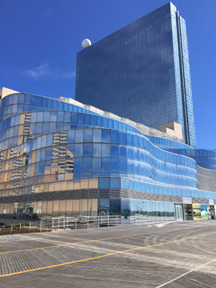
Glen Straub, owner of the closed Revel casino in Atlantic City, has begun another legal battle with New Jersey, this time over taxes he is paying on the former casino.

Straub wants the state to remove Revel from its payment in lieu of taxes program for city casinos. The state passed a bill setting set payments for casinos in an effort to halt costly tax re-assessments that had been crippling the city’s municipal budget.

Straub has filed the suit in Atlantic County Superior Court. The suit says Revel should be taxed as a vacant building and not as an operating casino under the PILOT program. Revel was closed when the state’s PILOT program went into effect a year ago and the suit points out that Straub has never owned the property while it functioned as a casino.

Straub bought the close property for $82 million out of bankruptcy court in 2015. The property closed in 2014.

“The PILOT Act penalizes it by requiring it to pay based on the fact that at one time the property was licensed to operate as a casino, but does not generate the level of revenue as casino properties because no casino operates there and, in fact, never did operate there in the entire ownership period of the plaintiff,” the complaint says.

Straub owes more than $8.3 million in taxes despite not having gaming at the property. Straub would be required to pay $5.1 million if the property was taxed based on its value, according to the suit.

“It’s crazy,” Straub told the Press of Atlantic City. “It’s not a casino, because the state says we need a license. They are penalizing us millions and millions of dollars.”

Straub also has a lawsuit against the state Casino Control Commission, which has ruled he needs a full casino license to re-open gaming at the property. Straub maintains that since he simply wants to lease the space to a casino company, so he does not need full licensing.

In another story centering on a closed Atlantic City casino, the resort’s mayor told the Press that the closed Trump Plaza casino is set to be razed by implosion in the spring.

The casino closed in 2014 and is owned by billionaire Carl Icahn, who took over the former Trump properties through bankruptcy action. Icahn did not comment on the story.

Atlantic City Mayor Don Guardian said the demolition plan does not include the site’s 2,658 parking space garage. The site would also have to pass city inspections for removal of hazardous materials—such as asbestos—before it could be demolished.

Pennsylvania Gaming Expansion Signed Into Law

Doubts remain over iGaming slot tax

Pennsylvania Governor Tom Wolf last week signed a budget reconciliation bill into law that also enacts the largest expansion of gaming since the state first legalized casinos in 2004.

Wolf’s signature makes Pennsylvania the fourth U.S. state to legalize online gaming, joining New Jersey, Delaware and Nevada. In Pennsylvania’s case, iGaming comes with a unique twist—casino operators both inside and outside of Pennsylvania may apply for licenses to operate gambling websites for PC and mobile applications for use by people located within Pennsylvania’s borders. License fees are $4 million each for online poker, online table games and online slot games—or $10 million for all three.

Current Pennsylvania casino licensees get first preference for the licenses, but If licenses remain unclaimed after the initial rollout, the state will license out-of-state operators piecemeal on those three segments at a fee of $4 million each.

The out-of-state provision was added because it is unclear how many current Pennsylvania casinos will apply for iGaming licenses, particularly to operate online slot games, which are by far the most profitable for New Jersey and Delaware online sites. (Nevada has online poker only.) The law sets the revenue tax at 14 percent for online poker and table games, but at a brick-and-mortar-style 52 percent for online slots. Many operators have already stated they cannot operate online slots profitably at a 52 percent tax rate.

“The rate for slots is high, and I don’t know how well casinos will do with that,” state Rep. George Dunbar told the Associated Press. “It’s something they’ll have to figure out internally. Hopefully, we didn’t put too high a number that will be prohibitive. The more casinos that are involved, the better finished product that we’ll have.”

Aside from the slot element, the potential to combine Pennsylvania’s population with the other three iGaming states to create pooled games is being viewed as a potential profit-generator for the poker sites created under the law.

Online gaming is only one of many gaming expansions enacted when Wolf signed the budget law. Gaming is projected to fill $200 million of the state’s $2.2 billion budget deficit with not only iGaming, but with a smorgasbord of other gaming expansions. Among the most prominent is a provision for up to 10 satellite casinos spread across the state in areas that do not currently have casinos.

Each of the state’s 10 larger casinos may bid on a satellite casino license that would allow up to 750 slot machines and 10 table games at a location that is outside a radius 25 miles from an existing casino. Bidding will start at $7.5 million, with table-game licenses costing an additional $2.5 million. License fees and taxes will go to local and state governments, public schools and civic development.

In addition to new satellite casinos, the law expands gambling to the airports, where current licensees can apply to operate interactive gaming parlors with tablet gaming at eight regional and international airports; and to truck stops, which are authorized to add five video gaming terminals, or VGTs, with revenue split among the operators, the state and the local host municipalities.

The VGT provision applies to truck stops that sell an average of 50,000 gallons of diesel fuel a month, have at least 20 parking spaces for trucks, have a convenience store, are current lottery retailers, and occupy at least a 3-acre parcel of land not owned by the Pennsylvania Turnpike. It falls far short of the VGT bill passed by the state House, which would have authorized up to 10 VGTs at each of thousands of liquor-licensed establishments. Many House members have vowed to continue fighting for expanded VGT authorization.

The law contains a provision allowing counties hosting current casinos to opt out of the VGT authorization, banning the truck-stop VGTs within their jurisdictions. Counties seeking to opt out must adopt a resolution in council and submit it to the state no later than December 30.

Among other changes in the law:

• The state’s two Class III resort-style casinos can now pay a fee to be relieved of the entry and slot-number limitations of the 2004 law.

• The new law also authorizes regulation and tax of daily fantasy sports betting, with DFS operators charge a $50,000 license fee with 15 percent of revenues going to the state. The law makes Pennsylvania the 17th state to enact a DFS law.

• The Pennsylvania Lottery is now authorized to offer instant ticket, lotto keno and other games online. The lottery may not offer casino-style games other than keno.

• Should the federal ban on sports betting be lifted, Pennsylvania casinos can apply to the gaming board to offer sports betting for a license fee of $10 million. Online sports betting will also be allowed.

• The casino host fee to local governments, struck down last year by the state Supreme Court, is reinstated at a flat $10 million annual fee to local governments.

Wolf, who previously opposed many of the gaming expansions he signed into law, told reporters after signing the bill that the package represents the best scenario for gaming expansion. “There’s been a lot of pressure from a lot of places in the commonwealth to actually expand this, and we do need some recurring revenue,” Wolf said, according to the Allentown Morning Call.

“Again, the goal has been all along to do what’s prudent, and not cannibalize existing gambling revenue coming to the state. And, I think what we’re settling on will actually do that.”

Some stakeholders in Pennsylvania moved quickly upon enactment of the legislation. Valley Forge Casino, one of the two resort-class properties, has already paid the $1 million fee to remove the restrictions of the 2004 law, which required membership fees or a minimum non-gaming spend for entry to the casino. The casino released a press release announcing the change to customers.

“Since opening five years ago, we have been constrained by the amenities requirements and membership fees which have confused and frustrated our guests,” said Valley Forge Casino Resort President and CEO Eric Pearson in the release. “We are thrilled to be able to welcome our guests to our casino in the same manner as the other Pennsylvania casinos. Lifting this special requirement for guests to enter the casino allows us to better serve our existing guests, and puts us in a better position to attract new visitors to our property.”

In Lawrence County, the Western Pennsylvania location of the ill-fated Lawrence Downs casino project—a license that is still dormant—Commissioner Dan Vogler announced that the county will pursue one of the satellite “mini-casinos” authorized under the law. According to a report in the New Castle News, county commissioners will meet with tourism and local chambers of commerce to determine the best location for the casino before submitting a bid.

And in the Lehigh Valley, the bill caused a surprise about-face from state Senator Lisa Boscola, one of the chamber’s biggest opponents of casino gaming and particular online gaming, as she represents the district where Sands Bethlehem—its parent company run by well-known iGaming foe Sheldon Adelson—is located.

Boscola voted for the expansion package and the online gaming it brings, because one of the perks in the law is release of $20 million in local-improvement funding to be used for a new science center in her jurisdiction.

Other potential reactions came in from as far away as Great Britain. Major iGaming news website Onlinecasino.co.uk speculated that Pennsylvania’s regulation of online poker and daily fantasy sports could reignite discussions of a possible customer-sharing pool with British iGaming sites.

“As part of the UK Gambling Commission’s drive to improve its services and make its market the best in the world, sharing resources with other countries has long been discussed,” wrote columnist George White for the site. “In light of this, the regulation of online poker, casino gaming and daily fantasy sports in Pennsylvania could bring talks of a possible deal back to the fore.”

Pennsylvania’s legalization of online gaming comes at the end of a five-year legislative battle, but lawmakers in some other states considering iGaming see it as a potential momentum-builder for their own online gaming proposals.

Lawmakers in West Virginia and Louisiana last week called for updates to their own gaming laws in wake of the Pennsylvania passage. “With (Pennsylvania) passing sports betting, online poker and daily fantasy legislation today, we must act this session or be left in the dust,” West Virginia state Rep. Shawn Fluharty said on social media, according to Card Player magazine.

And Louisiana state Senator Ronnie Johns has initiated a review of that state’s 1991 gaming law with an eye toward remaining competitive in light of the new Pennsylvania law, according to a report on the America’s Cardroom website.

Meanwhile, problem gambling groups, while not outright opposing Pennsylvania’s gaming expansion, are advising caution going forward. “At a minimum, (legislators should) make sure that there are protections that follow along with the National Council on Problem Gambling’s recommendations—both for the online option as well as for the stand-alone satellite casinos,” said Josh Ercole, chief operating officer of the Council on Compulsive Gambling of Pennsylvania, in an interview with WITF Radio Pennsylvania.

The law new doesn’t take effect until December 22—60 days after Wolf’s signature. After that, the state Gaming Control Board will promulgate regulations and hand out licenses to conduct iGaming, satellite casinos and the other expanded offerings. Observers predict that online gaming sites should be ready to launch by the second half of 2018.

Comedian Katt Williams Returns to Boardwalk Hall in February

Comedy icon Katt Williams will be performing LIVE at Boardwalk Hall on Saturday, February 24, 2018 at 8:00 p.m. Tickets for the show officially go on sale on Friday, November 10 at 12:00 p.m and can be purchased online at Ticketmaster.com, by calling 800-736-1420, or at the Boardwalk Hall box office.

This past year, Williams has immersed himself in multiple upcoming projects. From several big-name films to his latest standup special taping, the comedian remains at the top of his game.

Katt Williams’ upcoming movies include, “Father Figures” with Ed Helm and Owen Wilson, coming to theatres in December 2017. Williams also co-stars alongside Mike Epps for the ‘Meet The Blacks’ sequel titled, ‘The House Next Door’.

Over the years, Katt Williams’ comedy career has sustained tremendous change. The comedian has endured various challenges, among unpredicted industry shifts. However, the veteran comedian has taken it in stride, remaining in the business for over 12 years. His unforgettable specials and original comedic style continue to make him a force to be reckoned with.

Most commonly, Katt is known for his epic standup specials, including Katt Williams: Let A Playa Play, The Pimp Chronicles Pt. 1, Katt Williams Presents: Katthouse, Katt Williams: Pimpadelic, Katt WilliamsL 9 Lives,  Kattpacalypse and Priceless: Afterlife. The comedian’s most noteworthy film appearances include, Friday After Next (2002), Norbit (2007), American Hustle: The Movie (2007) and Scary Movie 5 (2013).

With his latest projects in full effect, Katt Williams appears on the comedy scene with undisputable presence. This will be a Katt Williams tour you won’t want to miss!

Fans may gain access to the pre-sale by subscribing to our Center Stage Comedy email list at www.centerstagecomedy.com and by following the Center Stage Comedy Facebook page at https://www.facebook.com/CenterStageComedy for exclusive event updates and promo codes.

Report: $5.8 Billion U.S. Sports Betting Market Possible

Issue heats up ahead of SCOTUS case; Trump administration supports leagues

As the U.S. Supreme Court’s hearing of New Jersey’s case challenging the federal ban on sports betting nears, a new report shows that a legalized sports betting market in the U.S. would be worth between $2 billion and $5.8 billion annually.

GamblingCompliance released a report on a study predicting those revenue numbers would result if anywhere from 21 to 37 states implemented sports betting programs at casinos, racetracks, retail outlets and mobile phone applications. Estimates concentrated on states with casino gambling.

The report’s release comes shortly before a major gaming industry conference on the subject, Clarion Gaming’s Sports Betting USA Conference in New York City November 14-15. Stakeholders from across the industry will focus on the federal sports-betting ban—the 1992 Professional and Amateur Sports Protection Act (PASPA)—and the merits of a nationwide repeal of the law.

The conference also will test the market demand for a legal sports betting market, and will focus on integrity in sports, which is PASPA’s key aim, and present opportunities for gaming growth against the harm currently being caused by the illegal betting market.

“This conference, the first of its type to be held in the United States, will hopefully be a guide for future forums and in the process achieve the legalization of sports betting across the U.S.A.,” said US Fantasy’s Vic Salerno, one of 50 “thought leader” panelists who will speak at the event.

PASPA prohibits sports betting in all states except those with pre-existing sports bet legislation—Oregon, Delaware, Montana and Nevada. Only Nevada has full-blown, single-event sports betting. The other three states offer only parlay wagers.

On December 4, first arguments are scheduled in the appeal of the lawsuit filed in 2014 by the four major professional sports leagues and the NCAA challenging a New Jersey law authorizing state-regulated sports betting at Atlantic City casinos. Lower courts ruled the law violated PASPA.

New Jersey has appealed those rulings to the high court on the basis that PASPA is itself an unconstitutional violation of states’ rights.

Last week, New Jersey Governor Chris Christie, who signed the New Jersey sports betting bill into law, lambasted the sports leagues who filed the lawsuit for what he called their hypocrisy.

“The hypocrisy is just so overwhelming,” Christie told Andrea Kremer of HBO’s Real Sports with Bryant Gumbel. “They say because we have the Giants and the Jets and the Devils that somehow we shouldn’t be allowed to have gambling here, because somehow it will threaten the integrity of the game. Well, are you kidding? How isn’t it threatening the integrity of the game in Las Vegas for the NHL and the NFL?

“I mean that’s why they no longer have moral high ground on this. They cannot make the integrity-of-the-game argument anymore… because they have now gone to the sports gambling capital of America with two of the four major sports now having teams in that city. It’s over.”

The report from GamblingCompliance estimates that if 21 states allow legal betting through land-based casinos alone, the market could produce $2 billion in gross gaming revenue annually. If 37 states introduce the legislation and if betting is extended to online and retail outlets and stadiums, that predicted value jumps to $5.8 billion. It adds that just five states could account for three quarters of this revenue: Nevada, Massachusetts, Pennsylvania, Illinois and New Jersey.

The report notes that a legal market would still face restrictions, such as those set by the 1961 Wire Act. This would prohibit bets that cross state lines, so each state would be responsible for its own players.

Meanwhile, the Trump administration has come down on the side of the leagues and against New Jersey’s sports betting law. Trump Solicitor General Noel Fransicso filed a brief with the Supreme Court last week holding that New Jersey’s law violates PASPA, and that PASPA itself falls within the bounds of the federal government’s “supremacy” over state law.

The solicitor general’s brief also contends that it is not necessary for the high court to rule on the constitutionality of PASPA in whole or part, which is what is being sought by New Jersey.

Regardless of the Supreme Court’s ruling in the New Jersey case, there is a movement in Congress to repeal PASPA through legislation. The American Gaming Association, which is lobbying heavily for a legislative repeal of the law, last week observed the 25th anniversary of the law’s passage with a statement from President and CEO Geoff Freeman.

“PASPA is a failed law that has driven everyday sports fans into an unregulated, illegal sports betting market that offers zero consumer protections and fails to benefit communities or strengthen the integrity of the sports we love,” Freeman wrote.

“Much has changed in the 25 years since PASPA was enacted. Today, casino gaming is omnipresent, American attitudes toward regulated gambling are extremely favorable and there is a newfound ability to use data from legalized sports wagering to protect the integrity of games. For PASPA to remain the law of the land is to place our collective heads in the sand and willfully ignore criminal activity, the will of the people and the power of technology. 

“PASPA’s days are numbered. The American Gaming Association is dedicated to working with the regulated gaming community, sports leagues and other stakeholders to finally provide sports fans with the wagering options and protections they desire and deserve.”

Atlantic City Announces Agreement to Upgrade Street Lighting to LED Technology

Mayor Don Guardian has signed an agreement with Atlantic City Electric to upgrade over 5,638 streetlights with high energy efficient light-emitting diode (LED) technology at no cost to the City. 

Mayor Guardian stated, “The City thanks the New Jersey Board of Public Utilities and Atlantic City Electric for helping to make this transition to LED lighting a reality.  This project is part of a concerted effort to provide better lighting in our neighborhoods and to improve public safety throughout the City.”

The total cost of the conversion is $750,000 which is fully funded by a grant from the New Jersey Board of Public Utilities.  Atlantic City Electric will continue to maintain the lights and replace them when needed under its LED streetlight pricing plan. 

“The Board is happy to help the City of Atlantic City upgrade to new high energy efficient LED streetlights that will greatly improve lighting, make the community safer and produce significant energy cost saving for the City,” said NJBPU President Richard S. Mroz.  “Energy efficiency projects like this also reduce demands on the grid which help to lower electric costs for all ratepayers.”

This project includes all the streetlights that are owned by Atlantic City Electric in the City.  The City has been working with Atlantic City Electric for four years to inventory the lights and develop this program.  Atlantic City will be the first major City in New Jersey to convert its entire City to LED technology.

“The effort will enhance public safety in Atlantic City by upgrading our street lights with all new state of the art fixtures. We are very proud to work closely with our partners the City of Atlantic City and the BPU” stated Vince Maione, Atlantic City Electric region president.  “LED streetlight technology is one example of how we are advancing innovative technologies that are transforming the future energy experience for our customers.” 

Atlantic City Electric has ordered the equipment needed to make the conversion and expects to commence installation in late November. 

The BPU has awarded Atlantic City a $2 million grant to fund the design and implementation of a City-wide conversion of street lighting to LED technology.  The remaining funds will leverage the conversion of City-owned street lights.

The second phase of this project will result in the conversion of another 3,283 City owned lights in the City.  Most of the City owned lights are near City facilities.  Atlantic City will also participate in NJ’s Clean Energy Program’s NJ SmartStart program for the second phase, which offers incentives for remodeling, renovation, equipment replacement, new construction and additions for commercial, industrial and local government facilities. Under the CEP SmartStart Buildings program, the incentive for LED street lights ranges from $50-$100 per light, depending on the product utilized. 

Atlantic City currently budgets approximately $2 million annually for energy to light its streets. With LED lights installed City wide, this cost should be reduced.   The City has made a concert effort to reduce energy cost by installing solar panels at the public works complex, solar lighting at Browns Park, LED lighting along the Boardwalk and completing an energy audit and upgrades at many city buildings.  The City plans to issue a request for proposal to develop a solar farm on Duck Island and is working on creating a microgrid to provide energy to critical facilities during power outages.

Atlantic City Casinos See 4 Percent Revenue Increase

Atlantic City casinos had a good September with revenue of $235.8 million, up 4.1 percent over September 2016.

However, if revenue figures for the now -closed Trump Taj Mahal—which closed in October 2016—are excluded, the seven remaining Atlantic City casinos saw a 7.9 percent increase in revenue.

Online gambling in the resort had another strong month taking in $20.4 million, an about 25 percent increase over 2016. It was the seventh consecutive month that online gambling revenue topped $20 million.

“More than half of the casinos had their best September in a decade or more, and the current operators as a group were up 7.9 percent, some of which was the result of having one more Saturday than in September last year,” stated Matthew B. Levinson, chairman and chief executive officer of the Casino Control Commission in a press release.

For the year to date, gambling revenue for the city’s casinos reached $2 billion through September, compared with $1.8 billion in 2016. Total online gambling revenue for the year is up 27.1 percent to $183.6 million through September, compared with about $144.5 million a year ago.

“This isn’t just luck. Business is building,” Levinson said. “Revenue at one operator was flat, but every other casino and every internet operation was up for the first nine months of this year.”

Five of the seven casinos currently operating showed increases in September, led by the Golden Nugget, which was up 14.1 percent to $24.6 million, according to an analysis by the Associated Press. Bally’s was down 1.7 percent 1 to $17.8 million and Caesars was down 0.1 percent to $29.8 million.

Report: Sands Bethlehem Sale Rumored

The New York-based investment firm that earlier this year reportedly made an offer of $225 million to buy Atlantic City’s shuttered Revel property has made is now planning to bid on the Sands Casino Resort Bethlehem, according to a report on the Lehigh Valley Live website.

According to the report, Keating & Associates LLC and its attorney, Brian Callaghan, are evaluating the Sands property, owned by Las Vegas Sands Corporation, and preparing to deliver a letter of interest in a sale. “As a company, we would be honored to have a jewel of a property like the Sands in Bethlehem within our portfolio, which is why we have initiated our evaluation process,” Jeffrey Keating, co-chairman of Keating and Associates, told Lehigh Valley Live. “The Sands is a wonderful property that we believe we can bring to the next level through programming and community activation.”

Although it has never officially acknowledged that the Sands Bethlehem property was for sale, negotiations for a sale to MGM Resorts International did take place, and ultimately broke down due to uncertainty with respect to bills in the Pennsylvania legislature to expand gaming.

The website reported that Keating could tender an official offer for the Sands within the next 30 days, although Sands spokesman Ron Reese told the website he had never heard of Keating and has not been contacted by the firm. That’s the same reaction given by Revel owner Glenn Straub when asked about the Keating offer for his property.

Sands Bethlehem had its best month ever in table-game revenue in September, its $22.7 million in revenue—a nearly 17 percent year-on-year increase—projecting it for the first time over Bensalem’s Parx Casino as the state’s highest-earning casino. Total gambling revenue for the month was $47.5 million, edging out Parx by only $59,000.

Resorts World Catskills Seeks To Fill 1,500 Jobs

Set to open in March 2018, Empire Resorts is seeking to fill, 1,500 jobs at its $1.2 billion Resorts World Catskills Resort Casino, in Monticello, New York. The challenge, however, is finding qualified applicants in a county with only 1,600 unemployed people. Empire Resorts President and Chief Executive Officer Ryan Eller said, “We have to fill our pipeline with thousands and thousands of candidates to yield 1,400 full-time employees and another 100 part-time employees. That is a significant challenge. I think that we will be successful, because we’re going to have very compelling compensation. It’s going to be really solid, middle-class jobs.” Starting pay will be $40,000-$50,000 or more, depending on tips, Eller said.

Eller also noted 600 dealers will be required by opening day. “We’re going to start using more social media, more advertising to get the word out there,” he said. Dealer classes already have begun.

Located on the former site of the Concord Resort, Resorts World Catskills will offer a 90,000 square foot casino with 2,150 slot machines, 102 table games and a poker room, plus an 18-story, 332-room 5-star hotel, a golf course, indoor water park, pools, spa and fitness center, entertainment village, nature trail and dining options including a high-end Italian steakhouse and an Asian restaurant.

Resorts World Catskills is one of four non-Native American, Las Vegas-style casinos authorized by New York state after voters approved a constitutional amendment to expand gambling in 2013. Three already are operating in Schenectady, Finger Lakes and the Southern Tier, although gaming revenue has fallen short of projections. However, Eller said, “Those were regional casino properties, focusing on that type of business. Ours is something where we’re focusing on a destination resort that is anchored by casino gaming.” He noted, “The only way that you’re going to be successful is doing something different.”

Montreign is a wholly owned subsidiary of Empire Resorts, which also owns the Monticello Casino and Raceway. A joint venture company of Genting Berhad, Resorts World, has facilities in New York City, England, Malaysia, Singapore, the Bahamas and the Philippines; a new property also is under construction in Las Vegas.

New Jersey CRDA Cuts Spending

The New Jersey Casino Reinvestment Development Authority has approved a 2017-18 operating budget, which decreases spending by more than 14 percent.

The $8.7 million budget is down $1.4 million from last year. The cuts were achieved mostly through cuts in CRDA staff.

The authority overseas the Atlantic City tourism district and funds improvement projects throughout the city and state.

“This budget clearly demonstrates the CRDA’s commitment to the Tourism District and to this great destination city,” said Chris Howard, executive director of the state agency in a press release. “By investing available funding in a wide range of partnerships, CRDA will continue to be a key part of the momentum driving the renaissance of Atlantic City. We are excited for all the great things to come in 2018.”

The authority cut 15 percent of its full-time staff during a reorganization in March, according to a report in the Press of Atlantic City. The cuts came after the authority lost $22 million in casino tax revenue as part of a state-implemented Atlantic City rescue package.

The CRDA Board also approved the budget for Meet AC, the resort’s convention and visitor’s bureau which stayed steady at $7 million, according to the Press.

Maryland Casinos Seek Lower Payout Threshold, Eye New Games

New RTP minimum closer to that of neighboring states

The Maryland Lottery and Gaming Commission has given preliminary approval of a drop of up to 3 percent in the minimum theoretical return-to-player percentage allowed for slot machines at the state’s casinos. According to a report in the Baltimore Sun, a final decision on implementation of the new rule is pending from state officials.

The minimum payback percentage on Maryland slots is currently 87 percent. Casino promoters of the drop in the percentage pointed to neighboring states such as New Jersey, which has an 83 percent minimum RTP, and to Nevada’s 75 percent minimum, in asking the regulators to lower the payout requirement.

The News 4 I-Team, an investigative unit of the Washington, D.C.-area NBC affiliate, reported last week that Maryland’s slots pay out slightly less on average than they did in 2012, and reported that the casinos’ request came amid complaints from gamblers about “tight slots” in D.C.-area casinos such as the MGM National Harbor and Maryland Live.

However, the news team could not verify complaints with data from the state, instead reporting anecdotal complaints from casino customers.

The new rule would not, of course, preclude casinos offering higher payback percentages or staying at current levels. The Sun quoted officials of Hollywood Casino Perryville, for instance, saying current hold strategies will not be affected by the change. “There is an opportunity for additional revenue for the state and the casino,” a spokeswoman said. “We support the change but do not plan to have a specific strategy to change our operation in any way. We have to stay competitive within the state and outside our borders, and customers need to know they can win here as much as at any casino around the area.”

An official of the National Council on Problem Gambling commented to the “The state would keep more money, because there would be more revenue from the slot machines, but there wouldn’t be more money going into the problem gambling fund,” NCPG Executive Director Keith Whyte told the Sun. “Problem gamblers are not very sensitive to payouts.”

Meanwhile, Maryland lawmakers are looking at one other development other than higher hold percentages to boost state gaming revenue. A panel of gaming suppliers headed up by New York-based GameCo, Inc. presented information last week to a joint legislative committee on the addition of new offerings such as skill-based games and eSports.

It was the first meeting of the Maryland Joint Committee on Gaming Oversight since it heard information last year on daily fantasy sports, which is now regulated in the state.

“As Maryland’s casino market matures, each of the six casinos is fine-tuning and adjusting its gaming floor to meet customer trends and demands,” said Carole Bober Gentry, managing director of communications for the Maryland State Lottery and Gaming Control Agency, in an interview with the Delmarva Daily Times.

At the committee meeting, Blaine Graboyes, co-founder and CEO of GameCo Inc., said skill-based video games and eSports competition can boost sagging revenues for the casinos. “Slot playing has been stagnant, and skill-based games address these challenges with a differentiated experience on the floor, and will bring in a younger audience,” Graboyes said.

Switzerland Approves Online Gambling Regulations

Switzerland has adopted new gambling regulations that allow for online gambling, but close the country off to offshore betting sites.

The new rules cover both the casino industry and the online gambling sector. Switzerland has been a grey market for online betting companies up until now.

Under the new law, foreign companies have been formally banned from operating in Switzerland and only locally licensed operators who have already established a land-based presence in the Swiss casino sector will be able to legally run online gambling services. The rules also allow the government to block unlicensed sites operating in the country.

The legislation also sets new tax values for winnings from lottery or sports betting which will be applied only for revenue exceeding CHF 1 million. The rules are expected to go into effect in January.

The revisions update the country’s gambling laws first passed in 1928, and last amended in 1998. However, the rules have been criticized by various Swiss political parties such as the Green Liberals and Free Democratic Party, that say the legislation breaches current EU laws on free movement of business services and adds new restrictions to internet access.

Gladys Knight at Trop

Seven time Grammy award winner Gladys Knight takes the stage at The Tropicana Showroom November 11 at 8:00pm.

Gladys Knight, known as the “Empress of Soul”, is an American singer-songwriter and actress. She has recorded more than 38 albums over the years, and is best known for well-loved ballads including “Midnight Train to Georgia”, “Heard It through the Grapevine”, “Neither One of Us”(Wants to Be the First to Say Goodbye), and her rendition of the Etta James classic “At Last”.

Enjoy an evening with Gladys Knight, as she showcases fan favorites and newer hits at 8 p.m. on Saturday, November 11, 2017, in the Tropicana Showroom.

Tickets: $90.00 – $307.00
Visit: https://tropicana.net/events-and-promotions

Kenny Rogers: The Gamblers Last Deal

Kenny Rogers will perform in his final farewell concert, The Gamblers Last Deal, at the Golden Nugget Hotel Casino on Saturday December 9, at 9:00 pm.

Country music legend Kenny Rogers is gearing up for retirement and you don’t want to miss his final farewell concert celebration. 

Kenny Rogers has left a mark in the history of American music during his career that spanned for more than six decades. Songs like “The Gambler”, “She Believes in Me”, “Through the Years”, and “Lady” are just a few songs that have endeared music lovers throughout the world. Rogers is a Country Music Hall of Fame member, a three time Grammy Award winner and a six time CMA winner. He was voted the “Favorite Singer of All Time” in a joint poll by readers of both USA Today and People.

Tickets: TBA
Visit: https://www.goldennugget.com/atlantic-city/entertainment/