Author: Casino Connection Staff

Valley Forge Fined $52K for Free Play Overuse

The Pennsylvania Gaming Control Board has levied a $52,000 fine on the Valley Forge Casino in King of Prussia, reportedly for going overboard on issuing free-play rewards to its loyalty club members.

According to the board, lower-level employees were found to have regulatory loaded loyalty cards with free play rewards, totaling 557 times in 2016 and 2017 for a total or $411,000, in violation of regulations requiring close control of such player rewards.

Casino lawyer Michael D. Fabius told the Philadelphia Inquirer that no fraud was involved in the free-play awards, as each was approved by a supervisor with the authority to issue comps.

“We have absolute confidence that every one of these free-play transactions was issued to a real customer with a real business reason,” Fabius said. He noted that 170 customers received the slot play noted by the board, with 80 percent of the award money going to the casino’s top 20 players.

The gaming board has been hyper-sensitive to excessive free play since a scam by an executive of Mohegan Sun Pocono in which he loaded free play totaling $420,000 to cards to a cocktail waitress, using numbers she lifted from player cards while serving drinks. The waitress then played the amount through and cashed out to split the money with the executive. That scam resulted in a $1 million fine for Mohegan, the largest fine issued by the board in the 14-year history of gaming in Pennsylvania.

Valley Forge officials agreed to pay the fine in the current case.

Pennsylvania Operators Pony Up for iGaming Licenses

After 30 days, remaining licenses can go to outside operators

After much speculation as to whether Pennsylvania casino operators would pay for full online gaming licenses given an onerous online slot tax, nine operators swallowed their wallets and submitted applications for full online gaming to the Pennsylvania Gaming Control Board just ahead of last Monday’s deadline.

Last week’s deadline was the last day operators could petition for a discounted license fee of $10 million to operate online poker, online slot games and online table games. Each license costs $4 million individually.

Parx Casino at Philadelphia Park in Bensalem, Mount Airy Casino Resort in the Pocono Mountains resort region and Live! Hotel and Casino, currently under construction in Philadelphia, were the first to petition for the $10 million full iGaming license, a week ahead of the deadline.

Six others slipped their applications in on the final day: Penn National Gaming, which applied for a license tied to its Hollywood Casino outside of Harrisburg; Harrah’s Philadelphia in Chester; SugarHouse Casino in Philadelphia; Rivers Casino in Pittsburgh; Valley Forge Casino Resort in King of Prussia; and Sands Casino Resort Bethlehem.

The Sands would have been the most unlikely to apply for an iGaming license, given the longstanding battle against legal online gaming pursued by Sheldon Adelson, chairman of parent company Las Vegas Sands Corp. However, the property is in the process of being acquired by Wind Creek Hospitality, an arm of Alabama’s Poarch Band of Creek Indians, for $1.3 billion.

The tribe made it part of the purchase agreement for Sands to pursue an online gaming certificate “in good faith.” The casino even made sure to give the tribe credit for the iGaming application in its petition, writing, “Sands submits to this petition in the interest of Wind Creek so that, if approved, and after Wind Creek acquires the purchased interests, Sands can conduct interactive gaming in the commonwealth of Pennsylvania.”

The gaming board must approve or deny petitions within 90 days, and the fees are due within 60 days after approval.

Of the four remaining Pennsylvania licensees, the Meadows Racetrack & Casino outside of Pittsburgh is in the process of being acquired by Penn National, and would be able to move forward with it own online gaming site under Penn National’s license. (The gaming law permits each licensee up to three “skins,” or iGaming websites.) The casino would need a separate license to operate sports betting online under the one domain. (Sports betting is limited to one skin.)

The three operators now have until August 14 to submit individual applications to offer any or all of the online games. Should there be licenses left over that, under last November’s gaming expansion law, the Pennsylvania Gaming Control Board could open up the petitions to out-of-state operators.

Many among Pennsylvania lawmakers and in the budget-crunched state government breathed a sigh of relief after the last-minute petitions, and the $90 million in quick revenue it will bring in the application fees. It had been uncertain how many operators would go for the full licenses, particularly the license to operate online slot games. The revenue tax on online slot games is set at 54 percent, the same as slots in brick-and-mortar casinos. Many have called the tax unworkable, and it is a big reason there may be iGaming licenses left over in mid-August.

The other factor that had been expected to reduce the number of takers for the slot licenses—and which may delay the creation of iGaming sites—is the state’s iLottery, which is offering the same slot-style games that the operators would offer on their online casino sites. The operators are threatening to sue to eliminate the games, which are nearly identical in play to online slot games and, the operators say, thus illegal under the state’s gaming law.

So far, the state Revenue Department, which runs the lottery, has refused the operators’ request, sent in a letter late in June, to eliminate the slot-style iLottery games, agreeing only to stop marketing them as slot games.

As in New Jersey, Pennsylvania operators will only be ably to offer play to those physically located in the state, and can prove through identity confirmation software that they are at least 21. Pennsylvania also has the option to create interstate compacts with other states that offer legal iGaming, permitting players in those states to choose any legal iGaming site licensed by those states.

What remains to be seen is what type of profit will be possible with the high tax on internet slot games, which drive the revenue in the current legal markets of New Jersey and Delaware (Nevada has online poker only). In New Jersey, online games accounted for $139.5 million in revenue the first six months of the year, up around 15 percent from 2017.

Online and sports betting come to Pennsylvania at a good time for the casino licensees, who recorded record revenue for the 2017-18 fiscal year.

The gaming board reported last week that casino gaming revenue from slot machines and table games at the state’s 12 operating casinos totaled about $3.25 billion for the year, up about 1.4 percent over FY 2016-17.

The previous record was set two years ago, with nearly $3.23 billion in revenue.

The board said table games revenue grew about 3.3 percent to $895.3 million, while slot machine revenue inched closer to $2.4 billion with a 0.7 percent increase for the year.

Tops in revenue growth for table games was The Meadows Casino (up 22.2 percent), followed by Lady Luck Casino Nemacolin (up 14.7 percent) and Valley Forge Casino Resort (up 10.3 percent). Valley Forge also grew slots revenue by 8 percent last year, the highest of the 12 casinos, according to the board.

Australia Investigating Offshore Gambling Sites

The Australian Communications and Media Authority is investigating a potential scam by illegal offshore gambling sites that are deceptively using the internet domain code of a remote Australian territory.

The sites are using domain codes from Cocos Islands—an Australian territory located 3,000 kilometers from Perth in the Indian Ocean. The sites are said to actually be based in Europe and the Caribbean, but are using the island’s online domain code.

According to a report by the Australian Broadcasting Company, the authority is concerned that Australian citizens are playing at the unlicensed casino and sports betting sites.

“When deciding if a site should be investigated, the ACMA considers a number of factors, including whether the service being provided may be a prohibited or unlicensed service … and whether it may have an Australian-customer link,” an ACMA spokesman told the ABC.

Monash University gambling law expert Dr. Charles Livingstone also told the network that there was no doubt the sites were breaking Australian law.

“The avowed purpose of the IGA is to protect Australians from less well-regulated gambling sites and to prohibit non-wagering gambling being available online,” he said. “Using a web address of an Australian territory to offer online gambling services is an offence, unless the provider is registered in an Australian jurisdiction.”

Sci Games Launches Monopoly Slot App

Gaming supplier Scientific Games, through its SG Social division, has launched a slot machine mobile app carrying the theme of the iconic board game Monopoly, under a continuing license agreement with Monopoly owner Hasbro, Inc.

“Building on SG Social’s successful history of social slot innovation, ‘Monopoly Slots’ offers new features and functionality that further engage fans with the iconic brand’s popular characters, game play and movers,” stated Scientific Games in a press release.

The mobile app is available for download on multiple online platforms, including the Apple App Store, Google Play, Facebook and Amazon App Store, according to the firm. It was released worldwide.

“Monopoly and Scientific Games have a longstanding history of successful collaboration, and this new game launch further signifies the strength of our relationship with Hasbro,” said Scientific Games’ new chief executive Barry Cottle in a prepared statement.

Scientific Games announced in February the launch of SG Digital as a new business unit incorporating the firm’s existing portfolio of interactive business-to-business products and services with those of the newly acquired sports betting unit NYX Gaming Group Ltd. The parent firm said at the time that SG Digital would have a workforce of 1,500 across 34 offices, providing support services for over 200 corporate customers with over 2,000 games and an aggregate of 40 licenses worldwide.

Atlantic City Seafood Festival

The Atlantic City Seafood festival returns to Bader Field in Atlantic City Saturday, September 8 & Sunday, September 9, 2018 for some of the best food the Shore has to offer.

Decades ago, Atlantic City had one of the largest and most coveted seafood festivals in the nation. The annual event took place in historic Gardner’s Basin, at the north end of Atlantic City. The event subsequently faded into the annuls of local history, until 2012, when Good Time Tricycle Productions created a new event that exceeded all previous expectations, with a larger floor plan, more programming, and family-friendly activities.

With the majority of the restaurants attending being brick and mortar Atlantic City restaurants, The Atlantic City Seafood festival will continue to give attendees the opportunity to experience this seaside city as a culinary destination. It is also a great opportunity for foodies and food seekers to meet some of Atlantic City’s most unique chefs and restaurateurs all while eating their tasty creations. From clams to calamari, oysters to ahi, and even alligator too, The Atlantic City Seafood Festival has it all!

The festival runs 11 a.m.-6 p.m. both days.
Tickets are $10.00 with children under 12 free.
For tickets & details visit:www.acseafoodfest.com

Sports Betting Heats Up In New Jersey

What is expected to be the busiest sports book in New Jersey began operations at the Meadowlands Racetrack in the shadow of New York City and immediately reported heavy action at the betting windows.

The FanDuel Victory Sports Bar & Club is the fourth live sports book to open the state, behind Monmouth Park Racetrack to the south and two Atlantic City casinos. The Meadowlands facility, however, is just minutes from Manhattan and is also in the same complex where the NFL’s New York Giants and Jets Play.

Despite it being a slow season for sports betting, initial reports—though not official numbers released by the state—had more than $1 million being bet at the facility on its opening weekend.

The first bet at the facility was placed July 14 by former state Senator Raymond Lesniak, a steady proponent of expanding gambling in the state and one of the principal forces in the state’s push to overturn a federal ban on sports betting. He placed an ultimately winning bet on France to win the World Cup and also a bet on the New York Giants to win the Super Bowl.

The opening also coincided with a major race at the track—the Meadowlands Pace—which helped bring large crowds to the new sports books.

“Our goal was to do over $1 million for the weekend,” track owner Jeff Gural told NJTV, the state’s PBS station. “I know we were at $560,000 on Saturday and before I went to sleep last night we were at $465,000 or something for Sunday, so I was very pleased.”

Those figures already surpassed the daily average of $480,954 in bets Monmouth Park averaged over its first 17 days in operation. According to figures released by the New Jersey Division of Gaming Enforcement, Monmouth Park saw a sports betting handle of $8.176 million for June. That sports book opened June 14.

The first report on sports betting by the division said the state’s three operating sports books took in $16.4 million in total handle for June, keeping about $3.5 million in revenue. That figure, however, includes bets of future events and uncashed winning tickets. Total win for the state was reported at about $1.2 million with the state collecting about $294,000 in taxes.

The FanDuel facility opened with 10 betting windows and officials said they hope to up that to 15 by the start of the NFL season. The Victory Bar features nine large video screens showing games and betting odds and many patrons said it had a nightclub-like feel. The 5,300-sqaure-foot bar has 27 video screens overall.

Gural said that he hopes to work out a deal with both the Giants and Jets to provide shuttle service between their stadium and the sports book, according to reports. MetLife Stadium officials told ESPN they have made no decision on the plan.


FanDuel’s Tech Partners

Meanwhile FanDuel, now a subsidiary of Paddy Power Betfair, announced it has partnered with IGT, which will provide FanDuel Group’s sports betting platform. The group also has a partnership with GAN plc.

According to a press release, FanDuel will leverage Paddy Power Betfair’s leading pricing, trading and risk management capabilities, which have been integrated into the IGT platform, along with a bespoke user interface to offer a best-in-class consumer experience. The joint solution will operate as FanDuel Sportsbook.

“We are delighted to choose IGT’s leading platform for our sports betting platform in New Jersey, starting with the recent ‘go live’ at the Meadowlands Racetrack,” said Matt King, FanDuel Group CEO in the release. “When we evaluated sports betting platform provider partners in the U.S., IGT was the ideal choice, based on the company’s proven history in the space and the quality, reliability and flexibility of the sports betting technology that it has deployed for customers around the world.”

The partnership includes an eventual move into online sports betting, the release said. According to the Associated Press, FanDuel plans to offer online sports betting through its partnership with the racetrack and other online gaming through its affiliation with the Golden Nugget in Atlantic City. GAN and IGT will provide the technology platform for both.

In a press release, GAN said it is working to complete the integration into the GAN Platform of FanDuel’s nominated Internet sports betting software which is a combination of IGT’s sports platform and Paddy Power Betfair’s leading pricing, trading and risk management technology, along with a user interface designed for the US customer by the FanDuel team.

“Online sports betting ‘go-live’ preparations for FanDuel are well advanced and we remain confident in launching integrated sports betting alongside our existing Internet casino later this year,” said GAN CEO Dermot Smurfit in the release.


New Sports Betting License Applications

Also, New Jersey regulators announced that they have received five new applications for sports books. The DGE had issued a warning to potential operators that if they want approval by the start of the NFL season, they had to apply by early last week.

David Rebuck, director of division, told the AP that applications were made by two brick-and-mortar facilities and three applications were made for online gambling by the unofficial deadline. Missing the deadline has no penalty for applicants, it simply means that regulators will probably not have time to approve an application by the start of the NFL season.

“Everybody wants to be fully functional by the end of August,” Rebuck told the wire service. “We’ll see.”

Rebuck did not identify the applicants, but the AP reported that Caesars Entertainment made applications to offer live sports betting at its Harrah’s and Bally’s Atlantic City casinos. The Bally’s sports book would also serve the adjacent Caesars Atlantic City.

The company also applied for permission to offer mobile sports betting affiliated with all three of its Atlantic City casinos, according to Kevin Ortzman, the company’s Atlantic City regional president.

The Golden Nugget casino also applied for in-person and mobile sports betting, according to its executive vice president, Tom Pohlman.

The applications for live sports books include permission to reconfigure areas of the casinos for sports betting and approval to license employees for the sports books. According to the Press of Atlantic City, the petition from Bally’s proposes using 3,648 square feet inside its Wild Wild West area for a temporary sports book. Seating, tables and video displays will be installed and existing cashier windows will be reopened to take sports wagers, the petition said.

The Harrah’s petition proposes eliminating 11 slot machines and installing video displays, seating and furniture for a temporary sports book area. The petition also proposes a modification to the satellite Total Rewards Center for sports wagering windows, the Press reported.

Details of Golden Nugget’s plans were not released. The casino has partnered with Churchill Downs to offer sports betting.

If approved, the three casinos would join the Borgata and the newly opened Ocean Resort casino in Atlantic City as offering sports books.

Applications had also been made before the deadline by Resorts casino, which has announced a partnership with FanDuel rival DraftKings. The application was for both online and live sports betting at the casino, the AP reported.

DraftKings founders Jason Robins and Matt Kalish recently tweeted, however, that the company is working on a sports betting app, though did not give a timeline on its launch. DraftKings also recently announced it will partner with the Del Lago Resort & Casino in Waterloo, New York, should that state approve sports betting.

There have also been reports that DraftKings is preparing to launch a fundraising drive hoping to raise about $200 million for its sports betting product. DraftKings has opened an office in Hoboken N.J. and announced a deal with platform provider Kambi.

Hard Rock Atlantic City has also made an application for a sports book license, according to the AP. The casino has reportedly partnered with Bet365 for a possible online site.

Under the state’s sports betting law, there are 14 potential licensees for sports betting including Atlantic City’s nine casinos, three state racetracks and two former racetracks. The application fee for a sports betting license is $100,000.

In another story, SportAd, a Washington DC-based sports gaming startup also announced it is partnering with Ocean Resort casino to offer its “FastFantasy” game in New Jersey. The game combines sports betting formats with fantasy sports scoring into real-money contests that will be playable across Ocean Resort’s digital and mobile channels, and featured in the Atlantic City casino’s new sportsbook, the company said in a release.

The game focuses on creating proposition bets and first launched in July 2017 in New Jersey’s regulated online gaming market through SportAD’s partnership with Resorts Digital, and has since expanded to other regulated states, the release said.


Leagues Respond to Monmouth Park Suit

Finally, lawyers for the four major professional sports leagues and the NCAA replied to a lawsuit brought by the New Jersey Horse Racing Association to collect betting revenue that was lost while the leagues fought to block the state’s efforts to legalize sports betting—calling the suit frivolous.

New Jersey spent an estimated $9 million in a long battle to overturn the federal Professional and Amateur Sports Protection Act. That battle culminated in May when the U.S. Supreme Court struck down the law as unconstitutional.

The lawsuit charges the leagues acted in bad faith when they got a restraining order in 2014 to block Monmouth Park Racetrack from offering sports betting. The association says the track lost close to $140 million during the several years of litigation.

Lawyers for the leagues say they were exercising their rights under the former federal law, according to a report by the AP.

Atlantic City Casino Reinvestment Funds to be Refocused

The New Jersey Casino Reinvestment Development Authority welcomed a new executive director and deputy executive director who both said they want a new direction for the authority.

Matt Doherty, 44, and Marshall Spevak, 30, assumed their respective roles as executive director and deputy executive director.

Doherty, the former mayor of Belmar N.J., was appointed by Governor Phil Murphy to the $175,000-per-year position in March. Spevak, former chief of staff for Assemblymen Vince Mazzeo and John Armato, both of Atlantic County, was appointed in April to fill the role vacated by Doherty’s promotion, according to the Press of Atlantic City.

Doherty said his mission is to “spearhead development in the Tourism District” by working with smaller developers to invest in the city’s tourism district while also capitalizing on the momentum from larger projects—such as the opening of two new casinos and a Stockton University city campus.

He also called for the authority to be “more engaging with the community” and “more transparent in our operations as an organization here in the city.”

“After years of negative press—rightfully so—now is the time for us to really promote everything that’s happening in the city and bring in more private economic dollars to develop vacant land that are oceanfront, beach-block properties,” he said according to the Press.

Spevak added that the authority will actively work with city residents, businesses and civic groups to navigate the bureaucracy of developing projects in the city.

“We want to be responsive to the residents who live here in the Tourism District and to all the residents in the city,” Spevak said. “Now that I’m here, I’ve come to realize just the incredible amount of things that go on here. This is an important organization in the city. We really cover so much here. But I think we have a really good staff that’s on top of it.”

In another Atlantic City story, Hard Rock Atlantic City—which opened June 28—has also opened a new gas station and convenience store on its property, believed to the first time a casino has opened such a facility in the resort.

“Rocktane Gas & Wash” is outside the parking garage of the hotel, between Maryland and Virginia Avenue, and will be open 24-hours-a-day. The 16-pump gas station includes a 5,100 square-foot convenience store as well as an automated carwash, according to a press release.

New Jersey Sees $3.5 million in Sports Betting Revenue in June

New Jersey’s three operating sports books saw a total handle of about $16.4 million in sports bets, taking in about $1.2 million in direct revenue—basically win—for a 17-day period in June.

Sports betting went live in the state on June 14. Total revenue was listed at about $3.5 million, but that includes bets on future events—which New Jersey does not count as direct revenue until the events are completed—and unredeemed winnings and adjustments. So the net revenue on sports betting can’t be determined on a month-to-month basis.

According to the report by the state Division of Gaming Enforcement, the $16.4 million in Total Handle included $15.4 million, or 94 percent related to completed events. About $10.1 million, or 66 percent of that was bet on MLB Baseball and $2.2 million, or 14 percent was bet on soccer and the World Cup.

Sports books opened June 14 at Monmouth Park Racetrack in Oceanport New Jersey and the Borgata casino in Atlantic City. A third sports book opened at Ocean Resort casino in Atlantic City on June 28.

Revenue by sports book broke down as $2,279,166 for Monmouth Park, $986,831 for Borgata and $192,671 for Ocean Resort. Again, the figures represent total revenue included future events and unclaimed tickets.

According to an analysis by the Asbury Park Press, Monmouth Park Sports Book by William Hill—the first to open in the state—generated a total handle of $8,176,212 for the 17-day period. The total revenue of $2,279,166 generated $193,605 in taxes.

Not included in the report is the 1.25-percent that goes to county and municipal governments where tracks are located. For casinos, the fee goes to a fund to promote Atlantic City.

Monmouth Park had a winning percentage on sports wagering of 11.8 percent, which equates to revenues of $967,403.

“We are extremely pleased with our numbers,’’ Dennis Drazin, president and CEO of Darby Development LLC, which operates Monmouth Park told the paper. “We think they show there is a huge appetite for sports betting. To be generating these numbers early, and it’s not even football season yet, speaks enormously of the potential for when football season comes around. So we’re thrilled by the early numbers.’’

In a possible indication that sports betting is also helping the track’s racing wagering, on nine weekend/holiday racing dates between June 14 and July 12, Monmouth Park’s on-track handle averaged $399,589, up 3.4 percent over the same dates a year ago, the Press reported.

The sports book operations at Borgata and even for two days at Ocean resort also helped Atlantic City casinos for the month.

The city’s now nine casinos took in in $233.6 million in June 2018, an increase of 7.3 percent from June 2017. Online gambling was also up 12.1 percent for the month to $22.6 million.

According to an analysis by the Associated Press, the Borgata had the best June in its 15-year history, winning $65.8 million from gamblers, more than twice the amount won by its nearest competitors in Atlantic City.

The city’s two newest casinos Hard Rock and Ocean Resort started soft-play gambling, a test with real money but for only a small group of guests, three days before their June 28 openings. Hard Rock won $4.1 million in that period, while Ocean Resort won $3 million, the AP said.

Meanwhile, a fourth sports book at the Meadowlands Racetrack was scheduled to open July 14. The track is opening the FanDuel Sportsbook at Victory Sports Bar & Club.

Due to the close proximity of the Meadowlands to New York City—as well as being where the New York Jets and Giants NFL teams play—the facility is expected to be the busiest sports book in the state.

“When you get to the metropolitan New York area anything could happen,” track owner Jeff Gural recently told reporters. “We’ll have to wait and see how it plays out.”

The track is partnered with Paddy Power Betfair to offer sports betting and officials from the bookmaker have confirmed they will use FanDuel’s branding for the facility.

Paddy Power recently announced it had completed its acquisition of FanDuel and that Paddy Power Betfair’s U.S. operations will now be known as FanDuel Group.

The company will be run by FanDuel CEO Matt King with Betfair US CEO Kip Levin taking over as president and COO of FanDuel Group. Levin will also remain CEO of online horse betting operation TVG.

The operations of the FanDuel Group, which include the daily fantasy sports operation, TVG, Betfair online casino in New Jersey and DRAFT fantasy sports, boasts a customer database of 8 million across 45 states and $265 million in annual revenue.

Also on the horizon could be a sports book operation at the Hard Rock casino in Atlantic City, which has reportedly signed a deal with European operator Bet365. Neither company, however, has confirmed the deal publicly, but the deal was confirmed in regulatory paper work.

Many analysts feel that the partnership with Bet365—an online operator—is likely a deal allowing the company to operate its own online brand in the state. Online gambling sites must partner with Atlantic City casinos in New Jersey.

It’s still unclear if Hard Rock will be able to open a live sports book at its property. Hard Rock has a stadium naming rights deal with the NFL in Miami, but it is unclear if restrictions in that deal would block the casino from offering a sports book or at least betting on NFL contests.

Finally, technically casinos and racetracks were allowed to begin online sports betting on July 11, but so far, no announcements of any online sites have been made. The state has also not announced that any potential sites have received regulatory approval.

MGM Sues October 1 Victims

In a bid to head off a barrage of lawsuits from victims of last October’s mass shooting on the Las Vegas Strip, MGM Resorts International is suing 1,000 of them in hopes of escaping liability under federal law.

MGM is being sued by thousands of people who claim the company was negligent for not preventing the October 1 massacre, the worst in U.S. history, in which gunman Stephen Paddock, holed up in a suite at MGM’s Mandalay Bay, rained automatic weapons fire on an outdoor music festival, killing 58 people and wounding hundreds.

In complaints filed in federal courts in Nevada and California, MGM claims it’s not liable, citing a 2002 act of Congress that protects any company that uses “anti-terrorism” technology or services that can “help prevent and respond to mass violence.”

Which is why MGM is suing the victims: to have the cases moved out of state court and into federal jurisdiction.

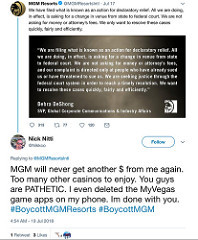
“We have filed what is known as an action for declaratory relief,” the company explained. “All we are doing, in effect, is asking for a change in venue from state to federal court. We are not asking for money or attorney’s fees. We only want to resolve these cases quickly, fairly and efficiently.”

Specifically, MGM claims the company it hired to provide security for the festival, Contemporary Services Corp., was protected from liability because its services had been certified by the Department of Homeland Security for “protecting against and responding to acts of mass injury and destruction.”

MGM contends this places CSC under the protection of the 2002 law and that this protection extends to MGM as the contractor. Therefore, as its complaints argue, any claims against it “must be dismissed.”

“Plaintiffs have no liability of any kind to defendants,” they state.

The FBI has not called the Las Vegas shooting an act of terrorism because the gunman had no clear motive, and the FBI defines terrorism as an act of terror associated with extremist ideologies of a political, religious, social, racial or environmental nature. On the other hand, the act cited in MGM’s suits was passed just more than a year after the Sept. 11, 2001, attacks and was written intentionally to afford broad protections. Accordingly, it defines terrorism as any unlawful act inside the United States that causes “mass destruction, injury or other loss.”

“Congress provided that the federal courts were the correct place for such litigation relating to incidents of mass violence like this one where security services approved by the Department of Homeland Security were provided,” MGM spokeswoman Debra DeShong said in a statement last week. “The federal court is an appropriate venue for these cases and provides those affected with the opportunity for a timely resolution. Years of drawn out litigation and hearings are not in the best interest of victims, the community and those still healing.”

Not surprisingly, attorneys for the victims blasted the complaints.

Robert Eglet, who has represented several of them, accused MGM of a “blatant display of judge shopping” that “quite frankly verges on unethical.”

“I’ve never seen a more outrageous thing, where they sue the victims in an effort to find a judge they like. It’s just really sad that they would stoop to this level.”

Attorney Craig Eiland, who represents several victims from Texas, said, “MGM is trying to beat these people to the courthouse and declare that they have no rights.

“The proper venue for this is Nevada State Court, plain and simple, under the law.”

Other lawyers say the move is “unprecedented.”

“As far as I know, this is the very first time the Safety Act has been tested,” Dismas Locaria, a partner at Venable in Washington, D.C. told the National Law Journal. “It’s definitely gotten a lot of people’s attention in my industry. We’re actively watching what happens here. But it’s all new ground, candidly.”

The complaints also sparked an uproar on social media, with Twitter users under the hashtag “BoycottMGM” calling on visitors to Las Vegas to avoid MGM properties.

“MGM Grand please remove me from your players list. I won’t be playing at any MGM casino going forward. Your lawsuit against victims of a mass shooting is disgusting!!” said one.

Eric Rose, a partner at California-based crisis management firm Englander Knabe and Allen, said MGM should have explained its actions before the complaints went public.

“They couldn’t explain the lawsuit in a sound byte, and therefore they are suffering the consequences with bad headlines. It makes it look like they are going after the victims. It is going to hurt their brand.”

Sports Betting May Mandate SEC Injury Reports

The legalization of sports betting by the U.S. Supreme Court in May could mandate the Southeastern Conference (SEC) to require frequent injury reports from coaches on their athletes the SEC Commissioner Greg Sankey said last week to reporters.

Sankey spokes at the league’s annual media gathering. He called the effect of sports betting one of the largest issues facing the league, which has schools in ten states, but said it’s unlikely that the weekly injury reports will be required this year.

The commissioner said, “My general feeling and our coaches general feeling is the same: That is probably something that needs to happen on a national basis. I don’t think it will happen for this season. I suspect it will be for next season. But I will be surprised if that is not in place.”

Sankey said, “FERPA and HIPAA requirements, academic suspensions, other team or athletics department-imposed suspensions and NCAA eligibility issues make something more like an availability report relevant for discussion.” He added, “I do not believe this has to happen before the 2018 season, either on the part of this conference or the national level.”

He added, “I think that is critically important and would not only include injuries but if there is disciplinary action where a player is suspended for a game for whatever reason, that would need to be a part of it as well. I think that reduces to some degree people you don’t really want coming around players and managers and doctors and anybody associated with the program, or coaches, and trying to get information in an underhanded kind of way.”

Currently only one state within the SEC, Mississippi, allows sports betting. But that is expected to change, with Kentucky, Missouri, South Carolina and Louisiana all considering bills.

Sankey said the SEC will not act hastily to adopt new rules to deal with the law. “That will result from collaboration among the American Football Coach’s Association and its representatives, the conference, the NCAA national office, learning from the professional leagues and with proper guidance from legal resources. If this is to happen, we have one opportunity to get it right.”

Sports books normally use information on players who want to be participating in a game to help them set odds.

Swofford doesn’t approve of sports betting, he said, but he said it’s part of the new world and that players should be protected.

“Sometimes when you think something is going to be horrible and incredible mess and it comes into play and a year or two later you find out, well, that’s not as impactful as I thought it would be,” he said. “We have seen that in recent years in college athletics.”

Delaware Releases Early Sports Betting Numbers

Delaware’s three racinos saw about $1 million in revenue come in during the first 20 days of full sports betting in the state.

A report from the Delaware Lottery Commission said that between June 5—when sports betting began in the state—and June 24 the three sportsbooks in the state took in $7 million in total bets, holding about 14 percent. In all, of 69,698 wagers were placed.

Delaware Park sold $5.2 million in sports tickets. Dover Downs reported $1.1 million in bets and Harrington Raceway took in $590,000. According to reports, Delaware Park saw $653,277 in net proceeds. Dover Downs netted $143,952 and Harrington earned $77,987.

According to an analysis by Legal Sports Report, the breakdown of the $1,000,247 in revenue saw about $125,000 go to the state’s sports betting suppliers—Scientific Games, William Hill and StadiumTech. After paying that share—or 12.5 percent of total revenue off the top—the rest of the revenue is divided up in the state with the state’s racinos keeping 40 percent.

Another 10 percent of remaining revenue, or about $85,353 this month, is allocated to horse racing purses. The remaining 50 percent goes to the state for about $437,609 during the reporting period.

Delaware was the first state to offer full sports betting after the U.S. Supreme Court struck down a federal ban under the federal Professional and Amateur Sports Protection Act. Delaware already had a partial exemption to the ban as it offered a type of parlay football betting through its lottery prior to the act being passed by Congress in 1992.

For comparison, over the 2017-18 NFL season, total revenue from the state’s parlay betting came to about $4.8 million. The state’s revenue share totaled $2.4 million.

Lottery officials said the betting was higher than expected, with about 75 percent of action on baseball and the rest split between futures bets and the World Cup. Lottery director Vernon Kirk had expressed concerns that sports betting would not be as lucrative to state as the parlay betting since single bets are easier to win. However, he acknowledged that sports betting is off to a strong start, especially considering that the NFL season hasn’t even begun.

NFLPA Official: ‘Athlete’s Voice’ Must Be Heard

The head of the National Football League Players Association, the union representing professional football players in the U.S., said players must be part of any discussion of fees for information used in sports betting, because the privacy of athletes is affected by the tracking of valuable information on player injuries, impending contracts or other factors that could affect their performance on the field—and wagers on their teams.

“There are serious consequences, particularly for the athletes,” NFL Players Association Business and Legal Affairs VP Casey Schwab told David Purdum of ESPN.com. “Because of those consequences, the athlete’s voice must be heard, particularly as we contemplate sports betting in the country.”

Schwab noted that bettors can profit on information about athletes’ health and contract plans, and should be compensated in some way. “That information—what our athletes are doing, where they’re going—has a price tag on it,” Schwab said. “And as more money goes into sports betting, that price tag goes up.”

Schwab made the comments during the summer meeting in Cleveland of the National Council of Legislators from Gaming States. He joined other union leaders representing players of Major League Baseball, the National Basketball Association and the National Hockey League in discussing sports betting at the meeting.

Veteran free-agent offensive lineman Eric Winston, three-term president of the NFLPA, said noted the “dehumanization of athletes” into statistical information that accompanies sports betting, in a video presentation at the conference.

Many pundits quickly assailed the union’s contention of “serious consequences” resulting from sports betting.

“Wagering on games and specific player events has long existed in the form illegal wagering (a humongous market that will continue to exist),” regular fantasy sports and daily fantasy sports,” opined SportsHandle.com. “With a legal sports wagering expansion, it’s business as usual for the players. They will not be required to do anything differently. (Union leaders) want a piece of the pie—and naturally they would; business is business—but their argument is a Hail Mary, and Aaron Rodgers isn’t at quarterback.”

Sports Attorney Names Betting Law Essentials

Prominent sports attorney and author Darren Heitner, in a piece published by Forbes magazine, has offered states some advice on creating successful sports-betting laws. Heitner, author of the book How to Play the Game: What Every Sports Attorney Needs to Know, identified five essential ingredients needed to create a successful and sustainable legal sports-betting operation.

1. Allow for online betting
“While it is not absolutely imperative that online gambling be offered as soon as a state implements sports betting, online offerings must be part of the development plan,” Heitner wrote. “Certain bettors will be interested in traveling to a land-based casino to place wagers, but many others will opt for illegal options unless the state allows for online and mobile wagering.”

2. Allow in-play betting
“This is also not a requirement immediately, but states would be wise to understand the opportunity and importance to offer in-play wagering to constituents, as Nevada has been doing for a number of years.”

3. Don’t cave to the leagues
“Professional sports leagues, with the NBA and MLB being the most stringent proponents, have been begging for integrity/rights fees in association with the opening up of sports betting outside of Nevada. Originally, they clamored for a 1 percent fee on the handle, which has quietly been amended to a request for 0.25 percent on same. Yet, no state has yet to enact a law that offers the leagues a piece of the pie.
“At the National Council of Legislators from Gaming States, William Hill US CEO Joe Asher called the request a tax and said that taxes should be collected by the state, not by the privileged few.”

4. Don’t overtax
“The money that New Jersey will gain to supplement its state budget is nothing to scoff at, but it also will not be the vast riches that many are anticipating. Further, a small change in the size of the taxes applied to wagers will have a much more negative effect on the betting population than a positive effect for the states that apply the enhanced taxation formula.
“It will become clear that a state invoking a high tax rate will make many of the larger sports bettors stick with the existing black markets as opposed to migrating to the newly created legal markets.”

5. Allow bets on NCAA sports
“While it is understandable that college athletes may be more susceptible to taking bribes from sports bettors, pushing the activity offshore does nothing to improve the perceived integrity of college sports match-ups. To think that banning such wagers will cause them to evaporate is simply being naive.
“If integrity is what the states and NCAA are truly after, then they would do whatever is in their power to bring those wagers onshore from where they are currently being placed. However, that seems to be the opposite of what is being lobbied for at the moment.”

Trade War Could Wound Gaming

The recently launched trade war started by President Donald Trump and accelerated by the Chinese government may have far-reaching impacts for gaming. Macau and Las Vegas are particularly vulnerable.

In a new report, Hong Kong-based risk management firm Steve Vickers & Associates says Macau’s gaming industry is “highly exposed” in the trade war heating up between the United States and China. Operators with close ties to U.S. President Donald Trump may be especially vulnerable, the report adds.

The report posted on SVA’s website said the trade conflict will “alter the shape of commercial activity across Asia,” harming some companies and possibly benefiting others, reported GGRAsia.

A passage published in the South China Morning Post observed that “U.S. patience towards China’s mercantilism—exemplified by the provision of cheap credit and subsidies to exporters, the systematic appropriation of intellectual property and a failure to open its economy—has run short.”

The Trump administration has slapped 25 percent tariffs on $50 billion of Chinese imports, $34 billion of which took effect earlier this month, in a bid to force Beijing to rein in longstanding trade practices the U.S. claims are unfair. China quickly responded with tariffs on U.S. exports in the same amount. The administration has since raised the stakes with proposed levies on an additional $200 billion of Chinese goods. China has vowed to retaliate.

“Further escalation” of the trade war “seems inevitable, as tensions intensify,” SVA predicted. “Investments are also at risk. Washington plans to curtail Chinese investment in high technology companies while (Chinese President) Xi Jinping has threatened to ‘punch back.’” Xi did just that, imposing new tariffs on American exports.

“Any significant slowdown or fall in the yuan’s value may lead to Beijing’s further curbing of capital outflows, (thereby) dampening casino revenues,” the report added. “Moreover, three of Macau’s six gaming concessionaires are U.S. companies: Las Vegas Sands, MGM, and Wynn Resorts. And LVS founder Sheldon Adelson boasts close ties to U.S. President Trump.

“These companies now sit on a geopolitical fault line,” said the firm. “Their Macau concessions can therefore be on the line.”

And does Las Vegas need to be concerned that an escalating U.S.-China trade war will threaten visitation levels from one of its largest and most lucrative tourism markets?

Experts say the jury is out.

There are those who are not optimistic, like Gary Hufbauer, a senior fellow at the Peterson Institute for International Economics, a Washington, D.C.-based think tank.

“My guess is that there will be many Chinese who will feel uncomfortable traveling to the United States if this trade war goes forward from here,” he recently told the Las Vegas Review-Journal.

Which could mean fewer big-spending Chinese gamblers and shoppers in Strip casinos.

As tensions rise the Chinese embassy in Washington has gone so far as to warn its citizens about traveling in the U.S., saying there’s a lack of public security and that shootings, robberies and theft are common.

“Travelers in the United States should be alert to their surroundings and suspicious individuals and avoid going out alone at night,” the embassy stated earlier this month.

“The atmosphere for pleasure travel is not so good right now, and it’s getting worse,” according to Hufbauer.

If so, it’s going to prove a costly problem.

Chinese travelers were good for 131 million international visits last year, up 7 percent over 2016, according to the China National Tourism Administration. In the U.S. they comprise the fifth-largest overseas tourist market, generating more than 2.24 million arrivals through the first nine months of 2017, according to the National Travel and Tourism Office, a division of the Department of Commerce.

And they spend too. A 2017 analysis from New York-based Nielsen found that Chinese tourists spent an average of $762 per person shopping on their most recent overseas trip. Non-Chinese tourists spent an average of $486.

“China is one of the fastest-growing international inbound markets,” said Jonathan Grella, executive vice president for public affairs for the Washington, D.C.-based U.S. Travel Association. “Increasing Chinese visitation is a golden opportunity to reverse the trade balance, bolster competitiveness and create American jobs.”

China is the sixth-largest source of international travelers to Las Vegas, contributing well more than 200,000 visitors annually, according to the Las Vegas Convention and Visitors Authority.

Stephen Miller, director of the Center for Business and Economic Research at the University of Nevada, Las Vegas, doesn’t think the city needs to worry yet that they’ll go away.

The worst that could happen, he believes, is that Beijing restricts travel to the U.S., as it did to South Korea in 2017 when it banned all group tours to that country during a diplomatic standoff over defense system installations. But even if the U.S. winds up on the receiving end of similar measures, Miller believes the effect would be minimal.

“Wealthier people are the ones coming to the United States, and they might have a better ability to avoid travel restrictions,” he told the Review-Journal. “The Chinese might feel offended that we’re picking on them and decide to go to Europe instead of the U.S. But that’s still to be seen.”

Barry Lin, vice general manager of destination marketing services for online travel booking service Tuniu.com, based in Nanjing, China, isn’t concerned either. Brinksmanship over trade will have little influence on his fellow citizens’ travel plans, he said.

“The trade war is just between the governments. The Chinese tourists, they don’t care a lot about the politics side. Once they have the money, they want to go abroad, stay in a good hotel, eat good food and buy something they cannot get in China. I think the trade war is just temporary. It will blow over very soon.”

Pooled Jackpots, iLottery Boost Pennsylvania; Casinos Object

Analysts of the lottery industry are observing that the effects of multi-state jackpots in reviving sagging profits for the Pennsylvania Lottery are exceeded only by the nascent iLottery program. But if the state’s land-based operators have anything to say about it, iLottery’s days are numbered in the state.

After experiencing the first revenue declines in its 40-year history, the Pennsylvania Lottery showed a growth of 5.4 percent in FY 2017-18, according to the state Independent Fiscal Office (IFO). According to PennBets.com, the increase was mainly credited to increases in instant-ticket sales and multi-state lotto games Powerball and Mega Millions.

The IFO projects another 3.8 percent growth in the current fiscal year, but not because of the traditional games. It cites iLotto, which debuted in May with a collection of slot-like online games. According to the lottery 45,000 players registered for online accounts during the first month, and collectively wagered $21.6 million on online lottery games. The state paid out $18.7 million, leaving a $2.9 million profit.

As reported last week, the state’s 13 land-based casino licensees (12 currently operational, one with a casino under construction in Philadelphia) are up in arms over the iLottery, claiming it is illegal under current gaming law that gives land-based casinos the exclusive right to operate slot games, and that it undermines the nascent online gaming program of the state.

Gary Miller, spokesman for the IFO, estimated that the online lottery will bring in around $30 million in profit this year.

In a letter to Governor Tom Wolf two weeks ago, the casinos asked that the iLottery program be suspended, and threatened legal action if it allowed to continue. “In virtually every way imaginable, Lottery’s iLottery program mimics a casino operation offering simulated casino-style games in direct contravention of (the law’s) express prohibition on Lottery offering ‘interactive lottery games which simulate casino-style games.,’” the letter said, adding that the definition of online lottery games in Pennsylvania’s gaming law does not include “games that represent physical, internet-based or monitor-based interactive lottery games which simulate casino-style lottery games, specifically including poker, roulette, slot machines and blackjack.”

So far, the lottery is not budging, conceding only that it was improper to market the games as slot-style gaming. But those ads have resumed since initially being withdrawn.

More Trouble for Encore Boston Harbor

Wynn Resorts, which is building the $2.5 billion Encore Boston Harbor across the Mystic River from Boston, has countersued the Everett real estate company that has sued it claiming that it made a side deal when it purchased the casino site—an under the table deal that it then later refused to honor.

Wynn accuses Anthony Gattineri of “intentionally and maliciously” trying to interfere with the company’s relationship with the Massachusetts Gaming Commission through his lawsuit. In that original suit, against the MGC, Gattineri alleges that in 2014 Robert DeSalvio, president of what was then called Wynn Boston Harbor agreed to pay $18 million in exchange for Gattineri agreeing to sell the riverfront property for a lower price.

Reacting to allegations that the property was partially owned by a convicted felon, the MCG required that the sale price be no larger than $35 million, which was the market price. Without that the MGC would have refused to issue a license.

Gattineri alleges that he lost a large profit for no good reason since it was later shown that no convicted felon was a partner in the property. He sued the MCG in federal court in June.

Wynn acknowledges that a meeting between DeSalvio and Gattineri occurred in San Diego in 2014 but denies ever agreeing to a separate deal with him.

Wynn issued this statement, “The claims that Mr. Gattineri made are patently false and are designed to negatively impact our reputation with the public, and the gaming commission. We will continue to defend and protect ourselves from his outrageous allegations.”

Gattineri’s lawyer Stephen Gordon scoffed at the countersuit. He told the Boston Herald, “They seem to be suggesting merely filing a lawsuit to enforce Mr. Gattineri’s contractual rights interferes with their relationship with the Massachusetts Gaming Commission.”


MGM Springfield

The $960 million MGM Springfield, which will open on August 23, is giving names to some of its meeting spaces and ballrooms taken from sister operations around the country.

The casino resort, which will open in the third largest city in Massachusetts, will have almost 34,000 square feet of space for ballrooms and meeting spaces next to a 6,200 outdoor terrace.

Michael Dominguez, MGM Resorts International’s chief sales officer told the Republican, “In designing MGM Springfield, we had a mission to create a luxury meetings experience that would be unique not only to Springfield, but to the entire region.” He added, “We’ve taken best practices from MGM Resorts properties from around the world and introduce them here, with a focus on delivering spaces that inspire collaboration, interaction and productivity.”

The property includes a 10,600 square foot Aria Ballroom (named after the casino on the Las Vegas strip), the 5,600 square foot Bellagio Ballroom, a 1,000 square foot Borgata Meeting Room and the 1,000 square foot Beau Rivage Boardroom. The casino will also operate the MassMuteal Center just a few blocks away, with over 100,000 square feet.

The casino resort will also be known for its restaurants. One of them will be Cal Mare, operated by celebrity chef and James Beard award-winner Michael Mina, who is known for kicking up Middle Eastern cuisine to new heights, but has also opened steakhouses, French and Japanese eateries from the Bay Area to the Gulf Emirates.

The chef at Cal Mare will be Adam Sobel, who will combine New England seafood with the tastes of Italy’s Amalfi Coast.

Mina told Haute Living, “We’ve had an incredible working relationship with MGM Resorts International over the years, as I have several restaurants in their Las Vegas Strip properties, so the idea of bringing one of our restaurants to this new market was a great opportunity for us. The North Atlantic has renowned seafood and is the epicenter of fishing in the United States; thus it made sense for us to introduce an Italian seafood concept there. Coastal Italian cuisine is a passion of Adam’s, so to have access to amazing shellfish, oysters, clams and fish is exciting for him.”

Worrisome Start for Resorts World Catskills

The casino at Resorts World Catskills is off to a disappointing start, generating in its first five months of operation less than half the revenue needed to meet first-year projections.

The newest, largest and most expensive of New York’s four commercial gaming resorts has been averaging $11.9 million from its slots and table games since it opened February 8, putting the $900 million property on a pace for $143 million in gaming revenue its first year, a 48 percent miss on owner Empire Resorts’ $277 million year-one estimate.

“The results are indicative of a challenging marketplace,” said Empire President and CEO Ryan Eller. “There’s a huge market out there, and we’re developing better ways to go after it.”

Eller attributes the early struggles, in part, to competition in a very crowded Northeast gaming market, stressing, however, that it’s premature to draw any conclusions from them, noting that Resorts World Catskills opened a month early in difficult winter weather and without its full complement of hotel rooms and non-gaming attractions.

Plans call for the opening of a hotel in December along with 15,000 square feet of retail and food and beverage space, with more on the way early in 2019, including a $150 million indoor water park, a second hotel and a revamped golf course.

“Here we are five months in, and we’re going to say, ‘They’re going to fall flat on their face?’” said Marc Baez, president and CEO of the Sullivan County Partnership for Economic Development, a non-profit that promotes the county’s economy.

“Everyone needs to relax and take a chill pill. The water park, the golf course and the rest of the property aren’t open. They haven’t lured the Asian market yet. And they need time for their promotions and advertising to take effect.”

Richard McGowan, a Boston College management professor specializing in gaming, is less sanguine.

“They’ll certainly improve themselves when those other things open,” he said, though he wonders how much of it will meaningfully translate to more play at the slots and tables. “There’s a question of how much more casino activity can take place. What we have here is a classic case of over-projection. There’s too much saturation” of gambling in the Northeast.

Clyde Barrow, an industry expert at Pyramid Associates of Westport, Mass., said Resorts World’s proximity to New York City is no guarantee of success either. “Who’s going to drive 90 miles and spend the night, when they have all this other stuff to do right in the city?”

Moody’s Investors Service is concerned enough about the soft start to downgrade the $535 million of debt incurred by Empire’s casino management subsidiary, Montreign Operating Company, to Caa1. That’s a low “negative” rating for debt considered to be “in poor standing.” The credit ratings agency said another downgrade to Caa2, near “speculative,” could be warranted if earnings don’t improve.

“The issue is not that it’s a bad property,” said Keith Folely, a Moody’s senior vice president who covers gaming. “The issue is market saturation.”

It’s been a problem across New York, which is home to three other upstate commercial casinos, seven Native-American casinos and 10 racetrack casinos, not to mention pari-mutuel betting, a state lottery and a growing array of competing gaming options in neighboring Pennsylvania, Connecticut and Massachusetts.

The commercial casinos preceding Resorts World Tioga Downs Casino Resort, which opened in December 2016, and del Lago Resort and Casino and Rivers Casino & Resort, which opened in February 2017 collectively came up more than $200 million short of gaming revenue projections in their first year.

del Lago, located in the Finger Lakes between Rochester and Syracuse amid a large and established Indian market, continues to be the hardest hit, slumping by 2 percent from February to June over the same period in 2017. Moody’s recently downgraded its debt to Caa2, with “negative” guidance.

Rivers, on the Mohawk River in Schenectady, is faring better on a comparative basis, growing gaming revenue by 15 percent over the first five months of last year.

Tioga Downs, on the Pennsylvania border near Binghamton, is up 10.5 percent year on year through June.

Interim Foxwoods CEO Named

Following the sudden unexpected death of CEO Felix Rappaport last month, Foxwoods Resort Casino has named Mashantucket Pequot Tribal Chairman Rodney Butler as interim chief executive officer, effective immediately.

A permanent CEO will be announced this fall, according to the tribe. Butler has been chairman since 2010 and served on the board since 2004.

Butler has been a leading proponent of a third casino in Connecticut, with the Pequots in partnership with the Mohegans in East Windsor, to combat the opening of the MGM Springfield facility, scheduled to open in late August.

Ohio Bill Would Legalize Sports Betting

Two Ohio state senators have introduced a bill that would create framework for sports betting in the state.

Senate Bill 316, introduced by Senators John Eklund and Sean O’Brien is what is known as a “shell” bill, one that leaves the details largely to be filled in. That’s on purpose, says O’Brien. Details needed clarification include whether bets could be made on major sports teams or college teams.

In fact, all the bill says is this: “It is the intent of the General Assembly to develop and enact legislation legalizing sports wagering.”

O’Brien said he wanted the bill to have a number and then to encourage feedback from constituents. He hopes to fill out some of the details by next month or the end of summer. There is plenty of time since the Buckeye state’s legislative session ends on December 31.

Last week O’Brien said, “My thinking right now is we already have casinos and racinos set up. I’d kind of like to keep it in those institutions because they are set up for gaming. I’m not sure we want it in every 7-Eleven … and every bar.”

The state is getting some pressure from neighboring West Virginia, where sports wagers will be taken at casinos and racetracks by the end of August or early September; and from Pennsylvania, where it is already legal.

It’s also getting prodded by Jack Entertainment, which owns three casinos in the state, whose CEO Matt Cullen wrote last week: “Under the proper regulatory framework, we support the State of Ohio moving forward with sports betting at brick and mortar facilities.” He added, “However, the detailed state regulations that will be written in response to the Supreme Court’s decision will determine the safety and viability of this potential amenity. Certainly there is significant guest interest in sports betting being available at our facilities.”

Jack’s controlling interest is held by Dan Gilbert, owner of the Cleveland Cavaliers, which complicates any sports betting laws. Different states treat this issue differently. In Atlantic City regulations would prevent the Golden Nugget, owned by Tilman Fertitta, who also owns the Houston Rocks, from taking any NBA bets. However, in Nevada regulations only forbid a casino from taking bets on games in which the owner’s team is involved.

Given that homegrown fans of Ohio State University are known for their intensity, betting on college games has a built in complication.

It is also the home to several NCAA football and basketball teams, including members of the American Athletic Conference and the FBS Mid-America Conference.

Other details to be worked out would be a tax rate. Currently the state’s four big casinos and seven racinos pay a 33 percent tax.

Ecklund said he doesn’t expect to see legalized sports betting before mid-2019.

Both houses of the legislature would first have to pass a bill legalizing sports betting, then voters would need to amend the state constitution. Casinos taxes go for education, host cities, the Ohio Casino Control Commission, Ohio Racing Commission, law enforcement and addiction programs. Racinos pay after expenses profits to education.

Thirteen other states have either introduced sports betting legislation or adopted such legislation.

O’Brien said he’s in no hurry to flesh out the bill. “We want to make sure we do it and do it right,” he told the Cleveland Plain Dealer.

Caesars Breaks Ground on LV Convention Center

Caesars Entertainment has taken the first step toward capturing a greater share of the lucrative Las Vegas convention market with the groundbreaking of its $375 million Caesars Forum.

The 550,000-square-foot facility, slated for completion in 2020, will feature 300,000 square feet of meeting space and a 100,000-square-foot outdoor plaza suitable for receptions or break space in a prime Strip location nestled behind the LINQ, Harrah’s and the Flamingo, which will connect with it via walkways.

Caesars has already booked $70 million in convention business for the venue, said Michael Massari, vice president of meeting sales and operations, evidence of the city’s robust business tourism market. The number of convention attendees traveling to Las Vegas has risen nearly 50 percent since 2010 compared with an 8 percent increase for leisure tourists.

Not surprisingly, the city’s convention space is at peak utilization rates of around 75 percent, according to a recent Morgan Stanley report, and operators are rushing to establish fresh supply. MGM Resorts International is building a 250,000-square-foot convention center at the MGM Grand that will open the end of this year. In February the company completed a 200,000-square-foot meeting space expansion at the Aria. Wynn Las Vegas this year launched construction of a 400,000-square-foot convention center.

In Las Vegas, Caesars Entertainment currently operates roughly 1.5 million square feet of meetings space, but LINQ, Harrah’s and Flamingo account for only 130,000 square feet of it, though they house a total of 8,500 hotel rooms. Caesars Forum will boost the company’s meetings space footprint in town by nearly one-third.

“Every property needs access to business travelers. (LINQ, Harrah’s and Flamingo) are really under-indexed in terms of the meeting space they have available and this gives us a chance to correct that,” Massari said.

In a separate transaction, Caesars’ VICI Properties REIT has completed its $507.5 million purchase of the Octavius Tower at Caesars Palace.

The sale calls for Caesars to continue to operate the 668-room hotel, which includes the 4,300-seat Colosseum theater, convention and meetings space and other attractions, under the terms of an existing ground lease that works out to annual rent payments to VICI of $35 million.

VICI, created last fall as a key component of the Caesars bankruptcy restructuring, currently owns 20 Caesars gaming facilities nationwide soon to be 21 with the pending $82.5 million purchase of Harrah’s Philadelphia four championship golf courses and 34 acres of undeveloped land adjacent to the Strip.